The Women Who Went First – Part 14
AboutHer
STORIES. WOMEN. NOW.
THE WOMEN WHO WENT FIRST ✦ CONTEMPORARY
PORTRAIT · ISSUE NO. 14
Jacinda
Ardern
Ardern
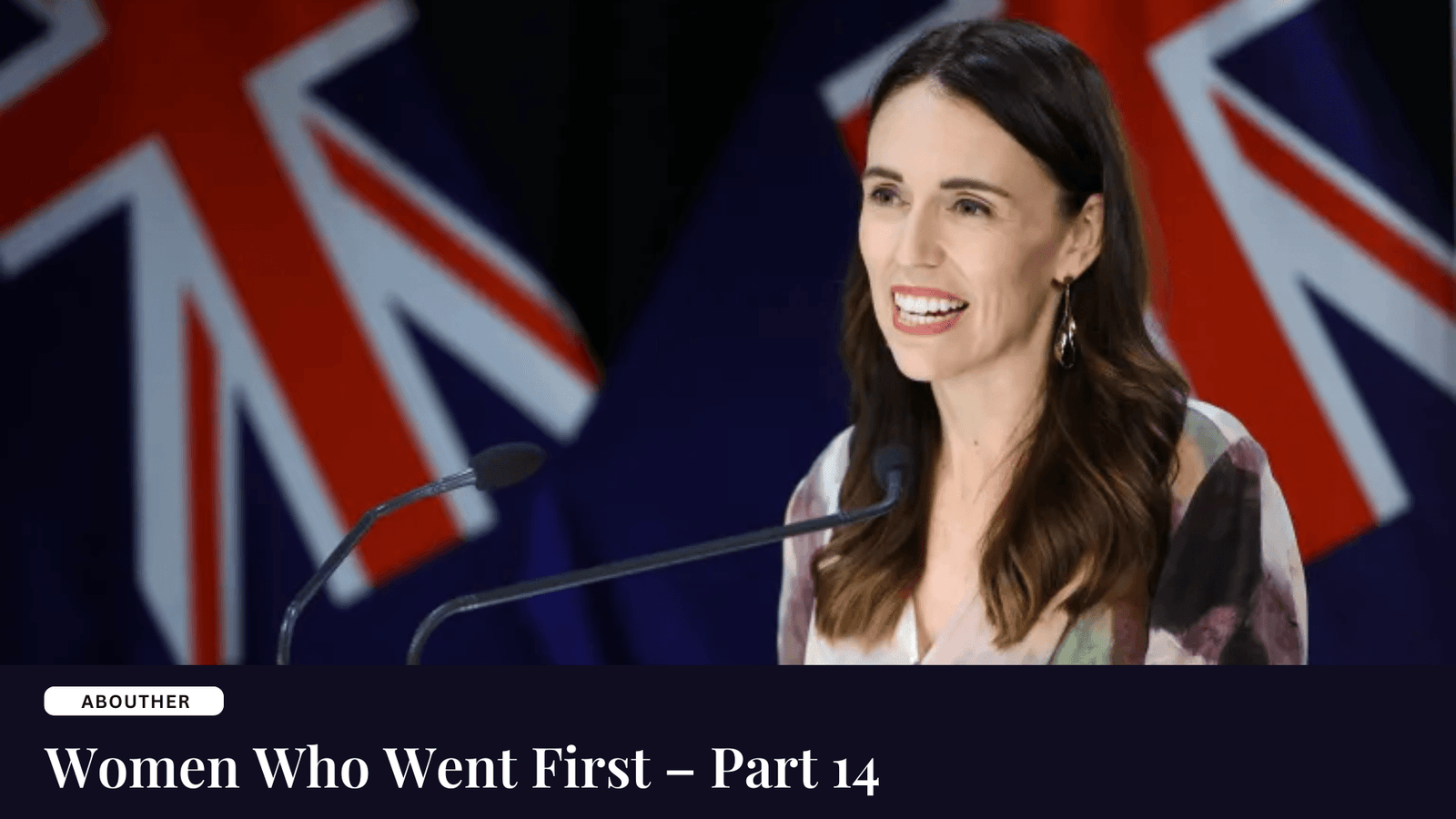
She governed through a massacre, a volcanic eruption, and a pandemic, brought her newborn to the United Nations, and then resigned before anyone could push her out. Every part of that is a first.
In March 2019, fifty-one people were killed in terrorist attacks on two mosques in Christchurch, New Zealand. The country’s Prime Minister was thirty-eight years old and had been in office for seventeen months. What Jacinda Ardern did in the days that followed has been studied by political scientists, crisis communicators, and leaders around the world. She wore a hijab when she met the families of the dead. She refused to say the killer’s name in public. She changed New Zealand’s gun laws within weeks. She held a grieving country without performing composure, and in doing so demonstrated something that political leadership had rarely shown before: that strength and tenderness are not opposites, and that a leader who feels things openly is not weaker for it.
WHERE SHE CAME FROM
Jacinda Kate Laurell Ardern was born in 1980 in Hamilton, New Zealand, and grew up in Murupara, a small town with high unemployment and significant social challenges. Her father was a police officer. She was raised in the Mormon faith, which she later left, citing its position on homosexuality. She studied communication at the University of Waikato and entered politics young, working as a researcher in the office of Prime Minister Helen Clark and later in the Cabinet Office of Tony Blair in London.
She was elected to the New Zealand Parliament in 2008 at twenty-eight, becoming at the time one of the youngest MPs in the country’s history. She was elected leader of the Labour Party in 2017, seven weeks before a general election. She was thirty-seven. The election was considered unwinnable for Labour. She won it.
THE FIRSTS THAT DEFINED HER TERM
2018
Baby at the United Nations
Became the first elected world leader to bring a newborn to the UN General Assembly. Her partner Clarke Gayford cared for their daughter Neve in the chamber while Ardern addressed world leaders.
2019
Christchurch Response
Led New Zealand through the worst terrorist attack in its history with a combination of decisive policy action and human warmth that became a global model for crisis leadership.
2020
Covid Elimination Strategy
Pursued an aggressive elimination strategy that kept New Zealand’s death toll among the lowest in the developed world. Communicated directly with citizens via Facebook Live from her couch in a sweatshirt.
THE CHRISTCHURCH MOMENT
15 MARCH 2019 — CHRISTCHURCH
Within hours of the attacks, Ardern had flown to Christchurch. She met survivors and families wearing a hijab, a choice that was both respectful and deliberate. In her public address she said: “They are us.” She refused throughout the following days to name the perpetrator, denying him the notoriety he had sought. Within weeks, New Zealand had passed sweeping gun reform banning the military-style semi-automatic weapons used in the attack. The legislation passed with near-unanimous parliamentary support. The speed, the tone, and the substance of the response were studied around the world as an example of what political leadership can look like when it is guided by values rather than only by calculation.
MOTHERHOOD AND WHAT IT MEANT
Ardern announced her pregnancy in January 2018, three months after becoming Prime Minister. She was only the second elected world leader in history to give birth while in office, after Benazir Bhutto in 1990. The announcement was met with a mixture of celebration and the kind of questioning that men in equivalent positions are simply never asked to answer: could she do both, who would look after the baby, would this affect her judgment.
Also Read: The Women Who Went First – Part 13
Her response was characteristically direct. Her partner Clarke Gayford would be the primary caregiver. She would breastfeed. She took six weeks of parental leave. She brought Neve to the UN General Assembly at three months old, where Gayford held her in the public gallery while Ardern spoke. The image of a world leader’s partner doing the childcare while she addressed the United Nations was, in its quiet way, among the most radical things she did in office.
“One of the criticisms I’ve faced over the years is that I’m not aggressive enough or assertive enough, or maybe somehow because I’m empathetic it means I’m weak. I totally rebel against that.”
JACINDA ARDERN
THE RESIGNATION AND WHY IT MATTERED
In January 2023, Ardern announced her resignation as Prime Minister. She was forty-two. She said she no longer had enough in the tank to do the job as it deserved to be done, and that knowing when you have reached that point and acting on it is not weakness but responsibility. She had served five and a half years. She left on her own terms, before an election, before anyone could push her out or her party could panic around her.
The resignation was as unconventional as everything else about her leadership. In a political culture that treats staying in power as the primary measure of success, leaving because you have genuinely assessed your own capacity and found it insufficient is a different kind of integrity. It was also, characteristically, completely honest. She did not dress it up. She said she was tired and that she owed the job more than she had left to give it.
WHAT SHE PROVED ABOUT POLITICAL LEADERSHIP
The argument Ardern’s career makes is not that empathy is a feminine quality that women bring to politics. It is that empathy is a leadership quality that politics has systematically undervalued, and that a leader who combines it with decisiveness, clear communication, and the ability to act under pressure is not leading differently from other politicians. She is leading better. The question her career leaves behind is not why more women do not lead like her. It is why more leaders of any kind do not.
THE PAIRING ACROSS TIME
This series placed Vijaya Lakshmi Pandit in the past slot some issues ago: a woman who walked into the most male-dominated political spaces of the mid-twentieth century and performed with such authority that the question of whether she belonged there became impossible to sustain. Ardern did something connected and different. She did not perform on the existing terms. She changed the terms. She showed that the qualities political culture had coded as weakness, empathy, directness, the acknowledgment of emotion, were not liabilities to be overcome but instruments of governance to be used.
Pandit proved women could lead. Ardern proved that how women are sometimes expected to lead, with warmth, with honesty, with the full acknowledgment of their humanity, was not a concession to femininity but a model worth following regardless of gender. That is a different kind of first, and it belongs in this series.
WHY SHE BELONGS IN THIS SERIES
The Women Who Went First has told stories of women who broke barriers by meeting the world on its own terms and exceeding its expectations. Ardern did something rarer. She broke barriers by refusing those terms and proposing better ones. She governed through three of the most testing events a leader can face and did it without pretending she was not human. She had a baby and brought it to the United Nations. She cried in public and passed legislation in the same week. She resigned when she was ready, not when she was forced.
Each of those things, taken separately, is a first. Taken together, they are an argument: that the qualities we have spent centuries telling women to suppress in order to lead are precisely the qualities that leadership most needs. Ardern did not make that argument in a speech. She made it in office, in a crisis, in a maternity ward, and in a resignation statement that was more honest than most political careers manage to be in their entirety.
“She did not prove that women could lead on the world’s terms. She proved that the world’s terms were worth changing, and then changed them.”
THE WOMEN WHO WENT FIRST · ABOUTHER MAGAZINE
Share This On Social
About the Author: Sangeeta Relan

Related Posts


I’m Sangeeta Relan—an educator, writer, podcaster, researcher, and the founder of AboutHer. With over 30 years of experience teaching at the university level, I’ve also journeyed through life as a corporate wife, a mother, and now, a storyteller.