The Women Who Went First – Part 12
AboutHer
STORIES. WOMEN. NOW.
THE WOMEN WHO WENT FIRST ✦ CONTEMPORARY
PORTRAIT · ISSUE NO. 12
Malala
Yousafzai
Yousafzai
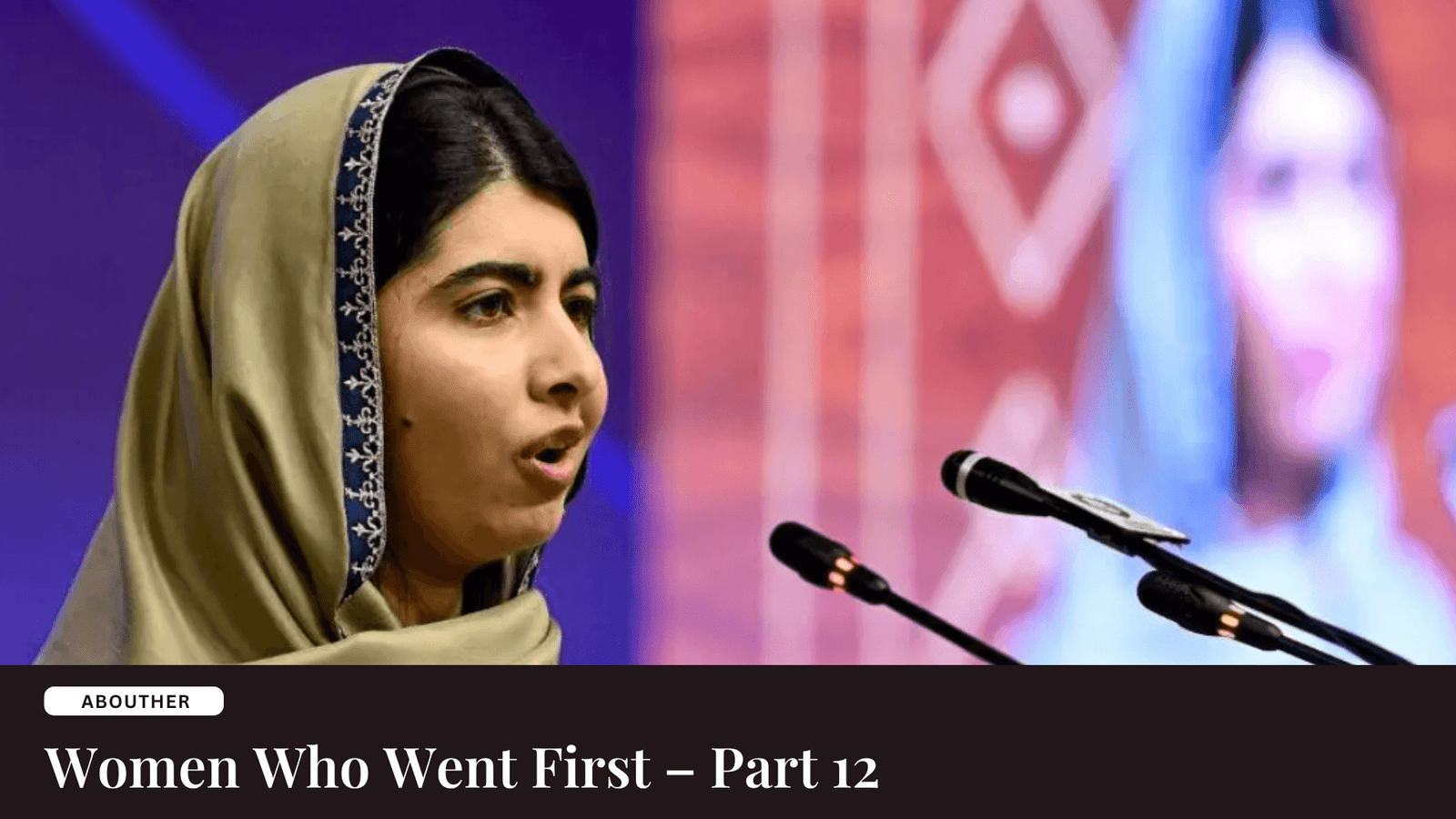
She was fifteen when a gunman shot her on a school bus for speaking about girls’ right to education. She survived, kept speaking, and at seventeen became the youngest person ever to win the Nobel Peace Prize.
On 9 October 2012, a Taliban gunman boarded a school bus in the Swat Valley of Pakistan and asked for Malala Yousafzai by name. He shot her in the head at close range. She was fifteen. The bullet passed through her skull, travelled down her neck, and lodged in her shoulder. She was airlifted to a military hospital in Peshawar, then to Birmingham, where she spent weeks in intensive care. She survived. Within months she was speaking again, and what she said when she could speak was exactly what she had been saying before the gun was pointed at her: that every girl deserves an education, and that no one has the right to take it from her.
WHERE SHE CAME FROM
Malala was born in 1997 in Mingora, in the Swat Valley of north-west Pakistan, the eldest child of Ziauddin and Toor Pekai Yousafzai. Her father ran a school and was himself an education activist who had spoken out against the Taliban’s growing influence in the region. He named his daughter after Malalai of Maiwand, a Pashtun folk hero who rallied fighters on a battlefield and became a symbol of courage.
She grew up in a valley that had been, for most of her childhood, beautiful and relatively peaceful. By the time she was ten, the Taliban had moved in. Their edicts came quickly: music was banned, men were required to grow beards, and girls were told they would no longer be permitted to attend school. For a girl whose father ran a school and whose entire sense of herself was built around learning, this was not a political abstraction. It was the removal of the thing she loved most.
THE BLOG AND WHAT IT STARTED
In 2009, when she was eleven, Malala began writing an anonymous blog for the BBC Urdu service under the pen name Gul Makai. She wrote about daily life under Taliban rule, about the fear and the restrictions and the slow disappearance of normal things. The blog was read widely and drew international attention to what was happening in Swat. When her identity was eventually revealed, she did not retreat. She gave interviews, spoke to journalists, appeared on television. She became, at twelve, a public voice in a place where public voices were being silenced by force.
The Taliban issued a death threat. She kept speaking. Her father was warned. She kept speaking. The shooting on the school bus in 2012 was the consequence of a campaign that had been building for years, directed at a child who refused to be quiet about something that should never have needed to be said at all.
“One child, one teacher, one book, one pen can change the world.”
MALALA YOUSAFZAI, UNITED NATIONS, 2013
THE SPEECH AT THE UNITED NATIONS
Nine months after being shot, Malala stood at the podium of the United Nations Youth Assembly in New York. She was sixteen. She wore a pink shawl that had belonged to Benazir Bhutto, given to her family by Bhutto’s widower. She spoke for eighteen minutes without notes, calmly and with complete precision, about the right of every child to education and the obligation of the world to protect it.
The speech was not the performance of a survivor. It was the argument of a person who had thought carefully about power, about silence, and about what it costs to keep speaking when the cost is your life. She said that the terrorists thought the bullet would silence her. It did not. It changed nothing, she said, except to give her strength.
ACROSS 170 YEARS — TWO GIRLS WALKING TO SCHOOL
Savitribai Phule, 1848
Walked to school in Pune each day while people threw stones and dung at her. Carried a spare sari in her bag. Opened India’s first school for girls at seventeen. Faced organised community opposition for years.
Malala Yousafzai, 2012
Boarded a school bus in Swat Valley and was shot in the head by a Taliban gunman. Survived. Returned to advocacy within months. Won the Nobel Peace Prize at seventeen. Has never stopped speaking.
THE NOBEL AND WHAT CAME AFTER
In 2014 Malala was awarded the Nobel Peace Prize, jointly with Kailash Satyarthi of India. She was seventeen years old, the youngest Nobel laureate in history. The prize was significant not just as recognition but as amplification. It gave her an audience that was now impossible to ignore and resources that could be directed toward the work.
Also Read: The Women Who Went First – Part 11
She established the Malala Fund, which works in eight countries to advocate for twelve years of free, quality education for every girl. The Fund does not just make arguments. It funds girls’ education projects on the ground, supports local advocates, and holds governments accountable for the commitments they make. She graduated from Oxford in 2020 with a degree in Philosophy, Politics, and Economics, and has been clear that the degree was not a destination but a tool.
THE MALALA FUND
Founded in 2013, the Malala Fund works in Afghanistan, Brazil, Ethiopia, India, Nigeria, Pakistan, Turkey, and the United Kingdom. Its goal is to ensure that every girl receives twelve years of free, quality education. The Fund supports local education activists, advocates for policy change at the government level, and amplifies the voices of girls who are closest to the problem and most often excluded from the solutions.
WHAT SHE REPRESENTS BEYOND HER STORY
Malala has been, at times, a contested figure. Some critics in Pakistan have argued that she was amplified by Western media in ways that served particular political narratives about the region. It is a fair point to sit with, and she has engaged with it directly rather than dismissing it. The criticism does not diminish what she did. It complicates the frame through which it is sometimes presented, which is a different thing.
What is beyond contest is that she was a child who spoke about something true, was nearly killed for it, and chose to spend her survival continuing to speak. The cause, girls’ education, is not a Western imposition. It is a claim that every girl has the right to her own mind, which is among the oldest and most contested arguments in human history.
WHY SHE BELONGS IN THIS SERIES
Placing Malala immediately after Savitribai Phule is the point. One hundred and seventy years separate them. The same opposition connects them: organised, violent resistance to the idea that girls deserve to learn. Savitribai faced stones on a road in Pune in 1848. Malala faced a gun on a bus in Swat in 2012. The world changed enormously in those seventeen decades. The resistance to girls’ education did not.
What both women share, beyond the specific courage of continuing to walk and speak in the face of that resistance, is the understanding that education is not a nicety. It is the thing that makes every other kind of freedom possible. You cannot claim rights you do not know you have. You cannot challenge power you cannot read about. You cannot build a life you cannot imagine.
Savitribai held the door open in all weather. Malala walked through it, was shot for walking through it, got up, and held it open for everyone behind her. That continuity is not coincidence. It is the series’ argument, made visible.
“The terrorists thought the bullet would silence her. It changed nothing, she said, except to give her strength.”
THE WOMEN WHO WENT FIRST · ABOUTHER MAGAZINE
Share This On Social
About the Author: Sangeeta Relan

Related Posts


I’m Sangeeta Relan—an educator, writer, podcaster, researcher, and the founder of AboutHer. With over 30 years of experience teaching at the university level, I’ve also journeyed through life as a corporate wife, a mother, and now, a storyteller.