The Women Who Went First – Part 20
AboutHer
STORIES. WOMEN. NOW.
THE WOMEN WHO WENT FIRST ✦ CONTEMPORARY
PORTRAIT · ISSUE NO. 20
Reita
Faria
Faria
In 1966 she became the first Asian woman to win Miss World. Then she did something nobody expected: she put the crown down, went to medical school, and never looked back.
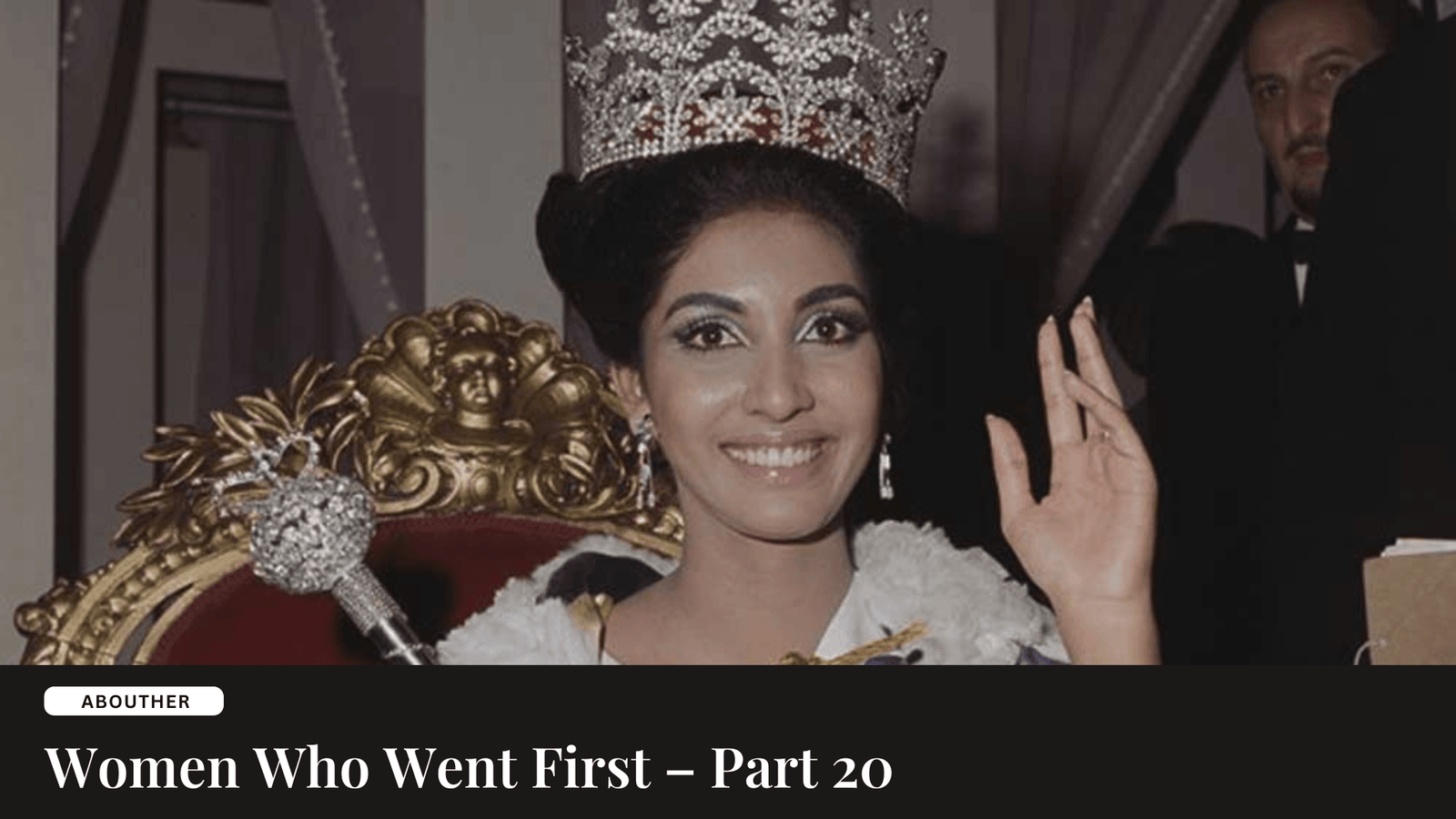
On 17 November 1966, at the Lyceum Theatre in London, a twenty-one-year-old medical student from Bombay was crowned Miss World. The moment was historic in ways that the audience may not have fully grasped: Reita Faria Powell was the first woman from Asia to win the title, the first Indian woman on that stage to take that prize, and she did it at a time when the idea of an Indian woman winning an international beauty pageant was so outside the frame of what was expected that the Indian establishment had not particularly encouraged her to enter. She won. She smiled. She wore the crown for her year. And then she went back to medical school, qualified as a doctor, married a doctor she had met in Dublin, moved to Zimbabwe, and built a quiet life of complete substance in which Miss World was a fact about her past rather than the definition of her present. She is, in this series, the first woman whose most radical act was not what she did to win but what she chose to do instead of capitalising on it.
WHERE SHE CAME FROM
Reita Faria was born in 1945 in Bombay into a Goan Catholic family. She was studying medicine at Grant Medical College in Bombay when she entered the Femina Miss India pageant in 1966, winning it and going on to represent India at Miss World in London. She has said that she entered primarily on a dare and with no particular expectation of winning anything beyond the experience. What she brought to the competition was not the studied ambition of someone who had been preparing for years but the natural ease of someone who was already serious about something else entirely and was treating this as an interesting detour.
That quality, the quality of someone for whom the pageant was not the destination, may be part of what made her so compelling to the judges. She was not performing aspiration. She simply was what she was, a bright, confident, medically trained young woman from Bombay who happened to be extraordinarily beautiful, and who clearly had somewhere else to be when this was over.
THE NIGHT IN LONDON
LYCEUM THEATRE, LONDON, 17 NOVEMBER 1966
The Miss World competition in 1966 was watched by hundreds of millions of people worldwide, making it one of the most viewed television events of the year. When Reita Faria was crowned, she became the first Asian woman in the competition’s history to win the title. India had not won Miss World before. Asia had not won Miss World before. The win was covered extensively in the Indian press and celebrated as a moment of national pride, which it was. What was less discussed at the time was what she planned to do next, which was to return to her medical studies with the same seriousness she had brought to everything else, and to treat the crown as one chapter rather than the whole story.
1st
ASIAN WOMAN TO WIN MISS WORLD, IN THE COMPETITION’S HISTORY
1966
THE YEAR INDIA FIRST APPEARED ON THE MISS WORLD MAP
THE CHOICE THAT DEFINED HER
After her Miss World year, Reita Faria did what almost no one in her position had done before or has done since with quite the same completeness: she stepped away. Not reluctantly, not after exhausting the commercial opportunities, not after the offers dried up. She stepped away deliberately, returned to her medical studies, completed her degree, and pursued a career in medicine that had nothing to do with her fame and everything to do with her original intention.
THE ROAD NOT CAPITALISED ON
The years immediately following a Miss World win are typically spent in exactly the way the entertainment and fashion industries design them to be spent: modelling contracts, film offers, public appearances, the careful conversion of a moment of visibility into a career built on that visibility. Reita Faria declined this path with a consistency that was remarkable then and remains remarkable now. She qualified as a doctor. She married David Powell, an Irish doctor she had met in Dublin. She moved to Zimbabwe where her husband worked, and built a life there that was defined by her medical practice and her family rather than by the title she had won at twenty-one. She gave occasional interviews over the decades when asked, always gracious and always clear that she had no regrets about the path she had chosen.
“I always knew medicine was what I wanted. Miss World was a wonderful experience, but it was never going to be my life.”
REITA FARIA POWELL
WHAT HER WIN OPENED
The significance of Reita Faria’s 1966 victory cannot be separated from what came after it in Indian beauty pageant history, even though she herself had no role in that aftermath and would have been unlikely to have sought one. Her win established, for the first time, that an Indian woman could compete on a global stage of that kind and win. It took nearly three decades for India to win Miss World again, when Aishwarya Rai won in 1994, followed by Diana Hayden in 1997, Yukta Mookhey in 1999, and Priyanka Chopra in 2000. The era of India’s dominance in international beauty pageants that those wins represented was made imaginable, in part, by what Reita Faria had shown was possible in 1966.
Also Read: The Women Who Went First – Part 19
She opened a door and walked away from it. Others walked through it with different intentions and different outcomes. That is not a contradiction. It is what first movers do: they make something possible without being responsible for everything that possibility becomes.
THE LIFE SHE BUILT INSTEAD
Reita Faria Powell spent her professional life as a practising doctor in Zimbabwe, where she and her husband settled and raised their family. She returned to India occasionally and gave interviews when sought, always speaking about her Miss World experience with warmth and perspective rather than with the wistfulness that might be expected of someone who had walked away from extraordinary fame. She spoke about medicine as her calling and about the life she had built as exactly the life she had wanted.
She is now in her late seventies and lives a life almost entirely outside public attention, which appears to be precisely what she intended. The deliberateness of that privacy, in an era when former Miss Worlds routinely build media careers on the back of their titles, is itself a statement about what she valued and what she did not.
WHAT SHE PROVED WITHOUT TRYING TO
Reita Faria proved two things simultaneously with a single life. First, that an Indian woman could win the most watched beauty competition in the world, which in 1966 was not obvious and is worth remembering as a genuine historic first. Second, and more quietly, that the crown was not a destination requiring a particular kind of future, that it was possible to receive the world’s attention and then redirect your own attention to something more important to you without that being a failure of ambition. The second proof is rarer than the first and, for the purposes of this series, more interesting.
WHY SHE BELONGS IN THIS SERIES
The Women Who Went First has told stories of women who built institutions, led armies, went to space, walked through gauntlets, wrote books that disturbed governments, and ran faster than anyone on their continent for a decade. Reita Faria belongs in this company for a reason that is quieter than any of those achievements and in some ways more subversive: she refused to let the most spectacular thing that happened to her become the most important thing about her.
In 1966, winning Miss World as an Indian woman was an act of going first in the most literal sense. No Asian woman had stood in that winner’s position before. The ground she broke was real and the door she opened mattered. But the more unusual first is the one that came after: the first to win Miss World and treat it as a footnote. The first to stand at the centre of the world’s attention and then, calmly and completely, choose medicine over fame, a practice over a platform, a life over a brand.
This series has argued, in different ways across twenty issues, that going first means different things in different contexts. For Harriet Tubman it meant returning through danger for others. For Kalpana Chawla it meant building the qualifications for a dream over fifteen years. For Reita Faria it meant knowing, at twenty-one, that the most extraordinary thing the world was offering her was not the most important thing she had to do, and having the clarity and the courage to act on that knowledge. At issue twenty, that feels like exactly the right note.
“She won Miss World and went back to medical school. Not reluctantly. Not after the offers dried up. Deliberately, completely, and without a moment’s apparent regret. That is its own kind of first.”
THE WOMEN WHO WENT FIRST · ABOUTHER MAGAZINE
Share This On Social
About the Author: Sangeeta Relan

Related Posts



I’m Sangeeta Relan—an educator, writer, podcaster, researcher, and the founder of AboutHer. With over 30 years of experience teaching at the university level, I’ve also journeyed through life as a corporate wife, a mother, and now, a storyteller.