The Art of Beginning Again
POWER & LEADERSHIP · ABOUTHER MAGAZINE
COVER STORY
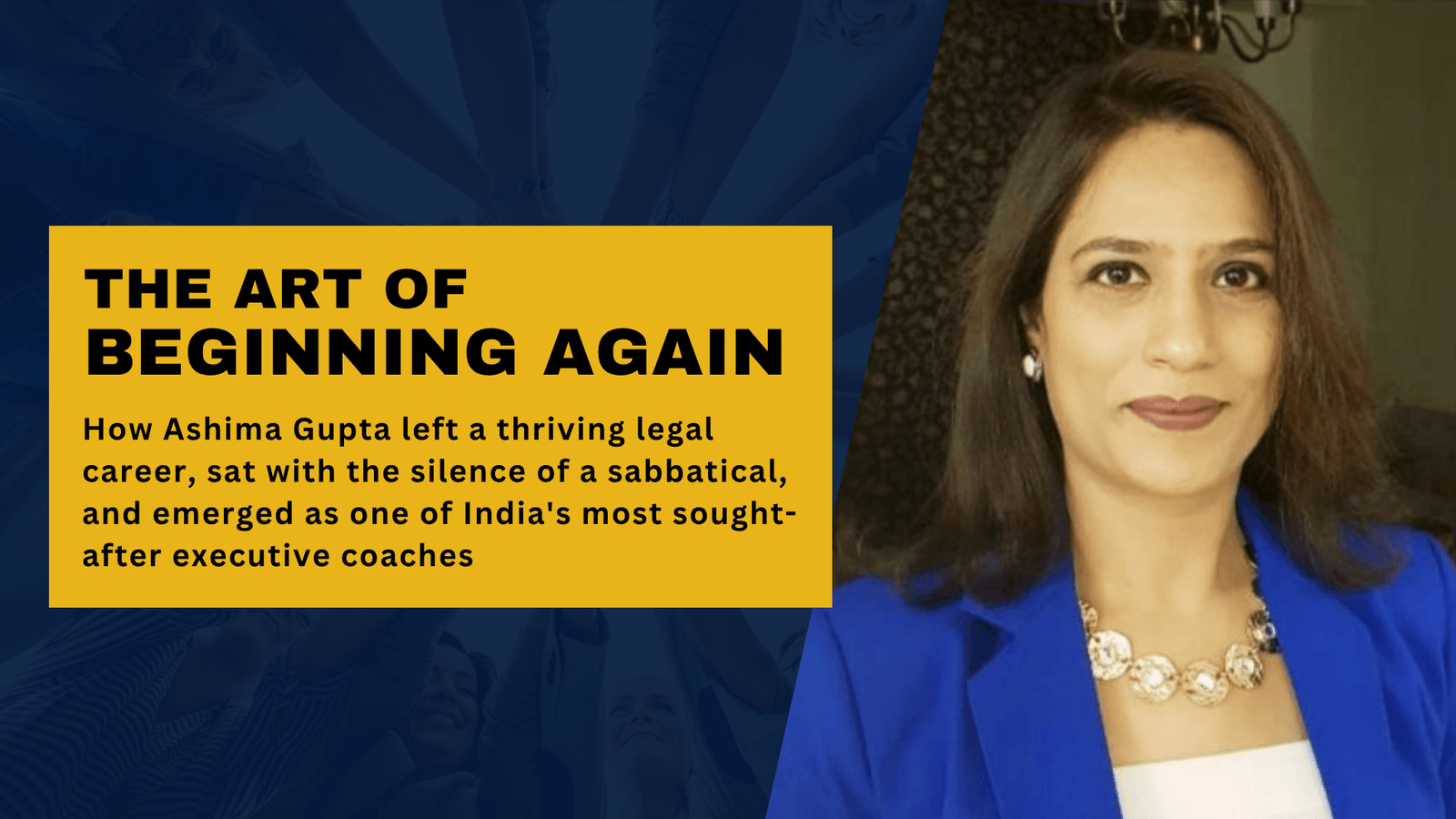
The Art of
Beginning Again
Beginning Again
How Ashima Gupta left a thriving legal career, sat with the silence of a sabbatical, and emerged as one of India’s most sought-after executive coaches
BY SANGEETA RELAN | THE ABOUTHER SHOW · SEASON 3
She was 25, standing in a High Court, cheeks burning, heart hammering. Outside, she looked every inch the confident young lawyer. Inside, she was barely holding it together. Nobody knew. That gap, between the person the world sees and the person you quietly are, would become her life’s work.
There is a particular kind of courage that doesn’t announce itself. It doesn’t stride into rooms or raise its voice at meetings. It sits quietly with discomfort, listens carefully, and eventually, when it has gathered enough of itself, it moves. Ashima Gupta has that kind of courage. And it took her the better part of two decades to trust it.
Today, Ashima is an executive coach who works with CXOs, senior leaders, and women professionals across India and beyond. She is sharp, deeply perceptive, and brings to every conversation a quality that is rare in high-stakes corporate spaces: she actually listens. But the road that brought her here was neither straight nor easy, and that, she says, is precisely the point.
WHERE IT ALL BEGAN
Ashima grew up in a structured, disciplined home where education was not optional. Her mother, highly educated and a homemaker by circumstance rather than limitation, made one thing non-negotiable for each of her daughters: professional independence. “She wanted each of us to pursue a qualification,” Ashima recalls. “Not just financially independent, but truly independent as women.” It was a quiet but powerful form of feminism, planted early, and it grew.
She began college with plans to study medicine, got two years in, and realised with complete clarity that it wasn’t the life she wanted. Rather than feeling lost, she found herself drawn towards something unexpected. Law. Not the safe, settled kind of legal career that parents imagined for daughters in that era, but the real thing: courts, cases, and the legal system that most people feared and few understood.
“What the profession and the course did to me was extreme confidence, extreme fearlessness. Now you know the system. You are not outside it.”
ASHIMA GUPTA
She threw herself into it. The high point, she remembers with a smile, was arguing a difficult case in the High Court as a young advocate, when a famously stern judge asked her senior to sit down and told her to continue. When she walked out of the court, people followed her asking for her visiting card. “That was the moment,” she says. By every external measure, she had arrived.
THE CRACK BENEATH THE SURFACE
But something was misaligned. Even at the height of her confidence in the courtroom, she could feel her cheeks burning with anxiety inside. She was performing brilliance while privately managing self-doubt. And as she looked around at colleagues, clients, and the people she worked with, she began to notice the same thing everywhere. Everyone was performing. Nobody was particularly well.
“Everybody is kind of either trying to cope or pretending to be somebody they are not,” she says. This wasn’t cynicism. It was observation. And it planted a seed that would take years to become something she could name.
Clarity is 50% of your journey. The rest you will find out as you go.
Then came the sabbatical. For Ashima, as for many women, it was not a choice made from luxury but from necessity. Family called. Priorities shifted. She stepped back from her legal practice. And in the silence that followed, something unexpected happened.
THE COCOON
She began to see herself differently. Away from the momentum of professional life, she could finally hear herself think. She recognised that she had a natural instinct for reading people, not judging them, but genuinely understanding what lay beneath their words and behaviours. She found herself coaching people without even knowing that was what she was doing. Friends would come to her, colleagues would confide in her, and she would ask the questions that somehow led them towards their own answers.
“I think I was the caterpillar who went into the cocoon to become the butterfly,” she says. “That transformation happened for me and when I felt it, I wanted to do the same for others. Because I could see people staying in that shell all their life, not even aware they were in it.”
The decision to study coaching formally came with one significant hurdle. She would have to go back to being a student. At forty. “I believe that whatever you do, you do it to your best,” she says simply. “Not because it’s a profession and you’ll make money. Because you need to give real value to people.” So she studied. She qualified. And she began again.
“Perseverance and persistence is the key. If you don’t give up and you continue, you will keep finding your path.”
ASHIMA GUPTA
WHAT SHE SEES AT THE TOP
These days, Ashima works primarily with senior leaders, people who have technically arrived and are struggling in ways they cannot quite articulate. She has noticed consistent patterns. The stress is almost always higher than anyone admits. The emotional regulation is almost always lower. And the biggest blind spot, the one that quietly undermines even the most accomplished leaders, is the gap between who they think they need to be and who they actually are.
“The corporate doesn’t tell you that your mindset is the problem,” she says. “It tells you to perform better, execute faster, lead louder. But the real work is internal.” Her coaching approach reflects this. Rather than giving leaders a new set of tools, she strips away the ones that don’t fit them. She asks them to look at the beliefs they are carrying, the conditioning they have mistaken for identity, and to consider what they might do differently if they stopped performing and started leading from who they actually are.
How you think and feel is what prompts your action. Change the thinking and feeling, and the results follow.
One of her most memorable recent clients was a woman CXO in London, working in the venture capital industry, convinced that her leadership style was a weakness. She felt her voice was not heard in rooms full of men. She was trying to be more aggressive, more assertive in the way she believed the room required. What Ashima found, through the coaching sessions, was something quite different. Her colleagues loved working with her. Her team members sought her out. People showed up for her projects voluntarily. She was leading, powerfully, in a way she hadn’t recognised as leadership.
“She was seeing her softness as weakness when it was actually her greatest strength,” says Ashima. The mindset shift was not dramatic. It was a reorientation. Once the client stopped trying to be a version of leadership she wasn’t built for, she could show up with real authority. Months later, with a corporate merger on the line and two CXO teams competing for one set of roles, she held her place. She is now CTO of one of the largest telecom companies in her region.
FOR WOMEN, SPECIFICALLY
Ashima is direct when it comes to what women face in leadership, and she has earned the right to be. She has lived it, navigated it, and now coaches women through it every day. The challenges are real and they are specific. Women returning from maternity leave are quietly sidelined. The language of inclusion exists but the practice often doesn’t. The title is there, the growth is not.
“We can have all the policies in the world,” she says, “but the career challenges women face in that period are for real. For the optics, organisations do a lot. But are they really practising it? That is the million-dollar question.”
Beyond the structural barriers, she sees something else too: women’s extraordinary reserves of emotional resilience, largely unacknowledged and frequently undervalued. “When I work with men in coaching, I can see how low it is versus women,” she says. “Emotional resilience is very high in women. It helps them build, continue, manage multiple things at once.” It is not a small thing. It may, in fact, be the defining edge.
“Become aware of your emotions. That is your starting point. Every emotion is telling you a story about what you are running and believing in your head.”
ASHIMA GUPTA
EAST MEETS WEST
Ashima’s coaching draws from two seemingly different traditions. Eastern spirituality, with its emphasis on self-awareness, purpose, and inner work, and western neuroscience, with its tools, frameworks, and evidence-based practices. In her hands, the combination is not a contradiction. It is a complete picture.
“The eastern side is about who you are as a person, your essence, your awareness, your purpose,” she explains. “The western tools come in to support and supplement that journey.” For her clients, this means the work is never just intellectual. It reaches the parts that a strategy deck or performance review never can.
THE FIRST STEP
When asked what she would say to someone who feels stuck, uncertain, or standing at a crossroads, Ashima doesn’t offer a framework or a five-step plan. She offers something simpler and harder.
“Sit down. Get the clarity of what you really want and where you really want to go,” she says. “Don’t give up on yourself and your dreams. Prioritise yourself.” For women especially, who are trained from childhood to place everyone else’s needs ahead of their own, this is not a small instruction. It is a radical one.
“Clarity is 50% of your journey,” she adds. “The rest, you will find as you go. But most women give up because they don’t have the courage to make the change. That is the gap I try to close.”
Ashima Gupta’s journey from courtroom to coaching room is not the story of someone who had a dramatic breakdown or a lightning-bolt moment of inspiration. It is the story of someone who paid close attention, who stayed honest with herself through the uncomfortable parts, and who eventually chose purpose over the safety of a known path. That, perhaps more than anything, is what makes her such an effective guide for others trying to do the same.
Also Read: She Chose Herself. Again and Again.
She started studying at forty. She rebuilt from scratch. She found her way, one careful step at a time. And she would be the first to tell you that if she can do it, so can you.
“Know what you dream of. Follow your dreams. And your dreams will then shape your way.”
SHALINI ARORA
KEY TAKEWAYS
01 Know before you go
Clarity is not a luxury, it is the foundation. Before you take the leap or make the pivot, get honest about what you actually want. Clarity gives you conviction, and conviction gives you courage.
02 Your soft skills are your strongest skills
The qualities women are most likely to dismiss in themselves, empathy, emotional attunement, collaborative instinct, are precisely the qualities that make exceptional leaders. Own them.
03 Results follow mindset
You cannot change your outcomes without changing how you think and feel. Action alone is transactional. Mindset work is transformational.
04 Name the emotion
Awareness is the first step to emotional resilience. Before you can manage an emotion, you have to recognise it. Sitting with discomfort long enough to label it takes away much of its power.
05 Persistence is not a motivational poster, it is a practice
Ashima did not succeed because she was brilliant or lucky. She succeeded because she did not stop. Defeat, in her own words, is not failure. It is giving up.
Share This On Social
About the Author: Sangeeta Relan

Related Posts



I’m Sangeeta Relan—an educator, writer, podcaster, researcher, and the founder of AboutHer. With over 30 years of experience teaching at the university level, I’ve also journeyed through life as a corporate wife, a mother, and now, a storyteller.