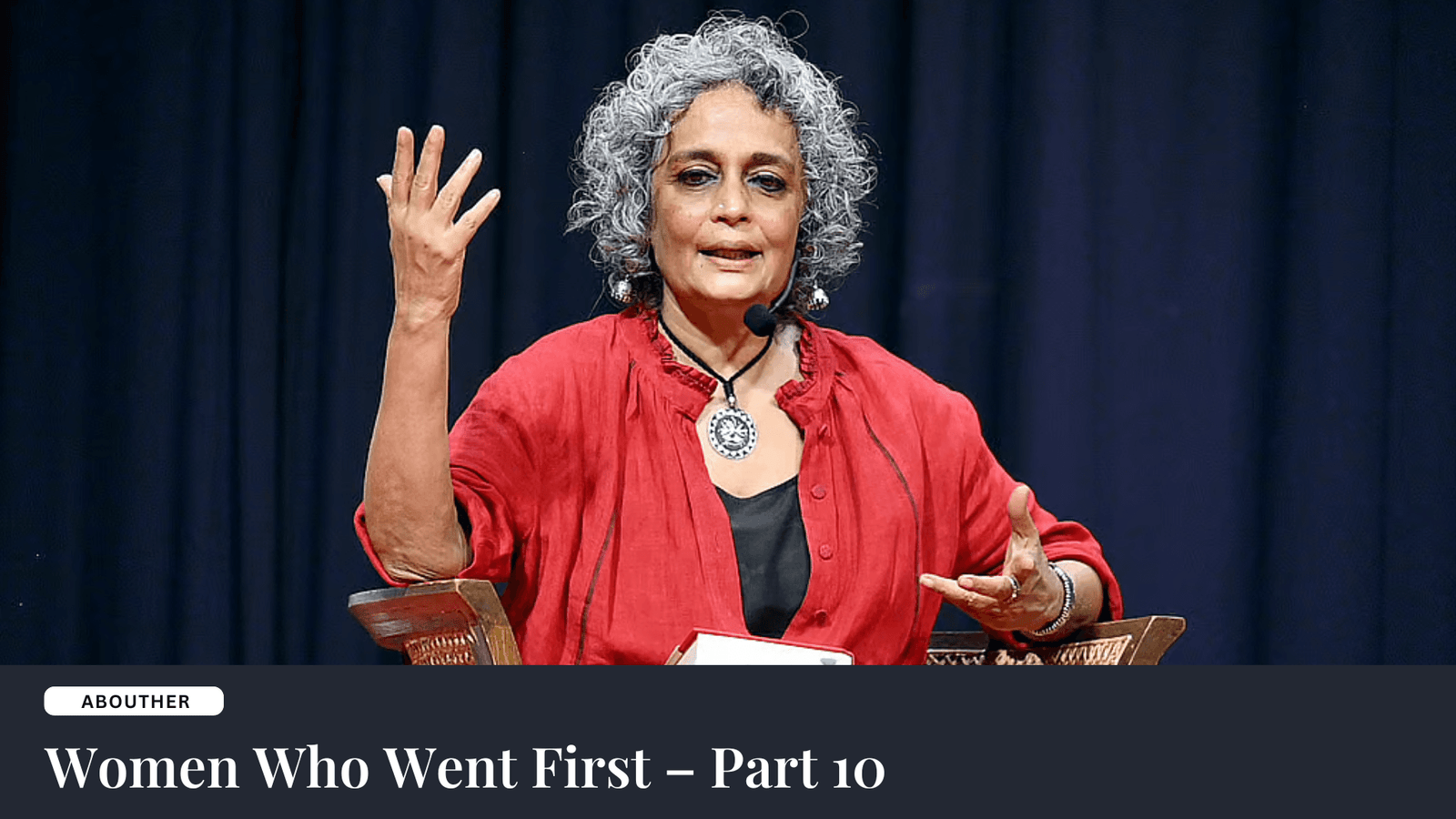
The Women Who Went First – Part 10
AboutHer
STORIES. WOMEN. NOW.
THE WOMEN WHO WENT FIRST ✦ CONTEMPORARY
PORTRAIT · ISSUE NO. 10
Arundhati
Roy
Roy
Most writers spend a lifetime chasing one book that matters. She wrote one, won the Booker, and then chose something harder — to keep saying what needed to be said, regardless of the cost.
In 1997, a first novel by an unknown Indian woman won the Booker Prize. The God of Small Things was everything the literary world loves — lush, precise, emotionally devastating, the kind of debut that arrives once in a generation. What happened next is not what anyone expected. Arundhati Roy did not write another novel for twenty years. She spent those two decades doing something that, in the long view, may matter just as much: she became one of the most uncompromising public voices in India, writing about dams, nuclear weapons, corporate power, Kashmir, and the Constitution with the same clarity she had brought to fiction. Fame, she seemed to decide, was most useful as a platform. She used it accordingly.
WHERE SHE CAME FROM
Roy was born in 1961 in Shillong to a Bengali Hindu father and a Syrian Christian mother from Kerala. Her parents separated when she was young, and she grew up in Aymanam in Kerala, a landscape that would become the central geography of her first novel. She studied architecture at the School of Planning and Architecture in Delhi, a training that shows in her prose, in the way she constructs a scene with structural precision before letting the feeling in.
She worked in Delhi for years, writing screenplays and acting in a small role in a film, before The God of Small Things took hold of her completely. She has said the book wrote itself over four years and that she knew, even as she was writing it, that it was the only novel she had in her. What she did not know was what she would become once it was done.
THE BOOK AND WHAT IT COST
The God of Small Things is set in Kerala in 1969 and tells the story of twins, a family, a forbidden love, and the caste boundaries that destroy lives quietly and then catastrophically. It was published in 1997 and within months had sold millions of copies worldwide. The Booker Prize followed. So did a legal case in Kerala, where a lawyer filed a complaint alleging that certain passages were obscene. The case was eventually dismissed, but the echo of Ismat Chughtai’s courtroom a half-century earlier was not lost on those paying attention.
Roy handled the fame with a kind of deliberate discomfort. She gave interviews but resisted the literary circuit. She was interested in what the attention could do, not in the attention itself.
1997
The God of Small Things
Booker Prize winner. Set in Kerala, it follows twins across a tragedy shaped by caste, colonialism, and forbidden love. Translated into over 40 languages.
2017
The Ministry of Utmost Happiness
THE TWENTY YEARS BETWEEN
Between her two novels, Roy wrote essays. Not occasional pieces but sustained, deeply researched, politically consequential arguments. She wrote about the Narmada dam project and the communities it displaced. She wrote about India’s nuclear tests in 1998, calling them a form of collective madness, at a time when most public intellectuals were celebrating them as national pride. She wrote about the American invasion of Afghanistan, about corporate globalisation, about what she called the NGO-isation of resistance. Each essay landed like a provocation because it was one, carefully aimed.
She was prosecuted for contempt of court after criticising the Supreme Court’s handling of the Narmada case. She paid a fine and served a symbolic one-day sentence. She continued writing. The pattern, by now, was clear. Consequence was not a deterrent. It was almost a confirmation that she was writing about the right things.
“There is really no such thing as the voiceless. There are only the deliberately silenced, or the preferably unheard.”
ARUNDHATI ROY
WHAT KIND OF ACTIVIST
Roy resists easy categorisation, which is part of what makes her uncomfortable for institutions that prefer their dissidents to have a single, manageable message. She has been criticised from the left and the right, by nationalists and by liberals, by people who feel she goes too far and people who feel she does not go far enough. She has written in support of Kashmiri self-determination, a position that has cost her considerable goodwill in mainstream Indian public life. She has been vocal about Hindutva, about the treatment of Dalits, about what she sees as the erosion of constitutional values.
Also Read: The Women Who Went First – Part 9
What holds it all together is not a party line but a consistent attention to who bears the cost of power. Her question, in every essay and every novel, is the same: who pays, and why are we not talking about it?
ON CHOOSING DISSENT OVER COMFORT
Roy could have taken the path that many Booker winners take: a comfortable position in the global literary establishment, a second novel that consolidated the first, a careful neutrality on anything politically contentious. She chose the opposite. She has said that she did not think of herself as a brave person, that she simply could not write about anything she did not care about. The bravery, if that is what it is, seems less like a choice than a constitutional inability to perform indifference.
THE SECOND NOVEL AND WHAT IT SAID
The Ministry of Utmost Happiness arrived in 2017, twenty years after the first book. It is a wider, more demanding novel than The God of Small Things, spanning Kashmir, Delhi, Gujarat, and the lives of people the Indian state prefers not to see clearly. It was reviewed with the careful ambivalence that meets books which refuse to be comfortable, praised for its ambition, criticised for its sprawl, loved fiercely by readers who felt it saw them.
The twenty-year gap had not softened her. If anything it had made her more willing to let the novel carry the full weight of what she wanted to say, without the concessions that literary debut-making tends to require.
WHY SHE BELONGS IN THIS SERIES
Placing Arundhati Roy after Ismat Chughtai is not accidental. Both women wrote things that disturbed the establishment, both faced legal consequences for it, and both kept writing without apology. The continuity is real and worth naming.
But Roy belongs in this series for a reason specific to her. She is the rare example of a woman who had everything the system offers, the prize, the global readership, the cultural capital, and chose to spend it rather than protect it. Most people who reach that position spend the rest of their careers managing the reputation it built. She spent it on the people and causes that reputation could amplify.
That is a kind of leadership that does not always look like leadership from the outside. It looks like risk, and stubbornness, and a refusal to be grateful for the wrong things. From the inside, it is simply the decision to use what you have been given for something that matters. Not every woman who goes first does it with a sword. Some do it with a sentence, written precisely enough that it cannot be ignored.
“She had everything the system offers and chose to spend it rather than protect it. That is a kind of leadership that does not always look like leadership from the outside.”
THE WOMEN WHO WENT FIRST · ABOUTHER MAGAZINE
Share This On Social
About the Author: Sangeeta Relan

Related Posts


I’m Sangeeta Relan—an educator, writer, podcaster, researcher, and the founder of AboutHer. With over 30 years of experience teaching at the university level, I’ve also journeyed through life as a corporate wife, a mother, and now, a storyteller.