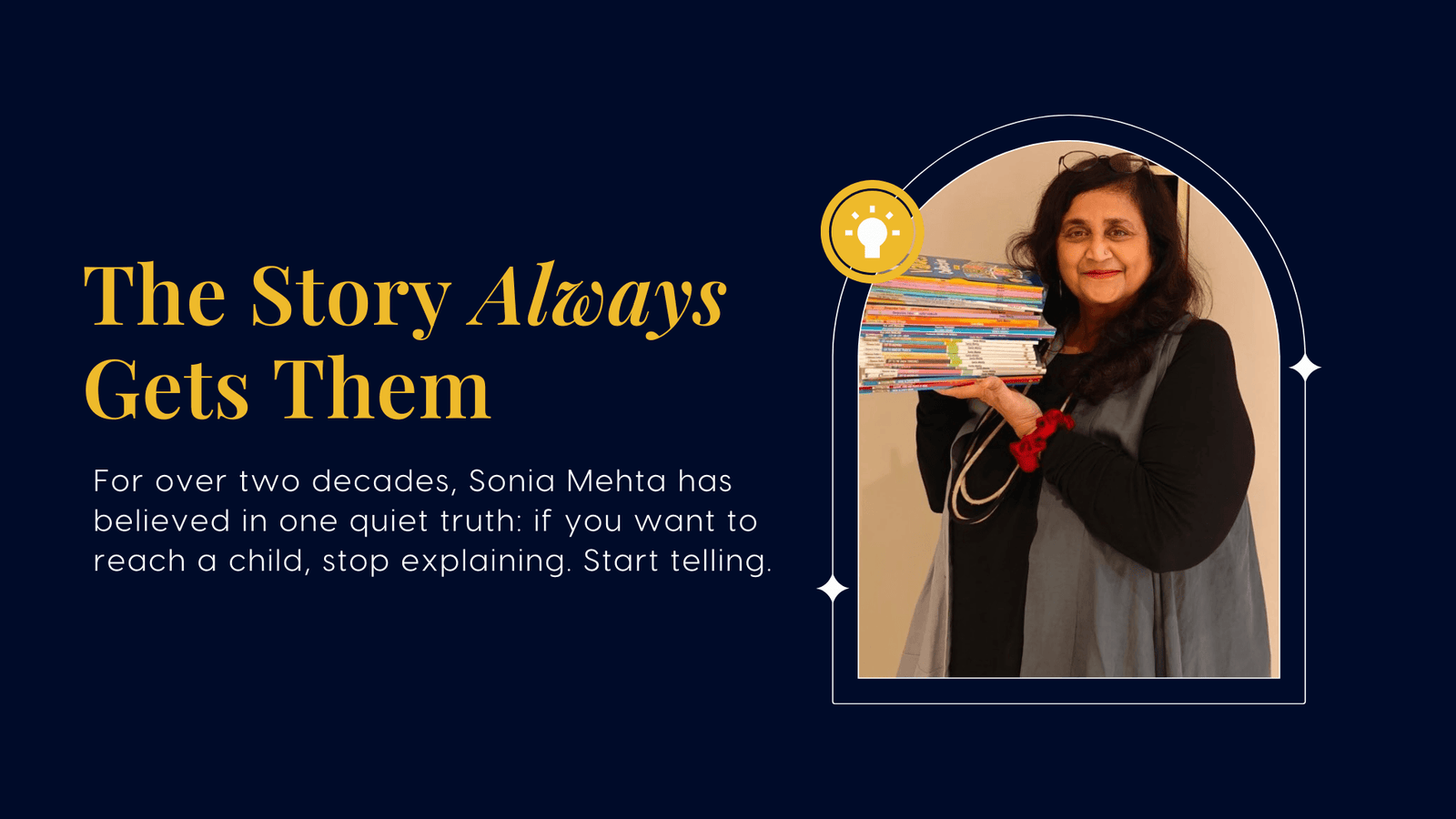
The Story Always Gets Them
ABOUTHER MAGAZINE ✦ WOMEN & STORIES ✦ SEASON 3
– CHILDREN’S LITERATURE
The Story Always
Gets Them
Gets Them
For over two decades, Sonia Mehta has believed in one quiet truth: if you want to reach a child, stop explaining. Start telling.
BY SANGEETA RELAN — THE ABOUTHER SHOW — S3E147 APRIL 2026
She did not plan to become a children’s author. She planned to be a journalist. Then life threw things at her, and somewhere between raising two children, typing on an actual typewriter, and convincing a Mumbai newspaper to run a Saturday edition entirely for young readers, Sonia Mehta found her calling. Or perhaps, as she would say herself, she simply stayed open enough for it to find her.
Over two decades later, with characters that children across the country have dressed up as and written letters about, Sonia shows no sign of slowing down. She now has two grandchildren. They are her live test audience, her first readers, the reason she still knows exactly what a seven-year-old cares about on a Tuesday. “I feel very lucky that I have this,” she says, and she means it.
The minute you turn something into a story, you get them. Whether it is adults or children, the minute you turn something into a story, you get them.
SONIA MEHTA
A Journey Never Planned
Sonia began as a business journalist, writing for publications like Business India before moving to Inside Outside. Marriage and children brought a pause, but her husband refused to let it become a full stop. “He kept saying, listen, just because you have had to take a break at this point doesn’t mean you take a break from everything. You are lucky that you can write at home.” So she did.
The turn toward children happened naturally. She had small children who needed stories. A Mumbai newspaper was looking for someone to create a weekly children’s edition. The two things found each other. Once she got a taste of writing for young readers and seeing their responses, there was no going back. She and her husband then built Quadrum Solutions together, creating content for publishers from Cambridge to DK to Macmillan. Thousands of books followed, many without her name on them. That anonymity, she says, was the finest education she could have received. It taught her the full grind of the publishing world: the writing, the editing, the designing, the understanding of what children, parents, teachers, and schools actually want.
“You need a support system. There are men who really support this. That is something I had, which I have to say I was incredibly fortunate for.”
Motherhood as the First Draft
Ask Sonia where her stories come from and she will tell you: from living with children. Not watching them from a careful distance. Living with them, in all of it. When her kids were small and obsessed with space, she wrote about planets. When teeth-brushing became a nightly standoff, she turned it into songs. The material was right there, in the house, every single day.
She is careful to note that motherhood is not a prerequisite. What is essential, she believes, is genuine time with children. Listening to them, not just hearing them. “For a children’s writer, to be able to interact with children is very critical.” Her grandchildren now serve exactly the role her own children once did, keeping her writing rooted in the present tense of childhood rather than a nostalgic version of it.
You are touching children across the country, hopefully across the world as well, and that in itself is very inspiring.
SONIA MEHTA
RJ Rini and the Right to Be Heard
Her latest book, On Air with RJ Rini, is her first published chapter book, and it feels personal in the way only the truest stories do. Rini is a seven-year-old girl who loves to talk and loves collecting completely useless information (“the weirder the better,” Sonia says, grinning). The problem is that nobody around her has time to listen. Her parents are busy. Her older sister has no patience. One day, almost by accident, she hears a radio jockey on her sister’s radio and thinks: that is what I want to be when I grow up. And she pursues it.
Sonia wanted Rini to embody something children do not always see modelled: the ability to stay positive when things go wrong, to not give up on herself, to have a point of view and trust it. “I wanted her to have a sense of determination,” she says. “The idea that she does not give up on things. She is an individual.” The friendship drama woven through the story is equally deliberate. At seven and eight, children are just beginning to make their own friends, take their own small decisions, navigate their own conflicts. Rini lives inside all of that.
“Today you could become a makeup artist, you could become a DJ, and be immensely successful. You do not have to be a doctor or a lawyer. Children, if they have a passion, if they have an interest, the opportunity of being able to do that for a living is wonderful.”
Stories, Not Sermons
Every children’s author faces the same challenge: how do you get a value across without the child shutting down the moment they sense a lesson coming? Sonia’s answer, refined over twenty years, is to never address the child directly. You tell a story about someone else entirely, and you let them draw their own conclusions.
In her feelings series, set in a small foggy forest, a jealous giraffe gradually comes to see that her famously long neck, the very thing she has always resented, is what makes her singular. In her values series, twins called Nikki and Noni learn about sharing not through a lecture but through getting stuck in situations where the absence of sharing makes everything harder. In a book about anxiety, a small snail named Uf realises that his worries shrink to nothing the moment he focuses on helping somebody else. The lesson travels inside the story, quietly, without announcing itself.
Each book also includes interactive activities, because children who have something to do stay engaged far longer than children who are asked to sit and listen. “Lecturing them doesn’t work in my experience,” she says plainly. The activity reinforces the message, she explains, and lets the child carry it forward without ever feeling instructed.
If you patronise them or talk down to them or give them moralistic lectures, chances are they will just shut down. They will not internalise it.
SONIA MEHTA
What Children Are Carrying Now
The world Sonia writes into has shifted enormously from the one she began in. The joint family system, with its grandparents and built-in buffer, is giving way to nuclear households where children manage their feelings with far less informal support around them. Social media shapes their sense of self before they even have their own phone. Instant gratification has become the default rhythm of daily life.
“The idea of patience, the idea of resilience, a lot of those things are not going in tune with today’s world,” she says. She does not frame this as doom. She frames it as the precise gap her books are trying to fill. If the environment is no longer quietly teaching these things, then stories have to.
She speaks about voice and visibility with real care. A child who grows up watching the women around them be dismissed or spoken over will absorb that as the natural order of things. A child who grows up watching everyone in the house treated with equal respect learns, just as quietly, that their own opinion has weight. “It does certainly begin in childhood,” she says. “And a lot of it begins by the children watching the parents.”
“There is never a problem child. There is always a problem parent.”
One Feeling to Carry Home
Toward the end of their conversation, Sangeeta offered Sonia a choice. If a child could walk away from her books carrying just one feeling, what would she want it to be: courage, confidence, or the comfort of being understood?
Sonia chose the third without a moment’s pause. “From that comes confidence,” she said. “From that you get the courage to do what you want, because you feel understood, you feel heard.” It is also, she added, what brings any reader back to a book. When a story makes you feel seen, you return to it. You look for more like it. That is how readers are made, in children and in adults alike.
Her Always Happy Books series is named for exactly this. “I feel that happy children make for a happy world,” she says. “And I think the world needs that now.”
The comfort of being understood. From that comes confidence. From that comes the courage to do what you want, because you feel heard.
SONIA MEHTA
For the Women Still Figuring It Out
Sonia’s advice to young women who want creative careers is not about building networks or finding the perfect moment. It is simpler than that. “Give it a try. Give it a shot.” She says it the way you say something you have actually lived through, not something you have read in a book. She built her career without a neat plan, without grandparents nearby for childcare, without the support structures many assume are necessary. What she had was a husband who pushed her not to stop, and the willingness to grab whatever life offered rather than wait for conditions to be ideal.
And for those who are already grown, who feel they missed their window? “There is nothing to stop you. You can try it out yourself. The only thing that can happen is that you find it is not for you. Which is fine. But that is always better than not trying.”
KEY TAKEAWAYS
1 STORIES BYPASS RESISTANCE
Children shut down when lectured to, but a story about a third person slips past every defence. The message lands precisely because it was never aimed at them.
2 EMOTIONAL INTELLIGENCE MUST BE TAUGHT EARLY
With nuclear families replacing the buffer of joint households, children are navigating big feelings with less informal support. Books that name emotions give them a language before adults have to.
3 BEING HEARD IS THE ROOT OF EVERYTHING
Confidence, courage, and the will to speak up all grow from one seed: feeling understood. A child who feels seen builds from there.
4 CHILDREN ABSORB WHAT THEY WATCH, NOT JUST WHAT THEY ARE TAUGHT
The environment at home shapes a child’s expectations of how they deserve to be treated. Respect modelled is respect learned.
5 FOR WOMEN: GIVE IT A TRY, EVEN WITHOUT A PERFECT PLAN
Sonia’s career was never linear. She moved through journalism, motherhood, ghostwriting, and entrepreneurship before she found her name on the cover. Staying open matters more than having a roadmap.
✦✦✦
Share This On Social
About the Author: Sangeeta Relan

Related Posts



I’m Sangeeta Relan—an educator, writer, podcaster, researcher, and the founder of AboutHer. With over 30 years of experience teaching at the university level, I’ve also journeyed through life as a corporate wife, a mother, and now, a storyteller.