The Women Who Went First – Part 15
AboutHer
STORIES. WOMEN. NOW.
THE WOMEN WHO WENT FIRST ✦ FROM THE PAST
PORTRAIT · ISSUE NO. 15
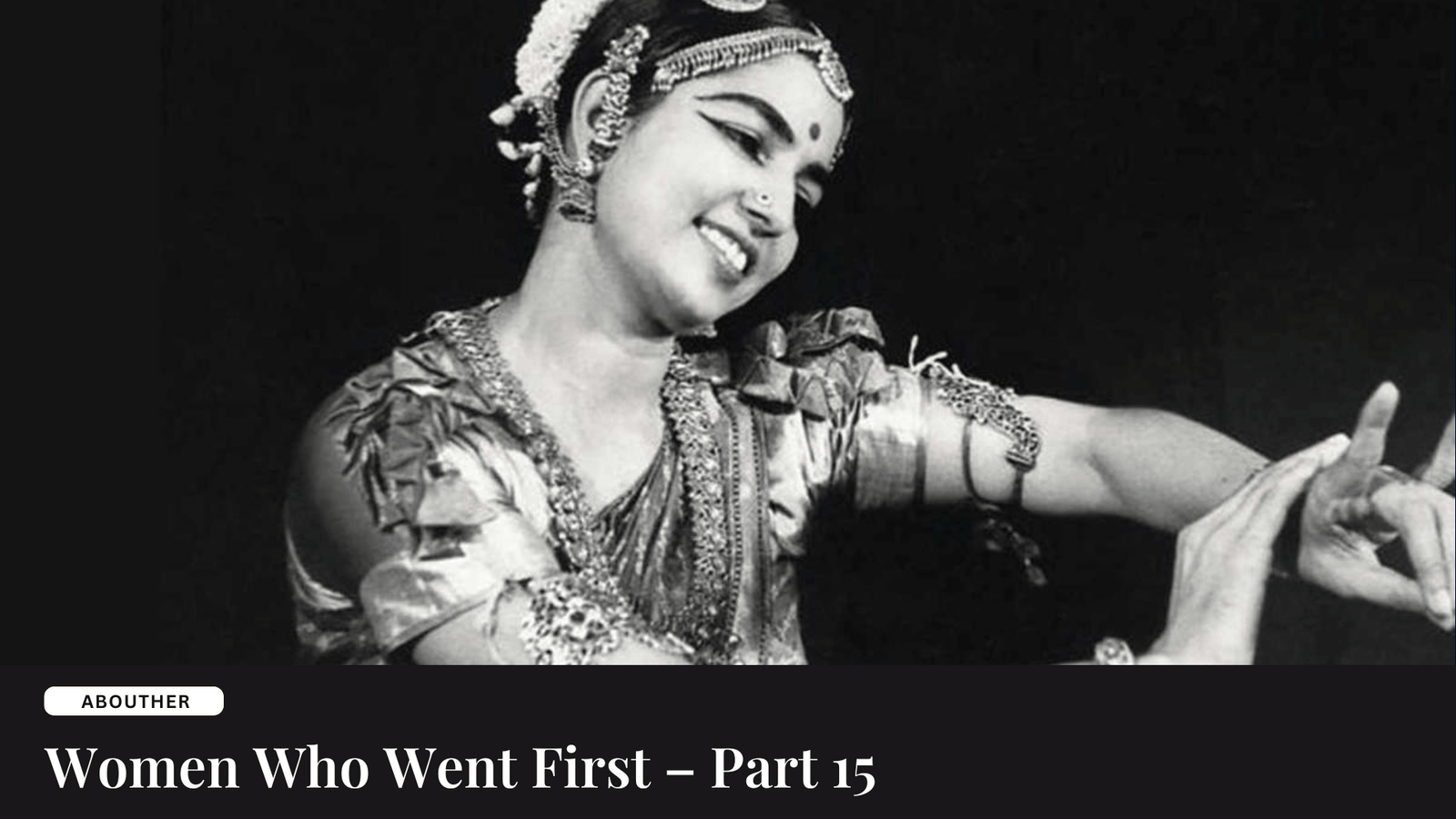
Rukmini Devi
Arundale
Arundale
She took a dance form that polite society had declared shameful and made it the crown jewel of Indian classical arts. To do it she had to defy her community, reimagine a tradition, and build an institution from nothing.
In 1935, a Brahmin woman from Madurai stood on a public stage and performed Bharatanatyam. This does not sound like an act of courage. It was. At the time, Bharatanatyam was a dance form performed almost exclusively by devadasis, women dedicated to temples, whose social status had been systematically destroyed by colonial legislation and upper-caste reform movements that conflated their art with prostitution. For a woman of Rukmini Devi’s background to perform it publicly was to invite social ostracism, to be accused of immorality, and to stand against the mainstream of the very community whose approval she had been raised to seek. She performed anyway, and in doing so began the work of rescuing an art form that was very close to disappearing entirely.
A CHILDHOOD BETWEEN WORLDS
Rukmini was born in 1904 in Madurai into a Brahmin family with an unusually open intellectual life. Her father was a theosophist, which meant that the family’s social world was international, unconventional, and genuinely curious about ideas that crossed cultural boundaries. This background mattered. It gave her a framework in which tradition and modernity were not opposites, in which Indian culture could be taken seriously on its own terms and also examined and reformed from within.
She married George Arundale, a British theosophist and later President of the Theosophical Society, when she was sixteen and he was forty. The marriage was itself scandalous by the standards of her community. It was also, by all accounts, a genuine intellectual partnership. It was through the Theosophical Society’s international connections that she encountered Anna Pavlova in 1928 on a voyage to Australia, and it was Pavlova who first suggested that she learn Indian classical dance rather than ballet. The suggestion changed everything.
THE PROBLEM SHE CHOSE TO SOLVE
WHAT WAS AT STAKE
By the 1930s, Bharatanatyam was on the verge of extinction as a public art form. The devadasi system, through which the dance had been preserved and transmitted for centuries, had been attacked by colonial reformers and nationalist social reformers alike, both of whom associated it with moral degradation. The Madras Devadasi Act of 1947 would eventually abolish the system. The unintended consequence was that the knowledge, the technique, and the repertoire that devadasis had carried for generations were disappearing with it. Rukmini Devi saw what was being lost and decided to save it, on new terms, with a new institution, and through her own body as the first argument.
Her approach was not simple preservation. She worked closely with devadasi practitioners, most importantly the legendary Pandanallur master Meenakshisundaram Pillai, to learn the form with full seriousness and technical rigour. She then made deliberate choices about how to present it: she cleaned up certain elements that she considered crude, added theatrical elements, refined the costuming and staging. These choices have been debated ever since, and the debate is legitimate. What is not debatable is that without her intervention, the dance form itself might not have survived long enough to be debated.
WHAT SHE BUILT
In 1936, a year after her first public performance, Rukmini Devi founded Kalakshetra, an academy of arts in Adyar, Chennai, on the grounds of the Theosophical Society estate. The name means Temple of Art. She built it from nothing, with a clear vision of what it should be: a place where Indian classical arts were taught with the same seriousness and rigour that European conservatories brought to their traditions, where the spiritual dimensions of the art were taken seriously alongside the technical, and where artists were trained as complete human beings rather than merely skilled performers.
WHAT SHE BUILT AND WHEN
First public Bharatanatyam performance
Kalakshetra Foundation, Adyar, Chennai
Bharatanatyam curriculum and notation system
Elected to Indian Parliament, Rajya Sabha
Kalakshetra declared Institution of National Importance
1935
1936
1940s
1952
1994
Also Read: The Women Who Went First – Part 14
Kalakshetra became, over the following decades, one of the most important cultural institutions in India. It trained generations of dancers, musicians, and artists. It developed a distinctive house style that influenced Bharatanatyam performance worldwide. It preserved texts, costumes, and traditions that would otherwise have been lost. It is still operating, still training, still producing dancers of international standing, nearly ninety years after Rukmini Devi founded it on the conviction that Indian classical arts deserved a permanent home.
“Art is not a luxury. It is the breath of a civilisation.”
RUKMINI DEVI ARUNDALE
THE DEVADASI QUESTION
Any honest account of Rukmini Devi’s legacy has to sit with a tension at its centre. The devadasis who had preserved and transmitted Bharatanatyam for centuries were, in the reform process that she was part of, systematically removed from the art they had created. The Brahminisation of Bharatanatyam, as scholars have called it, involved real losses for real women whose livelihoods and identities were tied to a tradition that was now being repackaged for respectability by those who had previously looked down on it.
Rukmini Devi was not solely responsible for this process and she was not indifferent to the devadasis whose knowledge she drew on. But the power dynamics of who got to save an art form, and on whose terms, and at whose expense, are part of the story. A series about women who went first is also, sometimes, a series about the complexity of what going first actually meant for those who were already there.
BEYOND DANCE
Rukmini Devi’s interests extended well beyond Bharatanatyam. She was a lifelong animal welfare advocate at a time when this was considered eccentric at best. She was elected to the Rajya Sabha in 1952 and used her platform there to push for animal welfare legislation with the same tenacity she brought to cultural preservation. She chaired the Animal Welfare Board of India and was instrumental in passing the Prevention of Cruelty to Animals Act of 1960. When she was offered the Presidency of India in 1977 by the Janata Party, she declined, citing her work and her animals. The offer itself speaks to how seriously she was regarded beyond the world of the arts.
THE PRESIDENCY SHE TURNED DOWN
In 1977, Rukmini Devi Arundale was offered the nomination for President of India by the Janata Party coalition. She would have been the first woman President of India, fourteen years before Pratibha Patil held the office. She declined. She said she had work to do at Kalakshetra and could not leave her animals. The refusal was entirely in character. She had never been interested in power for its own sake, only in the work that needed doing. The presidency, to her mind, was less important than the institution she had built and the creatures she was responsible for.
✦ ✦ ✦
WHY SHE BELONGS IN THIS SERIES
Kamaladevi Chattopadhyay appears earlier in this series as a woman who saved India’s craft traditions by building institutions that gave artisans markets, dignity, and futures. Rukmini Devi did something parallel and distinct: she saved a performing art tradition by staking her own reputation on it first, and then building the institution that would carry it forward.
Both women understood that culture is not preserved by admiring it. It is preserved by working on it, teaching it, funding it, arguing for it, and building the structures that allow it to outlast any individual who loves it. Kamaladevi did this for craft. Rukmini Devi did this for dance. Between them they account for a significant portion of what India’s classical arts heritage looks like today.
She also did something this series values particularly: she walked into a space that her community told her was shameful, performed there with full seriousness, and refused to accept the terms on which the conversation was being conducted. She did not argue that Bharatanatyam was respectable despite the devadasis. She argued that it was magnificent because of its tradition, and she put her body, her reputation, and her life’s work behind that argument. It took decades. It worked. The dance is now among the most celebrated classical art forms in the world, and her name is inseparable from its survival.
“She walked into a space her community told her was shameful, performed there with full seriousness, and spent the rest of her life building the institution that would make sure it could never disappear again.”
THE WOMEN WHO WENT FIRST · ABOUTHER MAGAZINE
Share This On Social
About the Author: Sangeeta Relan

Related Posts


I’m Sangeeta Relan—an educator, writer, podcaster, researcher, and the founder of AboutHer. With over 30 years of experience teaching at the university level, I’ve also journeyed through life as a corporate wife, a mother, and now, a storyteller.