
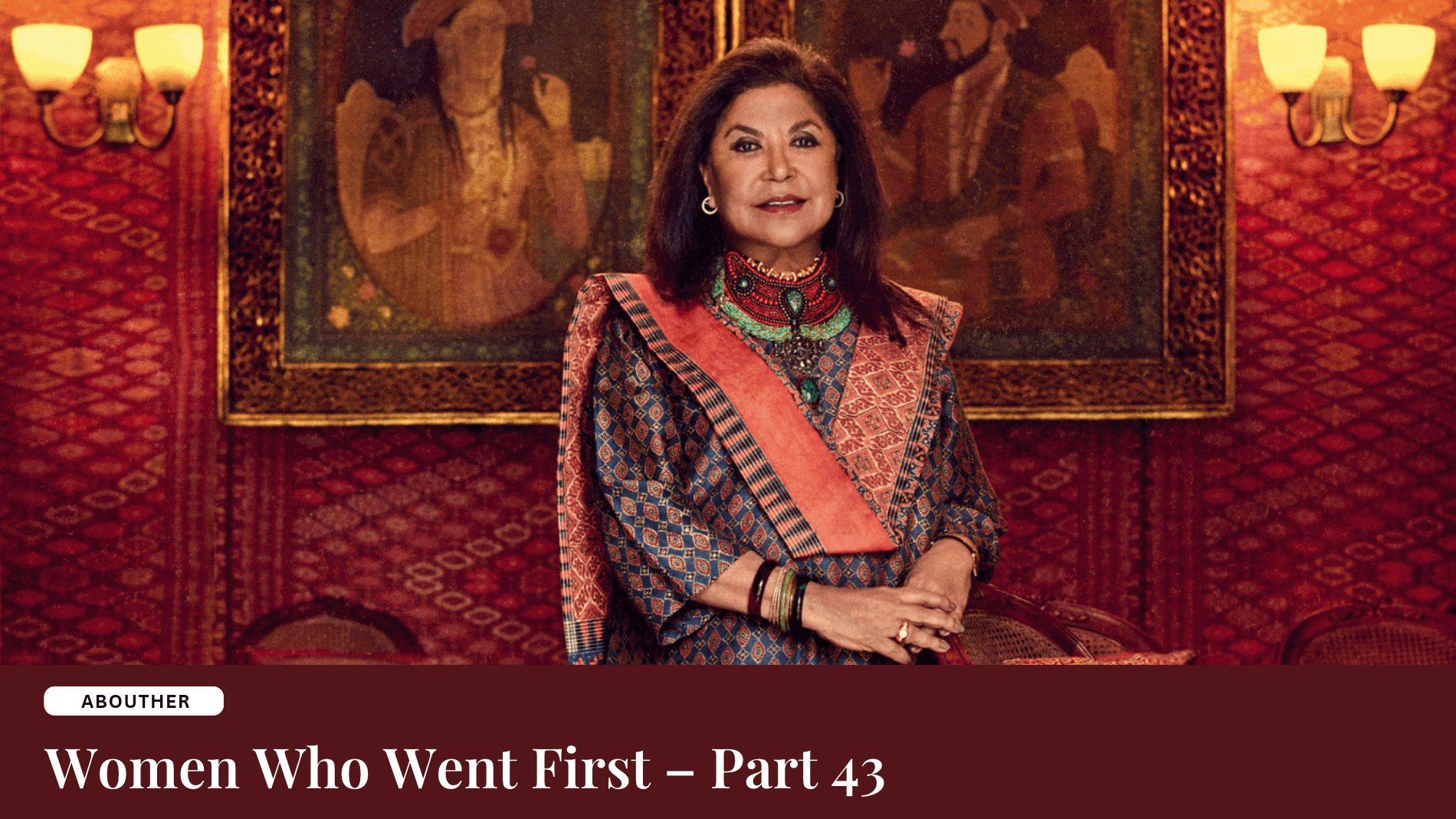
The Women Who Went First – Part 43
ISSUE 43 | THE WOMEN WHO WENT FIRST
CONTEMPORARY PORTRAIT
Ritu
Kumar
Kumar
She began in a crumbling haveli in Calcutta with six block-printers and a determination to save what India was quietly discarding. That was 1969. She is still at it.
1969
YEAR SHE STARTED, IN CALCUTTA
6
BLOCK-PRINTERS SHE BEGAN WITH
50+
YEARS REVIVING INDIAN TEXTILES
9
CRAFT TRADITIONS PRESERVED AND DOCUMENTED
THE BEGINNING
Ritu Kumar did not set out to build a fashion empire. She set out to understand a sari. It was 1969, and she had recently returned from studying museum design in the United States. She found herself in Calcutta, in a city still carrying its colonial and partition wounds, with an interest in Indian textile traditions that she suspected were vanishing faster than anyone had noticed.
She hired six block-printers from West Bengal, rented space in a crumbling haveli, and began experimenting. The fabric she was working with was Bengali kantha. The technique was resist-printing. The market she was aiming at barely existed yet. What she was doing, before anyone had a word for it, was reviving a craft that had nearly died and finding a way to make it economically viable.
Her first collection was shown in Delhi. It sold out. Word spread, the way word spread in those years, through people who had never seen anything quite like it and could not stop talking about it.
“She understood something that the fashion industry had not yet caught up to: that the most sophisticated thing India could offer was what it had always made.”
THE CRAFT
To understand what Ritu Kumar built, you have to understand what she was working against. By the late 1960s, Indian handloom and textile traditions were in serious decline. Machine-made fabrics were cheaper and faster. The artisans who carried the knowledge of zardozi, chikankari, kantha, block-printing, tie-and-dye, and temple weaves were ageing out. Their children were moving to cities for factory work. The techniques that had dressed Mughal courts and stocked European trade routes were being forgotten in a generation.
BENGAL
Kantha
Running stitch embroidery on layered muslin, originally made from old saris. Ritu Kumar documented its motifs and brought it into contemporary fashion.
LUCKNOW
Chikankari
White-on-white shadow embroidery on fine cotton or muslin. She commissioned master artisans from the ateliers of old Lucknow, keeping the technique alive.
DELHI / HYDERABAD
Zardozi
Gold and silver thread embroidery with metal wire, beads and sequins. Originally used for royal court dress. Ritu Kumar applied it to bridal and occasion wear, creating a market for the craftsmen who carried the skill.
RAJASTHAN / GUJARAT
Block-printing
Hand-carved wooden blocks pressed into natural dye and applied to fabric, pattern by pattern. She worked directly with block-printing communities, documenting their designs and creating sustained work for them.
What made Ritu Kumar’s approach different from revival efforts that had come before was that she did not treat these crafts as museum pieces. She worked with the artisans to understand what they knew, documented the techniques with rigour, and then found ways to present the results that could compete commercially with imported and mass-produced alternatives. She understood that a craft without a market is a craft in a waiting room for extinction.
Also Read: The Women Who Went First – Part 42
THE ARCHIVE
THE RESEARCH BEHIND THE WORK
In 1999, Ritu Kumar published Costumes and Textiles of Royal India, a scholarly survey that documented the dress traditions of Indian courts and the techniques behind them. It drew on years of research in museum archives, royal collections, and her own work with artisans. It is not a coffee-table book. It is a primary source, cited by researchers and conservators.
She spent years photographing and cataloguing block-print motifs before those blocks were lost or repurposed. She commissioned detailed surveys of regional craft clusters. She built, alongside her design practice, a documentary record of what India’s textile traditions actually looked like before globalisation fully reshaped them. This is work that most fashion designers never consider doing, because it has no immediate commercial return. She did it anyway.
THE LABEL
Ritu Kumar’s label, which bears her name, grew from that one Calcutta haveli into a network of stores across India. The brand has remained privately held and family-managed, which has given it a consistency that fashion houses oriented around investor timelines rarely sustain. Her son Amrish joined the business and her daughter-in-law Debarati extended its contemporary line. The house has not chased every trend. It has stayed, with unusual fidelity, with what it started as.
She dressed Indian women for weddings and ceremonies at a moment when the choice was often between imported Western formalwear and something that felt like costume. She gave them a third option: clothing that was rooted, contemporary, and genuinely theirs. In doing so, she helped shape the idea of what Indian luxury could look like, long before that idea became fashionable in international markets.
In 2013, she was awarded the Padma Shri. In 2023, she received the Padma Bhushan. Neither award changed the daily work, which remains what it has always been: working with artisans, designing clothing, and trying to hold the line against the disappearance of things worth keeping.
“She gave Indian women clothing that was rooted, contemporary, and genuinely theirs, before any of that was considered commercially viable.”
CROSS-SERIES CONNECTION · ISSUE 43
Read alongside Shakuntala Devi (Issue 43), and what emerges is a portrait of two women who understood the value of what India already had. Shakuntala Devi saw that a mind trained without formal schooling could outperform a computer. Ritu Kumar saw that a textile tradition ignored by modern commerce was more sophisticated than anything being imported to replace it. Both built their life’s work on the conviction that the most significant things are often the ones that everyone else has stopped paying attention to.
WHY SHE BELONGS IN THIS SERIES
Ritu Kumar went first in a direction that the Indian fashion industry had not yet taken: backward, into the craft traditions that modernity was quietly discarding, and then forward again into stores and collections and international exhibitions. She did this in 1969, before ethical fashion was a category, before artisan revival was a marketing concept, before Indian luxury was a phrase that anyone used in a serious sentence. She did it because she looked at what was disappearing and decided that someone should do something about it. She did it with six block-printers and a haveli and a stubbornness that has not noticeably diminished in fifty years. That is what going first really looks like.
ISSUE 43 • CONTEMPORARY PORTRAIT • ABOUTHER MAGAZINE
THE WOMEN WHO WENT FIRST
Share This On Social
About the Author: Sangeeta Relan

Related Posts






I’m Sangeeta Relan—an educator, writer, podcaster, researcher, and the founder of AboutHer. With over 30 years of experience teaching at the university level, I’ve also journeyed through life as a corporate wife, a mother, and now, a storyteller.