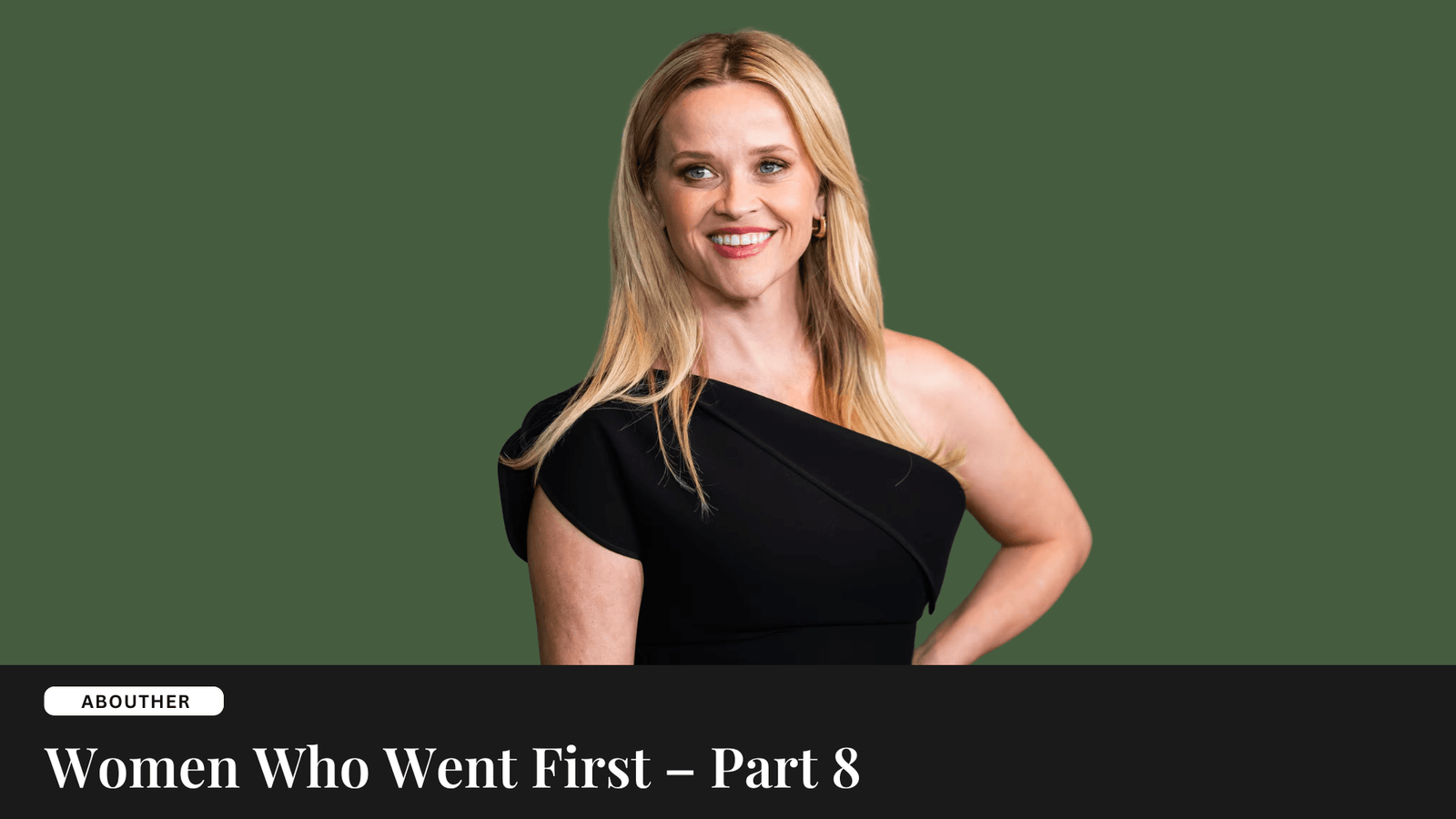
The Women Who Went First – Part 8
AboutHer
THE WOMEN WHO WENT FIRST • CONTEMPORARY
PORTRAIT · ISSUE NO. 08
Reese
Witherspoon
Witherspoon
FOUNDED
Hello Sunshine
VALUED AT
$900M+
BOOKS CHAMPIONED
100+
She spent twenty years being told what kinds of stories women would watch. Then she stopped asking for permission and started making them herself.
There is a moment Reese Witherspoon has spoken about more than once, a turning point that arrived not with fanfare but with quiet, clarifying frustration. She was in her late thirties, one of the most bankable actresses in Hollywood, and she could not find a script worth making. Not a shortage of scripts — a shortage of scripts about women who were fully human: complicated, ambitious, funny, broken, brilliant, real. The industry had a name for stories like that. They called them risky. She decided the real risk was continuing to wait for someone else to tell them.
THE ACTRESS WHO REWROTE HER ROLE
Laura Jeanne Reese Witherspoon was born in New Orleans in 1976 and raised in Nashville, Tennessee. She was performing before she was a teenager, landed her film debut at fifteen, and by twenty-three had delivered one of the most memorable performances of her generation as the relentlessly determined Elle Woods in Legally Blonde. The film was a phenomenon. It was also, for a long time, a ceiling — Hollywood’s tendency to reduce women to their most commercially legible moment meant that Witherspoon spent years navigating an industry that understood her as a brand before it understood her as a force.
Her Oscar win in 2006 for Walk the Line, in which she played June Carter Cash with startling depth and presence, confirmed what her best work had always suggested: there was a great deal more here than the industry was willing to use. The question was what to do about it.
“I want to be at the forefront of creating stories that reflect what women’s lives actually look like.”
REESE WITHERSPOON
BUILDING HELLO SUNSHINE
In 2016, Witherspoon co-founded Hello Sunshine with a deceptively simple premise: put women at the centre of every story. Not as satellites to male protagonists, not as rewards or obstacles, but as the full, complicated leads of their own narratives. It sounds obvious. In practice, it was radical enough that the company became one of the most significant forces in American entertainment within a decade.
The company produced Big Little Lies, the HBO series that became a cultural phenomenon and swept the Emmy Awards. It produced The Morning Show, Little Fires Everywhere, and Legally Blonde 3. It built a book club that turned into one of the most powerful forces in American publishing, with Witherspoon’s endorsement regularly propelling debut novels onto bestseller lists and giving women writers audiences they would have waited years to reach otherwise. In 2021, Blackstone acquired a majority stake in Hello Sunshine at a valuation of over 900 million dollars.
That number matters not because it measures success in the only terms Hollywood understands — though it does that too — but because it is proof of something the industry had long denied: that stories centred on women are not a niche. They are the market.
🎬
ACTRESS
Oscar winner, producer, and one of Hollywood’s most enduring leading women across three decades
💡
ENTREPRENEUR
Founded Hello Sunshine, a media company valued at over $900 million built entirely on women’s stories
📚
ADVOCATE
Her book club has championed over 100 titles, transforming careers and expanding what publishing calls commercial fiction
THE BOOK CLUB AS POWER MOVE
The Reese’s Book Club deserves particular attention because it is the piece of her work most easily underestimated. A celebrity book club sounds like a lifestyle accessory. What Witherspoon built is closer to an alternative publishing infrastructure — one that specifically amplifies the kinds of books that traditional publishing has historically underfunded and undermarketed: stories by women, about women, often dealing with experiences the industry considered too specific to travel widely.
She was wrong, repeatedly and profitably. Books selected for the club routinely sell hundreds of thousands of additional copies. Authors who might have spent years building an audience find themselves with one overnight. The club has become a signal to publishers that there is serious commercial appetite for the stories they were treating as risks, which in turn changes what gets commissioned, what gets advances, what gets shelf space.
That is not a book club. That is structural change delivered through the mechanism of enthusiasm.
WHAT SHE UNDERSTOOD THAT HOLLYWOOD DIDN’T
For decades the entertainment industry operated on an assumption so embedded it was rarely stated: that stories centred on women had limited commercial appeal. Witherspoon’s entire career as an entrepreneur is a systematic dismantling of that assumption, project by project, book by book, Emmy by Emmy. The $900 million valuation of Hello Sunshine is not just a business story. It is a correction of a market that had been mispricing women’s stories for generations.
THE ADVOCATE’S VOICE
Witherspoon was among the first major Hollywood figures to speak publicly in support of the #MeToo movement, doing so at a moment when the personal and professional risks of speaking were still very real. She has been consistent and specific in her advocacy, using her platform not for general declarations but for particular calls to action: equal pay, parental leave, the representation of women of colour in film and television, the pipeline of women into producing and directing roles.
Also Read: The Women Who Went First – Part 7
What distinguishes her advocacy from celebrity activism is that it connects directly to her business model. Hello Sunshine is not separate from her values — it is the structural expression of them. She is not asking the industry to do better and then returning to business as usual. She built a different business.
WHAT THE FULL PICTURE LOOKS LIKE
The temptation with Reese Witherspoon is to tell one story at the expense of the others — the actress who became a businesswoman, or the activist who happens to make television. But the full picture is more interesting and more instructive than any single frame.
She is someone who looked at a system that was using her partially and decided to use it fully, on her own terms. She took the thing the industry valued in her — her name, her taste, her audience’s trust — and converted it into ownership. Not just of her own image, but of the means of production. That is a move with a long history in the business world and a short one in Hollywood, particularly for women.
✦ ✦ ✦
WHY SHE BELONGS IN THIS SERIES
The Women Who Went First is about women who entered spaces that were not built for them and changed the terms of occupancy. Reese Witherspoon did not go somewhere no woman had gone before in the geographic sense — Hollywood has always had women. But she went somewhere most women in her position did not: behind the camera, behind the balance sheet, into the room where the decisions are made rather than the room where the performances are given.
And she made it legible. The Hello Sunshine model — woman-led, woman-centred, commercially serious — is now a template that other women in entertainment are building on. The first person to prove a thing is possible does not always get the credit. But the proof matters. It always matters.
“She took the thing the industry valued in her and converted it into ownership. Not just of her image, but of the means of production.”
THE WOMEN WHO WENT FIRST · ABOUTHER MAGAZINE
Share This On Social
About the Author: Sangeeta Relan

Related Posts


I’m Sangeeta Relan—an educator, writer, podcaster, researcher, and the founder of AboutHer. With over 30 years of experience teaching at the university level, I’ve also journeyed through life as a corporate wife, a mother, and now, a storyteller.