The Women Who Went First – Part 25
AboutHer
STORIES. WOMEN. NOW.
THE WOMEN WHO WENT FIRST ✦ FROM THE PAST
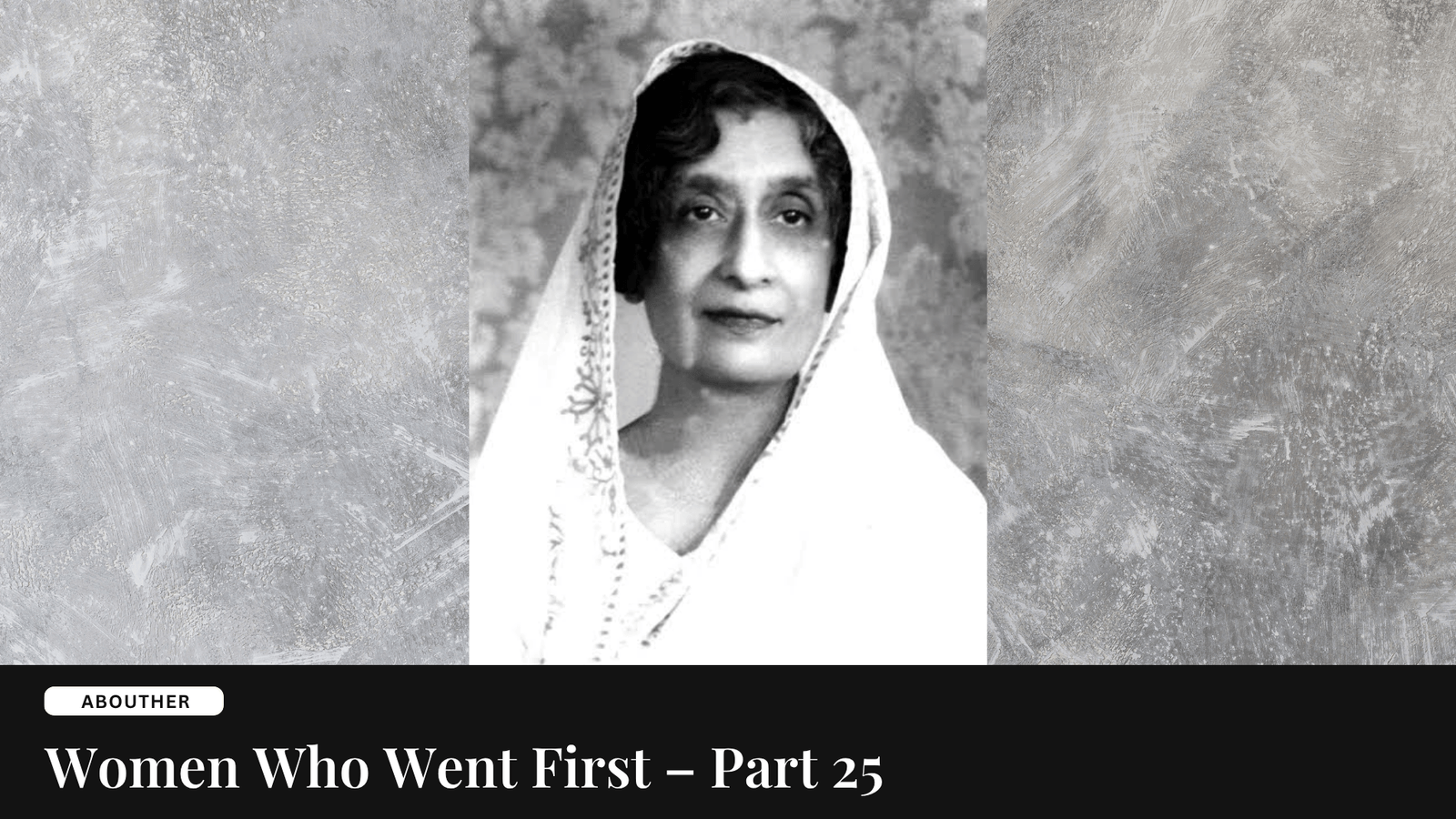
PORTRAIT · ISSUE NO. 25
Rajkumari
Amrit Kaur
Amrit Kaur
Every year, millions of Indians walk through the gates of AIIMS in Delhi seeking care. Almost none of them know that a princess built it. That gap between the institution’s fame and its founder’s invisibility is the story this series exists to correct.
The All India Institute of Medical Sciences in New Delhi is one of the most important medical institutions in the world. It trains doctors, conducts research, and provides care to patients who have often exhausted every other option. It was founded in 1956. It was built by Rajkumari Amrit Kaur, India’s first Health Minister, a Kapurthala princess who had given up a life of royal privilege to follow Gandhi, gone to prison three times for the freedom struggle, and then spent the first decade of independent India building the public health infrastructure that the country desperately needed and did not yet have. She is not a household name. AIIMS is. The distance between those two facts is one of the more instructive gaps in how India remembers its own history.
THE PRINCESS WHO CHOSE OTHERWISE
Amrit Kaur was born in 1887 in Lahore, the daughter of Raja Sir Harnam Singh of the royal house of Kapurthala and his English wife. She was a Christian by faith, educated at Sherborne School for Girls in England, and returned to India with a combination of English education and deep Indian identity that equipped her to navigate both worlds with unusual authority. She could have lived the life her birth entitled her to. She chose instead to write to Gandhi in 1919, having been moved by his work, and to offer her services to the independence movement. Gandhi wrote back. The correspondence became a sixteen-year collaboration.
She became his personal secretary, managing his correspondence, travelling with him, translating his ideas for international audiences, and doing the daily administrative work of a movement that ran on moral conviction and logistical precision in equal measure. She disagreed with Gandhi frequently, including on the question of birth control, which she supported and he opposed, and she said so directly, in writing, which tells you something essential about both of them.
THE FREEDOM STRUGGLE AND WHAT IT COST HER
Amrit Kaur participated actively in the Civil Disobedience Movement and the Quit India Movement, and was imprisoned three times by British authorities for her role in both. Imprisonment for a woman of her background and her age, she was in her fifties during the Quit India Movement, was not a symbolic gesture. It was a sustained personal commitment to a cause she had decided was more important than her comfort, her freedom, or her royal connections.
She was also one of the few women involved at the highest levels of the independence movement who combined political activism with technical expertise. She understood public health, she understood international institutions, and she understood the gap between the India that independence was creating and the India that existed on the ground, a gap that was, among other things, a public health catastrophe waiting to happen.
SIXTEEN YEARS WITH GANDHI
Amrit Kaur served as Gandhi’s personal secretary from 1919 until his assassination in 1948. Their relationship was one of genuine intellectual partnership, including genuine disagreement. She was a committed Christian and he a committed Hindu, and they debated theology, social reform, and policy with the directness of people who respected each other enough to argue properly. When Gandhi was shot on 30 January 1948, she was among the first to reach him. She administered first aid. He died in her arms. She went back to work the next morning, because that is what he would have wanted and because the work was not finished.
INDIA’S FIRST HEALTH MINISTER
When India became independent in 1947, Jawaharlal Nehru appointed Amrit Kaur as the first Health Minister of independent India. She was sixty years old. She served for ten years, from 1947 to 1957, and used that decade to build the foundations of India’s public health system with a seriousness and a vision that the ministry has rarely matched since.
She represented India at the first World Health Assembly in 1948 and was elected its President, the first woman to hold that position. She was instrumental in establishing the WHO’s framework for international health cooperation. She brought the same combination of moral conviction and administrative precision to international health diplomacy that she had brought to the independence movement, and she was taken seriously in both contexts by people who were not in the habit of taking Indian women seriously in any context.
1st
WOMAN TO PRESIDE OVER THE WORLD HEALTH ASSEMBLY, 1950
10
YEARS SERVED AS INDIA’S FIRST HEALTH MINISTER, 1947 TO 1957
1956
YEAR AIIMS WAS FOUNDED UNDER HER LEADERSHIP
THE INSTITUTION SHE BUILT
ALL INDIA INSTITUTE OF MEDICAL SCIENCES, FOUNDED 1956
Amrit Kaur conceived, lobbied for, and oversaw the establishment of AIIMS as a centre of excellence for medical education and research that would be genuinely world-class rather than merely adequate. She understood that India needed an institution capable of training the doctors who would train the next generation of doctors, that a country the size of India could not depend on sending its best medical minds abroad and hoping they returned, and that public health infrastructure built on compromise would produce compromised outcomes for generations. She lobbied New Zealand, Australia, and Sweden for the international funding that the Indian government alone could not provide, and she got it. AIIMS opened in 1956. It is now one of the premier medical institutions in the world. Her name is on a plaque inside it that most people who enter the building never stop to read.
“Health is not a privilege. It is a right, and it is the government’s obligation to make it real for every citizen, not merely to declare it.”
RAJKUMARI AMRIT KAUR
WHAT ELSE SHE BUILT
AIIMS is the most visible of her legacies but not the only one. She established the Central Government Health Scheme, which provides healthcare to central government employees and their families, a system that covers millions of people. She was instrumental in setting up the Indian Council of Medical Research and in developing the framework for India’s family planning programme. She worked to establish nursing as a respected profession in India at a time when it was considered unsuitable work for women of education and standing, and she founded the College of Nursing at AIIMS specifically to address that gap.
Also Read: The Women Who Went First – Part 24
She also gave her ancestral home in Shimla, The Retreat, to the Indian government for use as the official summer residence of the President of India. She kept nothing for herself that could be used for something larger. This was entirely consistent with how she had lived since 1919.
THE ANANDIBAI JOSHI CONNECTION
This series opened with Anandibai Joshi, the first Indian woman to qualify as a physician, who died at twenty-one before she could practise. Rajkumari Amrit Kaur, India’s first Health Minister, built the institution that would train generations of the doctors Anandibai Joshi had dreamed of becoming. That arc, from the first Indian woman to study medicine in 1883 to the woman who built India’s greatest medical institution in 1956, runs through the entire history of what women have contributed to Indian public health, and this series has now told both ends of it.
WHY SHE BELONGS IN THIS SERIES
The Women Who Went First has told stories of women who built institutions from nothing, who went where no one like them had gone before, and who spent their lives in the service of something larger than themselves. Rajkumari Amrit Kaur did all three simultaneously, across six decades, without making a performance of any of it.
She was a princess who chose the freedom struggle. A Christian who gave sixteen years to Gandhi. A woman who disagreed with the most powerful man in India and said so in writing. A minister who built one of the greatest medical institutions in the world and then gave her family home to the nation and died leaving very little behind for herself.
The institution she built sees millions of patients every year. It trains hundreds of doctors annually. It conducts research that shapes medical practice across the subcontinent. Almost none of the people who benefit from it know her name. That is the specific kind of erasure that this series exists to correct, one portrait at a time, and Rajkumari Amrit Kaur’s portrait belongs here as much as any in the series, and more than most.
AIIMS is her name, written in the health of the people it serves. This series is glad to write it out loud.
“She was a princess who chose the freedom struggle, a minister who built one of the world’s great medical institutions, and a woman who gave everything she had to something larger than herself. Her name is on a plaque inside AIIMS that most people never stop to read. This series stops.”
THE WOMEN WHO WENT FIRST · ABOUTHER MAGAZINE
Share This On Social
About the Author: Sangeeta Relan

Related Posts


I’m Sangeeta Relan—an educator, writer, podcaster, researcher, and the founder of AboutHer. With over 30 years of experience teaching at the university level, I’ve also journeyed through life as a corporate wife, a mother, and now, a storyteller.