The Women Who Went First – Part 16
AboutHer
STORIES. WOMEN. NOW.
THE WOMEN WHO WENT FIRST ✦ CONTEMPORARY
PORTRAIT · ISSUE NO. 16
The Payyoli Express
PT Usha
PT Usha
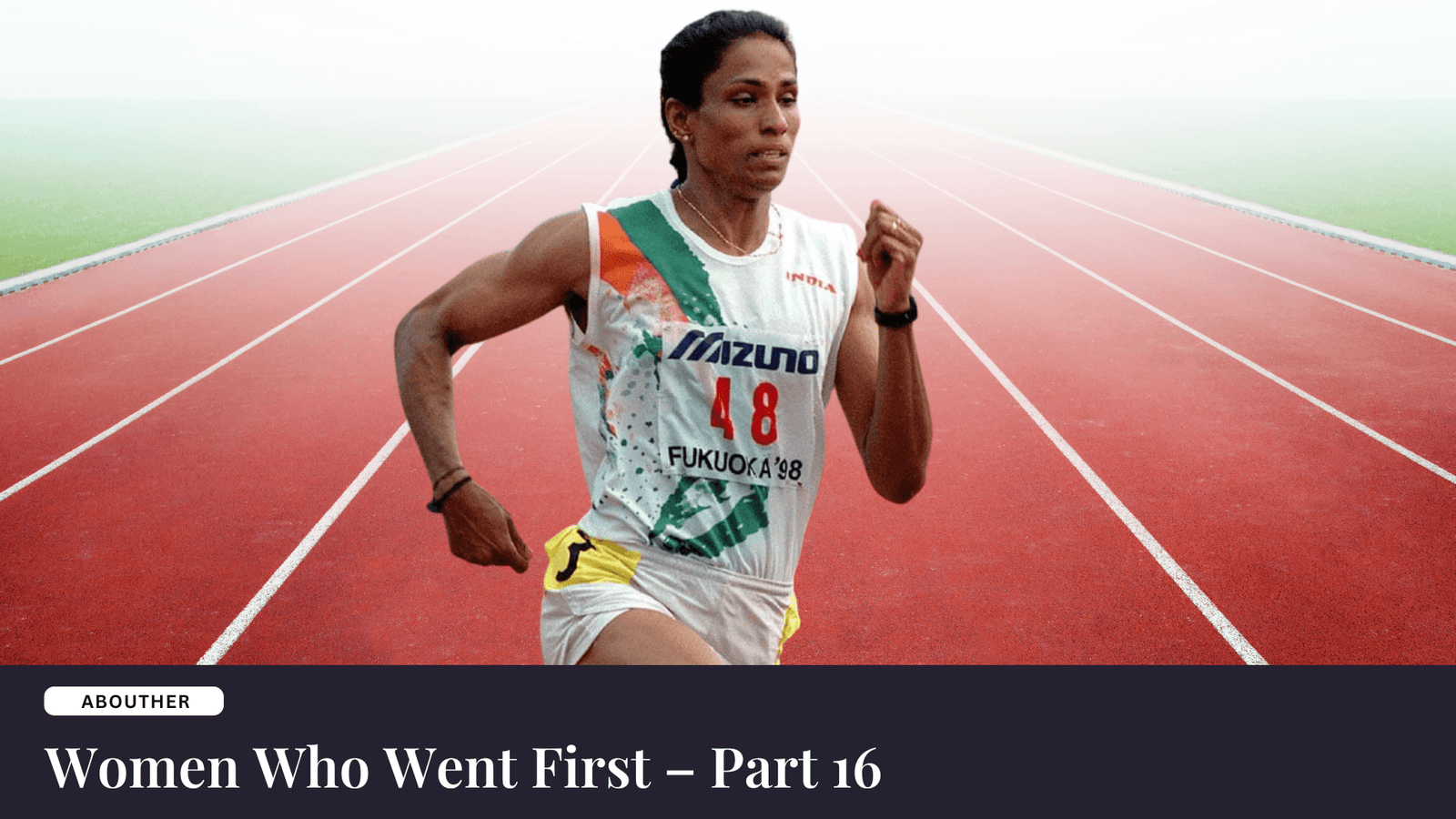
She missed an Olympic medal by one hundredth of a second. She came home to a country that did not fully know what it had almost had. She kept running anyway, for years, and then spent the decades after making sure the girls behind her had a path she never did.
On 8 August 1984, in the Los Angeles Memorial Coliseum, Pilavullakandi Thekkeparambil Usha ran the 400 metres hurdles final at the Olympic Games. She finished fourth. The Romanian athlete who took bronze finished in 55.41 seconds. Usha finished in 55.42 seconds. The difference was one hundredth of a second, a margin so small it exists below the threshold of human perception, a margin that separated her from becoming the first Indian woman to win an Olympic medal in athletics. She was nineteen years old. She had come from a village in Kerala with no running track, no proper shoes for years, and a coach who had seen something in her that she was still in the process of discovering herself. She went home without the medal. She went back to training the next morning.
WHERE SHE CAME FROM
Usha was born in 1964 in Payyoli, a small coastal town in Kozhikode district in Kerala. Her family was poor and her childhood was not cushioned by resources of any kind. She was a sickly child who spent significant time ill, which makes what followed even more improbable. At nine, she was spotted by a physical education teacher who noticed something in the way she moved and encouraged her to run competitively.
At twelve she was selected for the Kerala Sports Hostel in Kannur, where she came under the coaching of OM Nambiar, the man who would shape her entire career and who recognised immediately that he was working with something rare. He trained her not just as a sprinter but as a complete athlete, building the technical foundation that would eventually produce one of the most decorated track careers in Asian athletics history.
THE CAREER IN NUMBERS
SELECTED ACHIEVEMENTS
1982 Asian Games, New Delhi — 100m and 200m Silver, Bronze
1983 Asian Athletics Championships Gold
1984 Olympic Games, Los Angeles — 400m hurdles final 4th, 55.42s
1985 Asian Athletics Championships — 5 gold medals in one meet 5 Golds
1986 Asian Games, Seoul — 200m, 400m, 400m hurdles, 4x400m relay 4 Golds
1989 Asian Athletics Championships Gold
The numbers tell part of the story. Between 1982 and 1989, she won over a hundred international medals. She held the Asian record in the 400 metres hurdles for over two decades. At the 1985 Asian Athletics Championships she won five gold medals in a single meet, a performance that still stands as one of the most remarkable individual displays in the history of the competition. She was, by any objective measure, the dominant female track athlete in Asia for most of a decade.
ONE HUNDREDTH OF A SECOND
LOS ANGELES, 8 AUGUST 1984
The 400 metres hurdles final at the 1984 Olympics lasted just under a minute. Usha ran the race of her life. She finished fourth, behind the Romanian Cristieana Cojocaru by a margin that photo-finish technology could measure but human eyes could not detect. One hundredth of a second. Had she won bronze, she would have been the first Indian woman to win an Olympic athletics medal. The record would have stood until 2021, when Neeraj Chopra won gold in javelin at the Tokyo Games. That near-miss defined how India came to understand her career, which is both understandable and insufficient. A fourth-place Olympic finish, at nineteen, from the background she came from, was an achievement of the highest order. The medal it almost was should not obscure the race it actually was.
“I never thought of giving up. Sport taught me that you train, you compete, you lose sometimes, and then you go back and train harder.”
PT USHA
WHAT THE SYSTEM DID NOT GIVE HER
Usha’s career unfolded without the infrastructure that athletes in other countries took for granted. There was no proper synthetic track in Payyoli for most of her training years. Equipment was scarce. Financial support from sporting bodies was inconsistent and often inadequate. She trained on roads and grass and makeshift facilities with a coach who improvised constantly because he had to. The medals she won were won despite the system, not because of it.
Also Read: The Women Who Went First – Part 15
This is worth naming clearly because it changes what her achievements mean. Winning five gold medals at an Asian championship is remarkable for any athlete. Winning them as an Indian woman athlete in the 1980s, with the resources available to her, is something else entirely. The comparison is not with what other athletes had. It is with what she made of what she had, which was considerably less.
AFTER THE TRACK
Usha retired from competitive athletics and in 2002 established the Usha School of Athletics in Koyilandy, Kerala. The school has trained athletes who have gone on to represent India at the Commonwealth Games and Asian Games, women from backgrounds not unlike her own who needed exactly the kind of structured, serious coaching environment that had been so difficult for her to access. She built for them what had been built for her imperfectly and late, and she built it better.
THE SCHOOL SHE BUILT
The Usha School of Athletics in Koyilandy has trained dozens of national and international athletes since it opened in 2002. Several of her students have gone on to win medals at the Asian Games and Commonwealth Games. The school offers full residential training, something Usha herself had only partially and late in her career. It is the most direct expression of what she learned from her own experience: that talent without infrastructure is potential that the system fails to convert, and that someone has to build the infrastructure if it is not going to be built for you.
THE SENATOR AND WHAT IT MEANS
In 2022, Usha was nominated to the Rajya Sabha, India’s upper house of Parliament, as a representative of sport and public life. The nomination placed her in a position to advocate for athletes and sporting infrastructure at the legislative level, which is where the decisions about funding, facilities, and policy are actually made. She has used the platform to speak about the needs of grassroots athletics and the structural changes required to convert India’s athletic talent into consistent international performance.
The arc from a child running barefoot in Payyoli to a Senator arguing for sporting infrastructure in Parliament is not a straight line. It runs through decades of training, a hundredth of a second in Los Angeles, years of coaching young women in Kerala, and a lifetime of understanding, from the inside, exactly what the system fails to provide and why that failure costs India so much.
WHY SHE BELONGS IN THIS SERIES
Sport has not appeared in this series before, and its absence has been a gap worth filling. But PT Usha belongs here for reasons beyond the domain she represents. She belongs because her story is about what happens when exceptional talent meets inadequate infrastructure, and what a person of sufficient will does about that combination.
She ran faster than almost any woman in Asia for most of a decade, on facilities that would not have been acceptable to athletes in countries with functioning sports systems. She missed an Olympic medal by a margin that most people cannot even visualise. She came home, kept training, kept competing, kept winning, and then spent the years after her career making sure that the girls who came after her had something she had never had: a proper track, a proper coach, a proper chance.
That is the complete shape of what going first looks like when it is done with full seriousness. Not just the running. The school. Not just the medal that almost was. The medals that came after, won by women she trained, on a track she built, in a town not far from where she first learned to run. That is the work. That is what it means to go first and mean it.
“She missed an Olympic medal by one hundredth of a second, came home, kept training, and then spent the decades after building the track she never had for the girls who came behind her.”
THE WOMEN WHO WENT FIRST · ABOUTHER MAGAZINE
Share This On Social
About the Author: Sangeeta Relan

Related Posts





I’m Sangeeta Relan—an educator, writer, podcaster, researcher, and the founder of AboutHer. With over 30 years of experience teaching at the university level, I’ve also journeyed through life as a corporate wife, a mother, and now, a storyteller.