
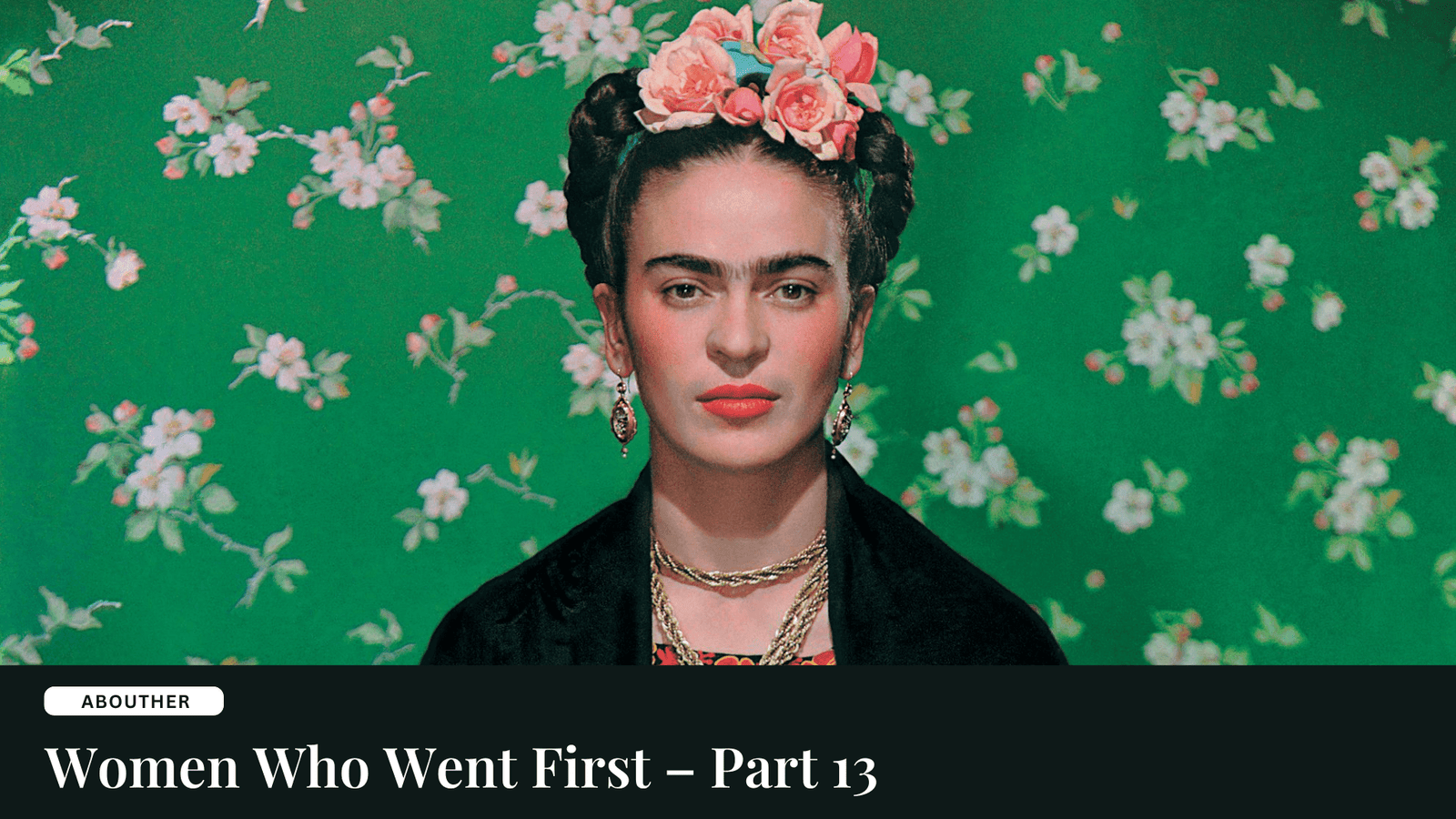
The Women Who Went First – Part 13
AboutHer
STORIES. WOMEN. NOW.
THE WOMEN WHO WENT FIRST ✦ FROM THE PAST
PORTRAIT · ISSUE NO. 13
Frida
Kahlo
Kahlo
She spent her life in pain, much of it horizontal, and produced some of the most viscerally honest paintings of the twentieth century. She did not paint despite what happened to her body. She painted because of it.
Frida Kahlo painted fifty-five self-portraits out of a total of one hundred and forty-three works. This is sometimes cited as evidence of vanity or narcissism, as though a woman placing herself at the centre of her own art is suspect in a way that a man doing the same thing is not. The more accurate reading is this: she had limited access to other subjects. She spent years immobile, in hospital beds and plaster corsets, with a mirror her father had rigged above her bed so she could see herself. She painted what she could see. What she saw, she painted with the kind of unflinching honesty that takes a lifetime for most artists to approach and that she had, by necessity, from the beginning.
TWO ACCIDENTS, ONE LIFE
Magdalena Carmen Frida Kahlo y Calderon was born in 1907 in Coyoacan, Mexico City, in the Blue House that would become her home for most of her life and her museum after her death. She contracted polio at six, which left her right leg thinner than her left and gave her the slight limp that other children mocked. She compensated with layers, with colour, with the sheer force of presence she had already begun to develop as a child.
The second accident was larger and worse. In 1925, when she was eighteen, the bus she was travelling on collided with a tram. A steel handrail impaled her through the hip. She suffered fractures to her spinal column, collarbone, ribs, and pelvis, a shattered right leg, and a crushed right foot. She was not expected to walk again. She spent months in a full body cast. During that time, flat on her back, she began to paint.
THE PHYSICAL REALITY
Over the course of her life, Frida Kahlo underwent thirty-five medical operations. She wore plaster and leather corsets for years at a stretch. Her right leg was eventually amputated below the knee in 1953, a year before she died. She was in almost constant pain from the age of eighteen. She painted through all of it, and the paintings are not tragic. They are ferociously alive.
WHAT SHE PAINTED AND WHY IT WAS NEW
Kahlo’s paintings did not look like anything being made by anyone else at the time. They drew on Mexican folk art traditions, on the retablo paintings made as offerings to saints, on pre-Columbian imagery, on European surrealism, though she resisted the surrealist label, saying she painted her own reality rather than her dreams. What she was doing, in the simplest terms, was painting the inner experience of a body that most of the art world would have preferred to look away from.
She painted her miscarriages. She painted her spinal surgeries. She painted the corset that held her upright and the bed she could not leave. She painted the Diego Rivera years, the love and the betrayal and the divorce and the remarriage, without softening any of it. She painted her Mexican identity with deliberate, political pride at a time when that identity was being systematically devalued. She made herself the subject not because she lacked imagination but because her experience was the most honest material she had access to, and she had the courage to use it completely.
WORKS THAT CHANGED WHAT PAINTING COULD SAY
The Two Fridas
My Birth
Henry Ford Hospital
The Broken Column
Self-Portrait with Thorn Necklace and Hummingbird
Without Hope
1939
1932
1932
1944
1940
1945
DIEGO, AND THE DANGER OF THAT STORY
Any account of Frida Kahlo that spends too much time on Diego Rivera risks repeating the exact problem she spent her life refusing: reducing her to her relationship with a man. Rivera was a significant figure in her life, her husband twice over, a serial philanderer, and also a genuine champion of her work who used his connections to bring her paintings to wider audiences. The relationship was complicated in the way that intense, unequal, mutually destructive relationships always are.
Also Read: The Women Who Went First – Part 12
What matters more is what she made of it. The Two Fridas, painted in 1939 during their divorce, is one of the great paintings of the twentieth century. It is not a painting about Diego. It is a painting about a self that survived him, about the parts of her that were connected to him and the parts that were not, about the specifically female experience of loving someone who does not love you in kind and remaining whole anyway. She turned the material of her life into art of universal resonance. That is the story. Diego is context.
“I never painted dreams. I painted my own reality.”
FRIDA KAHLO
THE POLITICS SHE NEVER SEPARATED FROM THE ART
Kahlo was a committed communist, a supporter of Leon Trotsky, who lived for a period in the Blue House, and a fierce advocate for Mexican cultural identity. She wore traditional Tehuana dress not as costume but as political statement, a deliberate assertion of indigenous Mexican culture against the European standards that dominated the art world of her time. Her braided hair, her flowers, her jewellery were not styling choices. They were arguments.
She understood that how a woman presents herself in public is never neutral, that appearance is always read politically, and she decided to control that reading completely. In photographs, in paintings, in life, she presented exactly the image she chose to present. For a woman whose body had been so radically outside her control, this was a kind of reclamation.
DISCOVERED LATE, CELEBRATED LONG
Kahlo had her first solo exhibition in Mexico in 1953, a year before she died, when she was already too ill to stand. She arrived at the opening on a stretcher and held court from a four-poster bed installed in the centre of the gallery. She died in 1954 at forty-seven. For decades after, she was known primarily as Diego Rivera’s wife. Her rediscovery in the 1970s and 1980s, largely driven by feminist art historians who recognised what they were looking at, gave her work the standing it deserved. Her paintings now sell for tens of millions of dollars. The Blue House in Coyoacan receives hundreds of thousands of visitors a year. She is among the most recognisable artists in the world.
The recognition came late and came from outside the establishment that had ignored her. That, too, is part of the story.
WHY SHE BELONGS IN THIS SERIES
The Women Who Went First has told stories of women who entered institutions and changed them, who built new ones when existing ones would not have them, who spoke when silence was demanded. Frida Kahlo did something different from all of them and something that connects to all of them: she went first into the interior. She painted the experience of being a woman in a body that suffers, that bleeds, that loses children, that is cut open by surgeons and by betrayal, and she did it without apology or decoration.
Before Kahlo, that territory was largely unspeakable in visual art. Women’s bodies appeared in painting as objects of beauty or allegory. Kahlo made her body the subject of unflinching witness. She went first into that space and she went in completely, and the painters and writers and artists who came after her, who painted their own illnesses and losses and desires with honesty, owe her a debt that is still not fully calculated.
She also, simply, refused to disappear. Given everything her body went through, given the pain and the surgeries and the immobility, disappearing would have been understandable. She stayed visible, stayed loud, stayed political, stayed herself. That stubbornness, that refusal to be diminished by what had been done to her, is its own kind of first.
“She went first into the interior, and painted the experience of being a woman in a body that suffers, without apology or decoration. Before Kahlo, that territory was largely unspeakable.”
THE WOMEN WHO WENT FIRST · ABOUTHER MAGAZINE
Share This On Social
About the Author: Sangeeta Relan

Related Posts


I’m Sangeeta Relan—an educator, writer, podcaster, researcher, and the founder of AboutHer. With over 30 years of experience teaching at the university level, I’ve also journeyed through life as a corporate wife, a mother, and now, a storyteller.