The Women Who Went First – Part 44
ISSUE 44 | THE WOMEN WHO WENT FIRST
PAST PORTRAIT
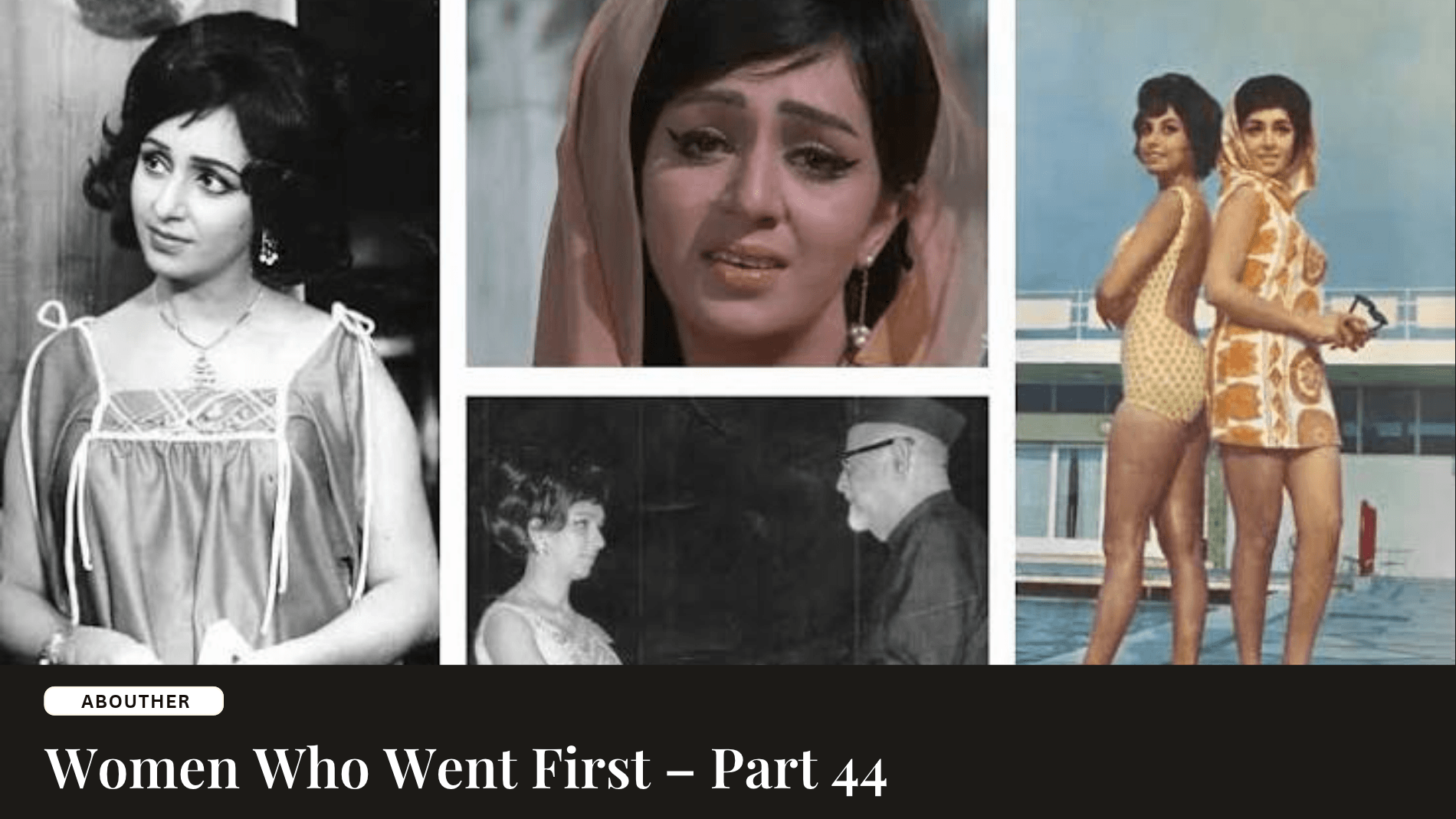
Vimi
1945 – 1977
She arrived on screen and took the breath out of a room. The industry that built her had no idea what to do with her when she stopped being convenient.
1965
YEAR WAQT MADE HER A STAR
5
MAJOR FILMS IN HER PEAK YEARS
32
AGE WHEN SHE EFFECTIVELY DISAPPEARED
38
AGE AT DEATH, 1977
THE ARRIVAL
Her real name was Vijaya. She was born in 1945 in a Punjabi family, and she came to Bombay the way many young women came in those years, with a face that stopped people and very little else. Sunil Dutt saw her and cast her. That is essentially the whole of her origin story, which tells you something about how the industry worked and how much it asked women to bring to a transaction in which they had almost no leverage.
She was given the screen name Vimi, one of those single-word identities that Bollywood assigned to women it wanted to present as a kind of product: Waheeda, Sadhana, Nanda, Asha. The name was designed to fit on a poster and lodge in a memory. It worked.
“She had the particular quality that the camera rewards and that no training produces: she was completely, unguardedly herself on screen.”
WAQT
THE FILM THAT MADE HER · WAQT, 1965 · DIRECTOR: YASH CHOPRA
Waqt was one of the defining films of the decade. It had an ensemble cast that included Sunil Dutt, Raaj Kumar, Balraj Sahni, Shashi Kapoor, and Sadhana. In that company, Vimi held the screen. She played Meena, the glamorous, slightly dangerous romantic lead, and she brought to the role something that the film did not strictly require but that made it memorable: a quality of genuine feeling beneath the surface confidence.
The film was a commercial and critical triumph. It ran for months. Vimi was discussed in the press as the next significant female star. She had a contract with Sunil Dutt’s production house. She had offers. She had, for a moment, everything the industry could give a woman in 1965.
She followed Waqt with Hamraaz (1967), Aadmi (1968), and a handful of other films that kept her visible through the late 1960s. She was not a minor talent who got lucky once. She was a genuine screen presence who deserved a longer run than she got.
THE UNRAVELING
WHAT THE INDUSTRY DID NOT TALK ABOUT
By the early 1970s, Vimi was no longer being cast. The official version, to the extent there was one, was that she had become difficult. The word used in the industry was alcoholism, and the alcoholism was real. What was not discussed was what preceded it, what accompanied it, or what the industry itself contributed to it.
She had been discovered at twenty, turned into a product, made famous on someone else’s terms, and then discarded when the terms changed. She had no union, no legal protection, no mental health support, no financial independence that was not contingent on continued employment. When the work stopped, the money stopped. When the money stopped, the support structures, such as they were, dissolved.
She spent her last years largely out of public sight. The industry that had made her a household name did not organise a benefit, did not make public statements, did not, as far as the record shows, do anything in particular. She died in 1977, at thirty-eight. The cause was liver failure. She was largely forgotten within a year.
In 1977, she published The World of Homosexuals, one of the first studies of homosexuality in India, written at a time when the subject was almost entirely taboo. She interviewed gay men and their families, examined the law, and argued plainly for decriminalisation and acceptance. She was ahead of Indian public discourse on this by decades. The book was largely ignored at the time. It has since been recognised as a landmark.
She ran for political office twice, standing as an independent candidate in the 1980 general elections from Mumbai South and Medak. She lost both seats, including Medak to Indira Gandhi. She was not embarrassed. She had something to say and she said it in every arena available to her.
The arc of Vimi’s life is not unusual in the history of Bollywood. What is unusual is how completely it happened, how fast the fall was, and how little trace it left. Women who had been on the covers of Filmfare and Stardust, whose names had been in the mouths of millions, could vanish so entirely that a generation later there would be no Wikipedia entry with reliable dates, no archive of interviews, no collected footage. The industry had no infrastructure for memory that was not commercially useful.
Also Read: The Women Who Went First – Part 43
What we have are the films. In Waqt, in Hamraaz, the evidence is there: a young woman with a quality of presence that the camera loved and that she seemed entirely unaware of. She was not performing stardom. She was simply being herself, which is the hardest thing to do and the thing that lasts longest on film.
“The industry had no infrastructure for memory that was not commercially useful. She vanished while she was still alive, and finished vanishing when she died.”
CROSS-SERIES CONNECTION · ISSUE 35
Read alongside Leela Naidu (Issue 35), and the same outline appears twice: a woman of extraordinary beauty and genuine talent, discovered and elevated by the film world, then set aside when the industry found someone newer or when the woman’s own terms became inconvenient. Leela Naidu had Merchant Ivory and a second chapter. Vimi had neither. The difference was not talent. It was who was in the room, and what they were willing to do.
WHY SHE BELONGS IN THIS SERIES
Vimi belongs here not because she triumphed but because she mattered, and because the way she was treated tells us something specific about what the film industry asked of women in those years and what it gave them in return. She went first in the sense that she was one of the earliest and clearest examples of a pattern that would repeat itself through Bollywood’s history: a young woman with real gifts, made into a commodity, used for as long as she was useful, and then released without ceremony into whatever came after. She went first, and the industry learned nothing from it, and the same thing happened again and again. Remembering her is one small part of the reckoning that the industry still owes.
ISSUE 44 • PAST PORTRAIT • ABOUTHER MAGAZINE
THE WOMEN WHO WENT FIRST
Share This On Social
About the Author: Sangeeta Relan

Related Posts




I’m Sangeeta Relan—an educator, writer, podcaster, researcher, and the founder of AboutHer. With over 30 years of experience teaching at the university level, I’ve also journeyed through life as a corporate wife, a mother, and now, a storyteller.