The Women Who Went First – Part 7
ABOUTHER • THE WOMEN WHO WENT FIRST • FROM THE PAST
THE WOMEN WHO WENT FIRST • PORTRAIT NO. 07
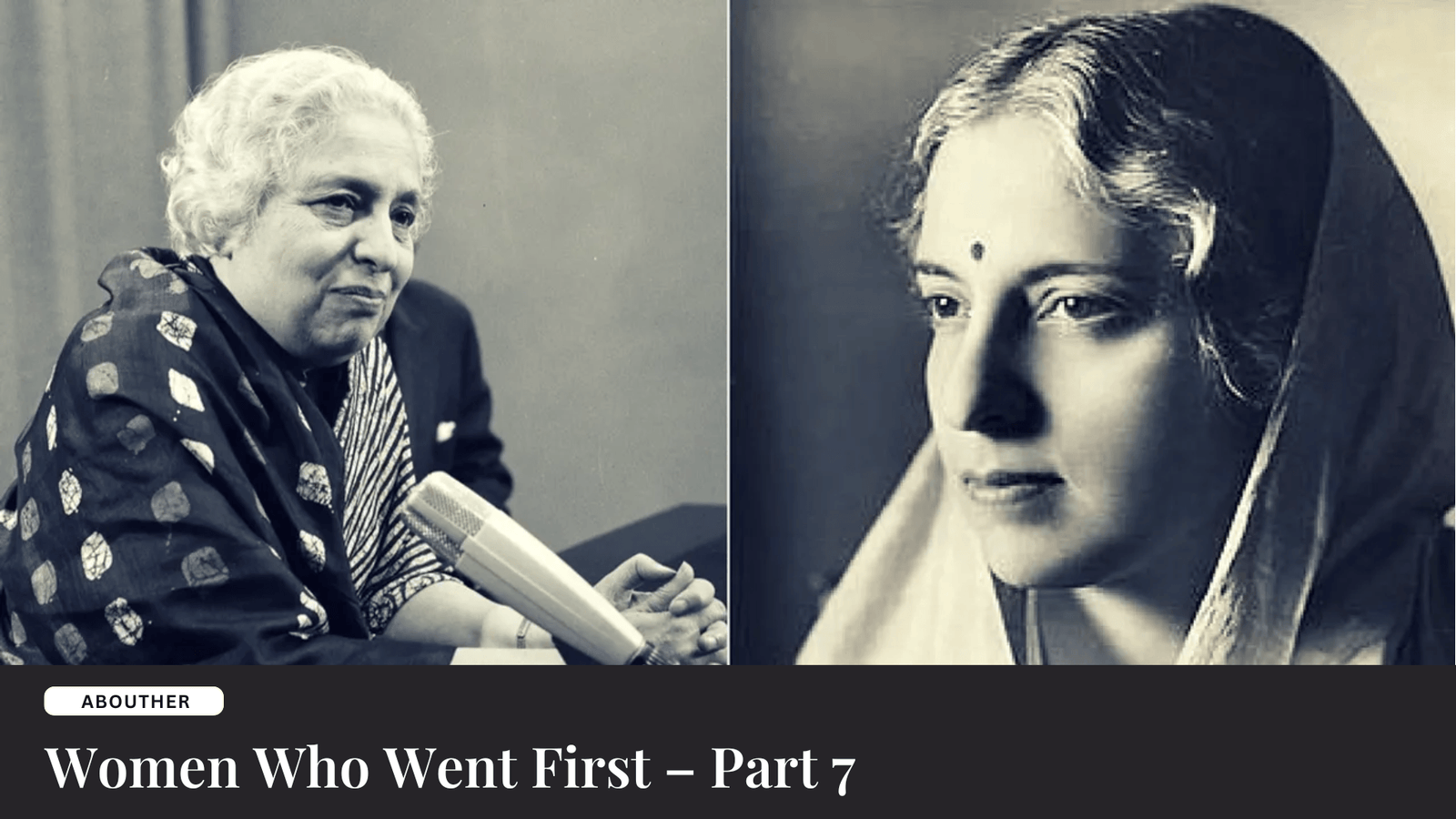
Vijaya Lakshmi Pandit
While the world was still debating whether women belonged in politics, she was already running the room — and then the entire United Nations General Assembly.
In 1953, a woman from Allahabad became President of the United Nations General Assembly. She was the first woman ever to hold that position. Her name was Vijaya Lakshmi Pandit, and by the time she took that chair in New York, she had already served as a cabinet minister in British India, survived three imprisonments for her role in the independence movement, represented India as ambassador to three of the world’s most powerful nations simultaneously, and raised three daughters largely alone after the early death of her husband. She was fifty-three years old. She considered it, by her own account, still early days.
THE NEHRU SHADOW — AND BEYOND IT
She was born Swarup Kumari Nehru in 1900, sister to Jawaharlal Nehru, daughter of Motilal Nehru — one of the most prominent families in the independence movement. It would have been easy, and perhaps forgivable, to spend a life in that shadow. She did not. She married Ranjit Sitaram Pandit in 1921, took his name, and began building an identity entirely her own — as a politician, a diplomat, and a public intellectual who could hold a room in Delhi, Moscow, Washington, and London with equal ease.
The Nehru connection opened doors, undoubtedly. But the rooms she walked into were not ones that welcomed women, regardless of their surnames. What she did once inside those rooms was hers alone.
“The more we sweat in peace, the less we bleed in war.”
VIJAYA LAKSHMI PANDIT
IMPRISONED, REPEATEDLY, UNDETERRED
She joined the Indian National Congress and threw herself into the independence movement with a commitment that was personal, not merely political. She was arrested three times by British authorities — in 1932, 1940, and 1942 — spending months in prison each time. Her husband died in 1944, partly, it is believed, as a result of the privations of imprisonment. She was widowed at forty-four with three young daughters and no private income.
She did not retreat. Within a year she was back on the public stage, more determined than before. The losses, it seems, only clarified what she was fighting for.
A LIFE OF FIRSTS — TIMELINE
1936 Elected to the United Provinces Legislative Assembly — among the first women in India to hold elected office
1937 Appointed Minister of Local Self-Government and Public Health — the first woman cabinet minister in Indian history
1946 Led India’s delegation to the United Nations — the first Indian woman to do so
1947 Appointed Ambassador to the Soviet Union — India’s first ambassador to Moscow
1949 Appointed Ambassador to the United States and simultaneously to Mexico
1953 Elected President of the United Nations General Assembly — the first woman in history to hold the position
1962 Elected to the Indian Parliament, later serving as Governor of Maharashtra
THE DIPLOMAT’S ART
What made Vijaya Lakshmi Pandit exceptional as a diplomat was not merely her intellect — though she was formidably intelligent — but her instinct for the human dimension of geopolitics. She understood that nations, like people, respond to being seen and respected. During the years of the Cold War, when India was navigating a careful path of non-alignment between the American and Soviet blocs, she was one of the key architects of that posture — charming Washington without alienating Moscow, building relationships that kept India’s options open when every other nation was being forced to choose sides.
She was also an advocate for racial equality at a time when it was not a comfortable thing to raise in international forums. At the United Nations she pushed consistently on the question of South African apartheid and on the rights of Indian communities in Africa — connecting India’s own recent experience of colonial subjugation to the broader global struggle for human dignity.
FIRST IN EVERY ROOM SHE ENTERED
First woman cabinet minister in Indian history. First Indian woman to lead a UN delegation. First woman President of the United Nations General Assembly. At every stage of her career, Vijaya Lakshmi Pandit walked into rooms that had never held a woman before — and conducted herself with such authority that the question of whether she belonged there was never seriously raised twice.
A COMPLICATED LEGACY
Her later years were marked by a painful public falling out with her niece, Indira Gandhi, whose authoritarian tendencies during the Emergency of 1975 Vijaya Lakshmi Pandit opposed openly and at personal cost. It was a remarkable moment — an elderly woman, in her mid-seventies, choosing democratic principle over family loyalty at a time when very few people in India dared to criticise the Prime Minister at all.
She died in 1990 at ninety years old, having lived long enough to see India move through independence, emergency, and return to democracy. She was, by any measure, one of the great political lives of the twentieth century.
WHY SHE BELONGS IN THIS SERIES
The Women Who Went First is about women who did not wait for permission. Vijaya Lakshmi Pandit operated in arenas — colonial legislatures, Cold War diplomacy, the United Nations — where the permission structure was entirely designed by and for men. She did not dismantle that structure. She walked through it, performed so visibly and so well that the question of women’s presence in those spaces became, in her wake, harder to argue against.
That is a particular kind of first. Not the loudest, not the most radical, but perhaps the most durable. She changed what was imaginable — and that, in the end, is the work that lasts.
“She changed what was imaginable. And that, in the end, is the work that lasts.”
THE WOMEN WHO WENT FIRST · ABOUTHER MAGAZINE
Share This On Social
About the Author: Sangeeta Relan

Related Posts


I’m Sangeeta Relan—an educator, writer, podcaster, researcher, and the founder of AboutHer. With over 30 years of experience teaching at the university level, I’ve also journeyed through life as a corporate wife, a mother, and now, a storyteller.