The Women Who Went First – Part 30
AboutHer
STORIES. WOMEN. NOW.
THE WOMEN WHO WENT FIRST ✦ CONTEMPORARY
PORTRAIT · ISSUE NO. 30
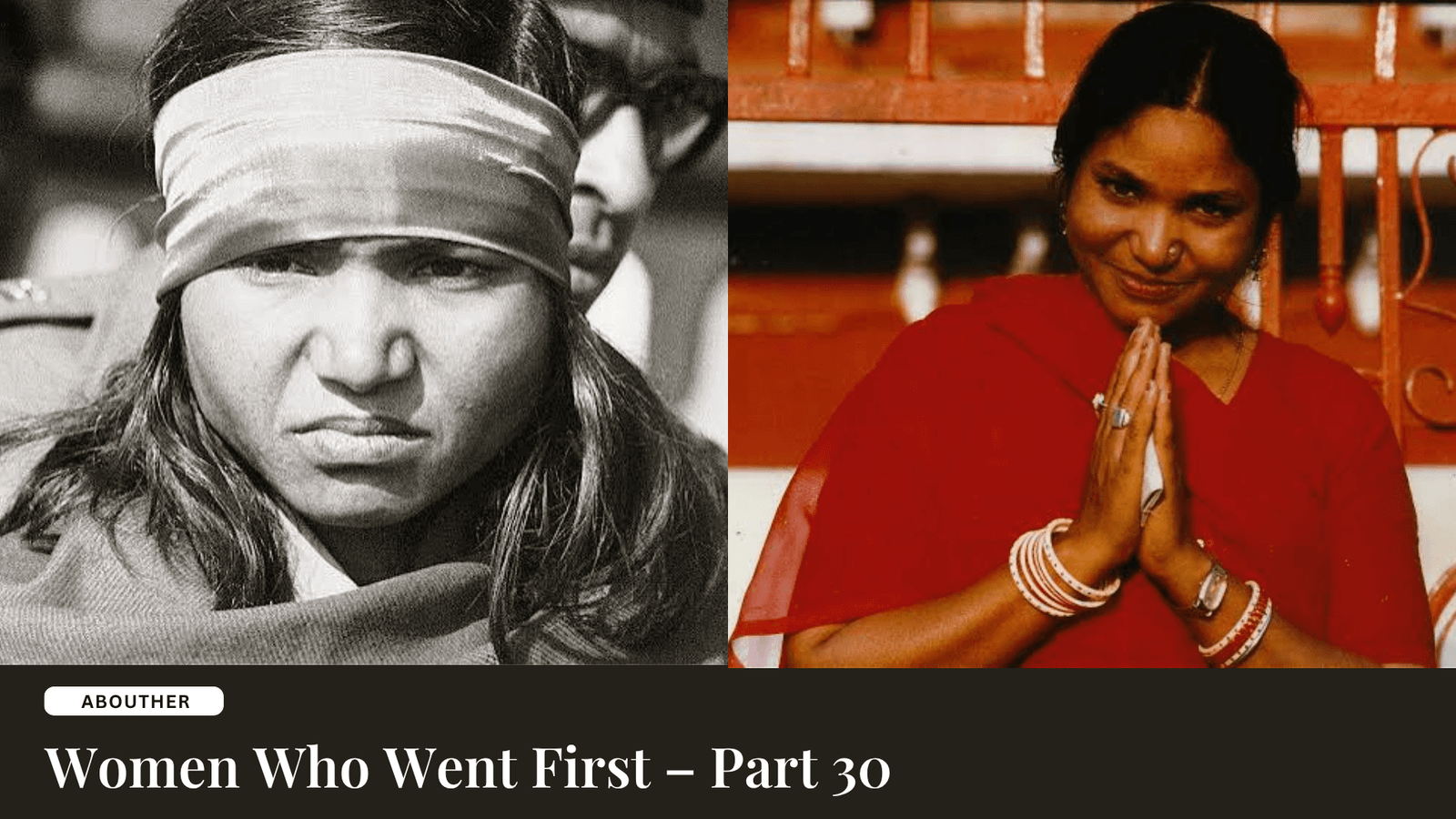
Phoolan
Devi
Devi
The system gave her nothing: not safety, not justice, not dignity. She took what it would not give her. Then she won a seat in Parliament and sat in the same building where the laws that had failed her were made. That is a kind of first this series has not seen before.
This is not a comfortable portrait. Phoolan Devi’s life does not fit neatly into the category of inspiring woman overcomes adversity. It fits into a harder category: what happens to a person when every institution that should have protected her fails, and what that person decides to do about it. She was a dacoit who led a gang. She was responsible for killings. She was also a child bride, a rape survivor, a prisoner held for eleven years without trial, and a Member of Parliament elected by people who saw in her something that the formal political system had never offered them: proof that someone like them could fight back and survive. All of these things are true simultaneously. This series holds them all.
WHERE SHE CAME FROM
UTTAR PRADESH, 1963
Phoolan Devi was born in 1963 in Ghura Ka Purwa, a small village in Uttar Pradesh, into the Mallah caste, a low-caste community of fishermen and boatmen who occupied the lowest rungs of the rural social order. Caste was not an abstraction in the world she was born into. It was the daily, material reality of who could do what to whom and with what consequences. She was married at eleven to a man three times her age who abused her. She was expelled from her husband’s village and returned to her own family, only to be expelled from there too after she objected to a cousin’s attempt to claim family land. She was arrested on a false charge, held in custody, and subjected to abuse by police. By the time she was in her mid-teens, the state, the family, and the community had all demonstrated clearly and repeatedly that they had no intention of protecting her. She drew the appropriate conclusions.
THE DACOIT YEARS
Phoolan Devi was abducted by a gang of dacoits in 1979. Within the gang she was again subjected to violence, this time by its upper-caste Thakur leader Babu Gujjar, who was killed by another gang member, Vikram Mallah, who became her protector and eventually her partner. Under Vikram Mallah’s influence she learned to use weapons, to ride horses, and to conduct herself as an outlaw with authority. When Vikram Mallah was killed by upper-caste rivals in 1980, she was handed over to the Thakur gang, taken to the village of Behmai, and gang-raped over several weeks by members of the gang.
What happened after Behmai is what made Phoolan Devi a legend. She escaped, formed her own gang, and on 14 February 1981 returned to Behmai.
BEHMAI
BEHMAI, 14 FEBRUARY 1981
On Valentine’s Day 1981, Phoolan Devi led her gang into the village of Behmai, rounded up the men, and ordered the shooting of those she held responsible for what had been done to her. Twenty-two men died. The massacre was the single largest dacoit killing in the history of Uttar Pradesh and it made Phoolan Devi the most wanted criminal in India overnight. The government deployed thousands of police to find her. She evaded them for two years, moving through the ravines of the Chambal valley, her legend growing with every failed attempt to capture her. When she eventually surrendered in 1983, she did so on her own terms: to the Chief Ministers of Madhya Pradesh and Uttar Pradesh, in a ceremony attended by thousands of people from her caste community who treated her surrender as a kind of triumph. She laid down her weapons before a photograph of the goddess Durga.
ELEVEN YEARS WITHOUT TRIAL
Phoolan Devi surrendered in 1983 on the understanding that she would face trial. She was held in prison for eleven years without one. The charges against her were numerous and the legal process was, by any honest account, used as a mechanism to keep her confined rather than to deliver justice in any direction. She was finally released in 1994 when the Samajwadi Party government in Uttar Pradesh, recognising her political significance, dropped the charges.
Eleven years in prison without trial is not a footnote to her story. It is one of its central facts. The same state that had failed to protect her from the violence done to her, that had held her in custody and subjected her to abuse as a teenager, now held her for over a decade without the legal process it was obligated to provide. Her imprisonment was, in this sense, entirely consistent with everything the system had done to her before.
11
YEARS HELD IN PRISON WITHOUT TRIAL, 1983 TO 1994
1996
YEAR SHE WAS ELECTED TO PARLIAMENT FROM MIRZAPUR
37
HER AGE WHEN SHE WAS ASSASSINATED IN 2001
THE MEMBER OF PARLIAMENT
MIRZAPUR, 1996
In 1996, two years after her release from prison, Phoolan Devi stood for election to the Lok Sabha from Mirzapur on a Samajwadi Party ticket. She won. She won again in 1999. The people who voted for her were overwhelmingly from lower-caste communities who saw in her not a criminal but a symbol: proof that someone from their background could fight the upper-caste power structure and not only survive but reach the highest legislative body in the country. She sat in Parliament. She spoke about the rights of lower-caste women. She was articulate, determined, and completely aware of what her presence in that building represented. The same woman who had been expelled from her village at eleven for objecting to a land grab was now making laws in New Delhi. The arc of that journey is one of the most extraordinary in modern Indian political history.
“I am not a dacoit. I am a daughter of this country who was given no choice but to fight for herself because no one else would.”
PHOOLAN DEVI
Also Read: The Women Who Went First – Part 29
THE ASSASSINATION
On 25 July 2001, Phoolan Devi was shot and killed outside her home in New Delhi by a masked gunman. She was thirty-seven years old. The man subsequently convicted of organising her killing was Sher Singh Rana, a Thakur who stated publicly that he had acted in revenge for the Behmai massacre. The cycle of caste violence that had shaped every chapter of her life claimed the last one.
She was buried in Delhi. Thousands attended her funeral. The grief was real and it was political, because in her the people who mourned her had lost the most visible evidence that the system could be survived and challenged and that its chambers could be entered by someone it had spent a lifetime trying to destroy.
WHAT HER STORY REQUIRES OF US
Phoolan Devi’s story does not permit simple conclusions. She was a victim of sustained violence who became perpetrator of violence. She was a criminal who became a lawmaker. She was a low-caste woman who used the only instruments available to her and then, when more instruments became available, used those too. The Behmai massacre cannot be erased from her story and this series does not attempt to erase it. Twenty-two men died. That is a fact that belongs in this portrait alongside every other fact.
What the series asks is not that we celebrate everything she did but that we understand the conditions that produced it. A girl married at eleven. A woman gang-raped and left with no legal recourse. A prisoner held for a decade without trial. At each stage, the system that should have protected her instead compounded the harm done to her. Behmai was not the first time violence was used against Phoolan Devi. It was the first time she used it back. The moral weight of that distinction is not simple and it should not be made simple.
WHY SHE BELONGS IN THIS SERIES
The Women Who Went First has told stories of women who went first into institutions, into space, into courtrooms, and into hostile territory. Phoolan Devi went first into territory that none of those categories fully captures: the territory of a woman to whom the state offers nothing, who refuses to accept that offer, and who uses whatever is available to her to survive, to fight back, and eventually to enter the very institution whose laws had failed her and try to change them from inside.
She belongs here because her story is about caste and gender simultaneously, in a way that Indian public life still struggles to hold together. What happened to her happened because she was low-caste and because she was a woman, and neither of those facts can be separated from the other. The violence done to her was caste violence and it was gendered violence and it was both at once, and the response she mounted to it was a response to both at once, which is part of why it resonated so deeply with communities that understood the intersection from the inside.
She belongs here because she won two parliamentary elections. After everything. After the marriage and the abuse and the abduction and Behmai and eleven years without trial. She sat in Parliament. She spoke. She was heard. That is not a redemption arc, because her story does not need redemption. It is a completion arc: a woman who was told at every stage that she had no place in the formal structures of power, who found her way into them anyway, and who used her time there to argue for the people who had sent her.
She is the most complicated portrait in this series. She is also, in her own way, one of the most complete. The series is glad she is in it.
“She was told at every stage that she had no place in the formal structures of power. She found her way into them anyway, and used her time there to argue for the people who had sent her.”
THE WOMEN WHO WENT FIRST · ABOUTHER MAGAZINE
Share This On Social
About the Author: Sangeeta Relan

Related Posts


I’m Sangeeta Relan—an educator, writer, podcaster, researcher, and the founder of AboutHer. With over 30 years of experience teaching at the university level, I’ve also journeyed through life as a corporate wife, a mother, and now, a storyteller.