The Women Who Went First – Part 6
STORIES. WOMEN. NOW.
THE WOMEN WHO WENT FIRST ✦ CONTEMPORARY
PORTRAIT · ISSUE NO. 06
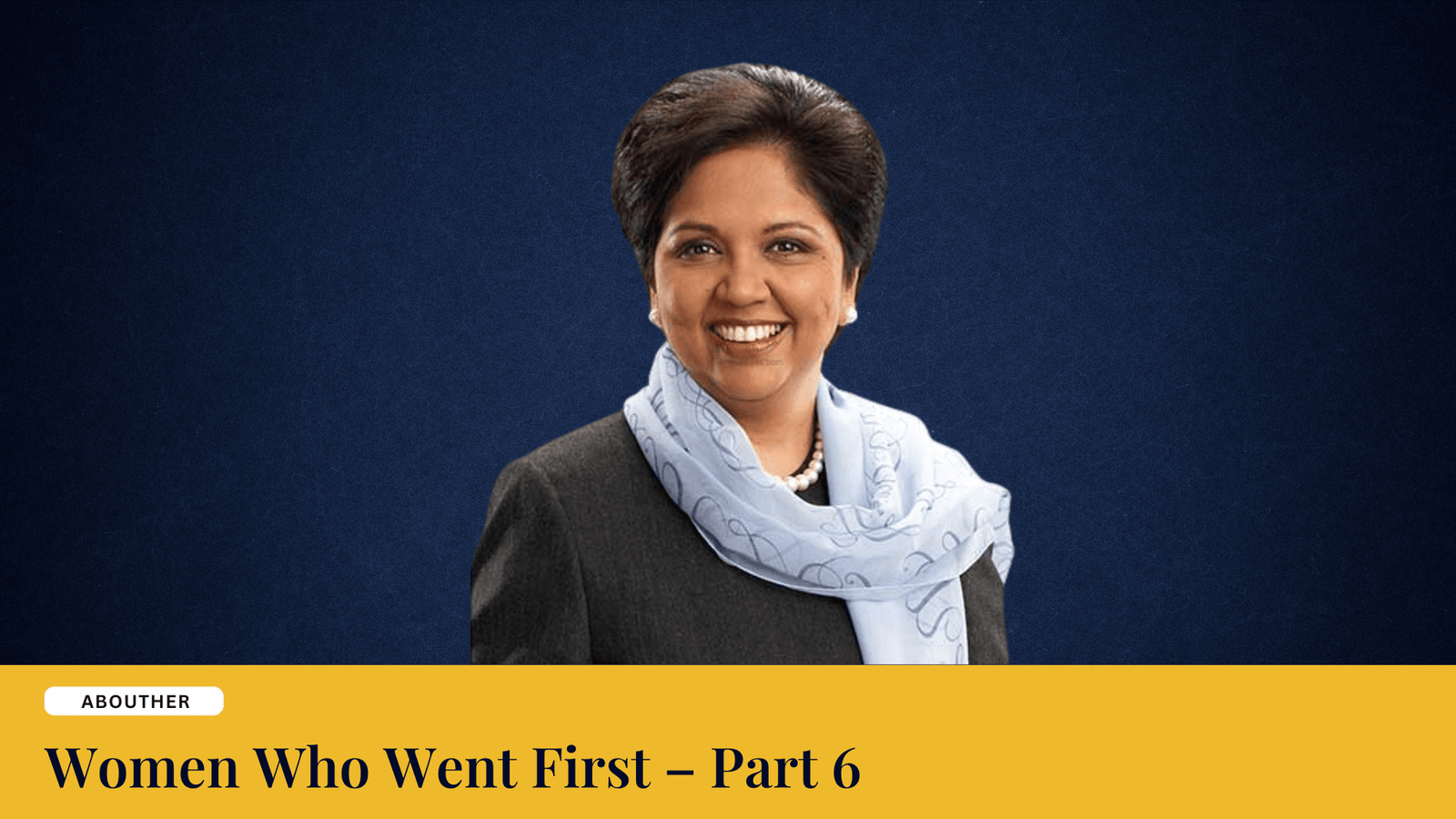
Indra
Nooyi
Nooyi
She ran one of the world’s largest companies for twelve years. The more interesting question is how — and what she carried with her the whole time.
There is a story Indra Nooyi tells about the night she was made President of PepsiCo. She came home late, electric with the news, and her mother stopped her at the door. Go get the milk, her mother said. The store is still open. Nooyi went. The story has become famous because she tells it without bitterness — as an illustration, she says, of the invisible labour women carry even at the peak of their professional lives. It is the kind of story that only someone fully at ease with their own complexity would choose to tell about themselves.
— FROM CHENNAI TO THE CORNER OFFICE
Indra Krishnamurthy grew up in Chennai in a middle-class family where ambition was encouraged but boundaries were clear. She was a good student, a surprising cricket player, and — perhaps most tellingly — the kind of girl who formed a rock band at a time when that was not remotely what girls in Chennai did. She studied at Madras Christian College, then at IIM Calcutta, before making the move that changed everything: a scholarship to Yale’s School of Management in 1978, arriving with, as she has recalled, fifty dollars and a suitcase.
She worked at Johnson & Johnson, then the Boston Consulting Group, then Motorola, before joining PepsiCo in 1994 as Senior Vice President of Strategy. She was made CFO in 2001 and CEO in 2006, becoming one of the first women of colour to lead a Fortune 50 company. The headline was historic. The work that followed was harder and more interesting than any headline.
12
YEARS AS PEPSICO CEO
$63B
REVENUE WHEN SHE LEFT
80%
TOTAL SHAREHOLDER
RETURN UNDER HER TENURE
— LEADING DIFFERENTLY
What distinguished Nooyi’s leadership was not simply that she was a woman running a giant corporation, but the framework she brought to it. She coined the phrase “Performance with Purpose” — a commitment to making PepsiCo’s products healthier, its environmental footprint smaller, and its workforce more equitable, without sacrificing profitability. Critics called it idealistic. She called it inevitable, and spent twelve years proving the point.
She was known for writing personal letters to the parents of her senior executives — thanking them for raising the people who now helped run her company. Unusual for a Fortune 500 CEO. Deliberately so. She understood something about loyalty, about what makes people give their best, that balance sheets alone cannot teach.
“Just because you are CEO, don’t think you have landed. You must continually increase your learning, the way you think, and the way you approach the organisation.”
Indra Nooyi
— THE INDIAN WOMAN IN THE ROOM
Nooyi never set aside her identity to succeed — she carried it with her, conspicuously, into every boardroom. She wore saris to formal occasions at a time when that was not the default choice for a global CEO. She spoke openly about her mother, her upbringing, her faith. In a corporate culture that often rewards assimilation, she chose integration instead — bringing her whole self to work in a way that she has said, frankly, was not always easy and was not always welcomed.
For Indian women watching from afar, this was significant beyond her title. She was not just proof that an Indian woman could reach the top. She was proof that an Indian woman could reach the top without becoming someone else in the process.
Also Read: The Women Who Went First – Part 5
ON BEING A WORKING MOTHER
Nooyi has been remarkably candid about the cost of her career on her family life — and the guilt that never fully went away. In her memoir My Life in Full, she writes with unusual honesty about missing school plays, arriving home after her daughters were asleep, and the quiet grief of realising that some moments simply cannot be recovered. She does not frame this as a failure of ambition or of family. She frames it as a structural problem — one that better parental leave, affordable childcare, and more humane workplace cultures could actually solve. The candour is, in itself, a form of leadership.
— AFTER PEPSICO
She stepped down as CEO in 2018, handing over to Ramon Laguarta. Since then she has served on Amazon’s board, advised governments and institutions on economic policy, and published her memoir — which became a bestseller not because it was a conventional success story, but because it was not. It was honest in ways that business memoirs rarely are, particularly about the trade-offs women make that men in equivalent positions are almost never asked to articulate.
She continues to speak and write about the systemic changes she believes are necessary — in childcare, in corporate culture, in how we define and reward leadership. She has moved from being an example of what one woman can achieve to being an advocate for the conditions that would allow many more women to achieve it. That shift — from symbol to structural thinker — is perhaps the most interesting thing she has done.
WHAT SHE MEANS FOR THIS SERIES
The Women Who Went First is not a series about perfection. It is a series about the particular courage it takes to go somewhere no one who looks like you has gone before — and to do it without a map. Indra Nooyi had no map. She made decisions, made mistakes, made history, and has spent the years since trying to make sure the path is a little clearer for the women behind her.
That, in the end, is what separates a trailblazer from a leader. The trailblazer gets there first. The leader looks back and builds the road.
“She was not just proof that an Indian woman could reach the top. She was proof that she could do it without becoming someone else in the process.”
THE WOMEN WHO WENT FIRST · ABOUTHER MAGAZINE
Share This On Social
About the Author: Sangeeta Relan

Related Posts


I’m Sangeeta Relan—an educator, writer, podcaster, researcher, and the founder of AboutHer. With over 30 years of experience teaching at the university level, I’ve also journeyed through life as a corporate wife, a mother, and now, a storyteller.