The Women Who Went First – Part 33
ISSUE 33 | THE WOMEN WHO WENT FIRST
PAST PORTRAIT
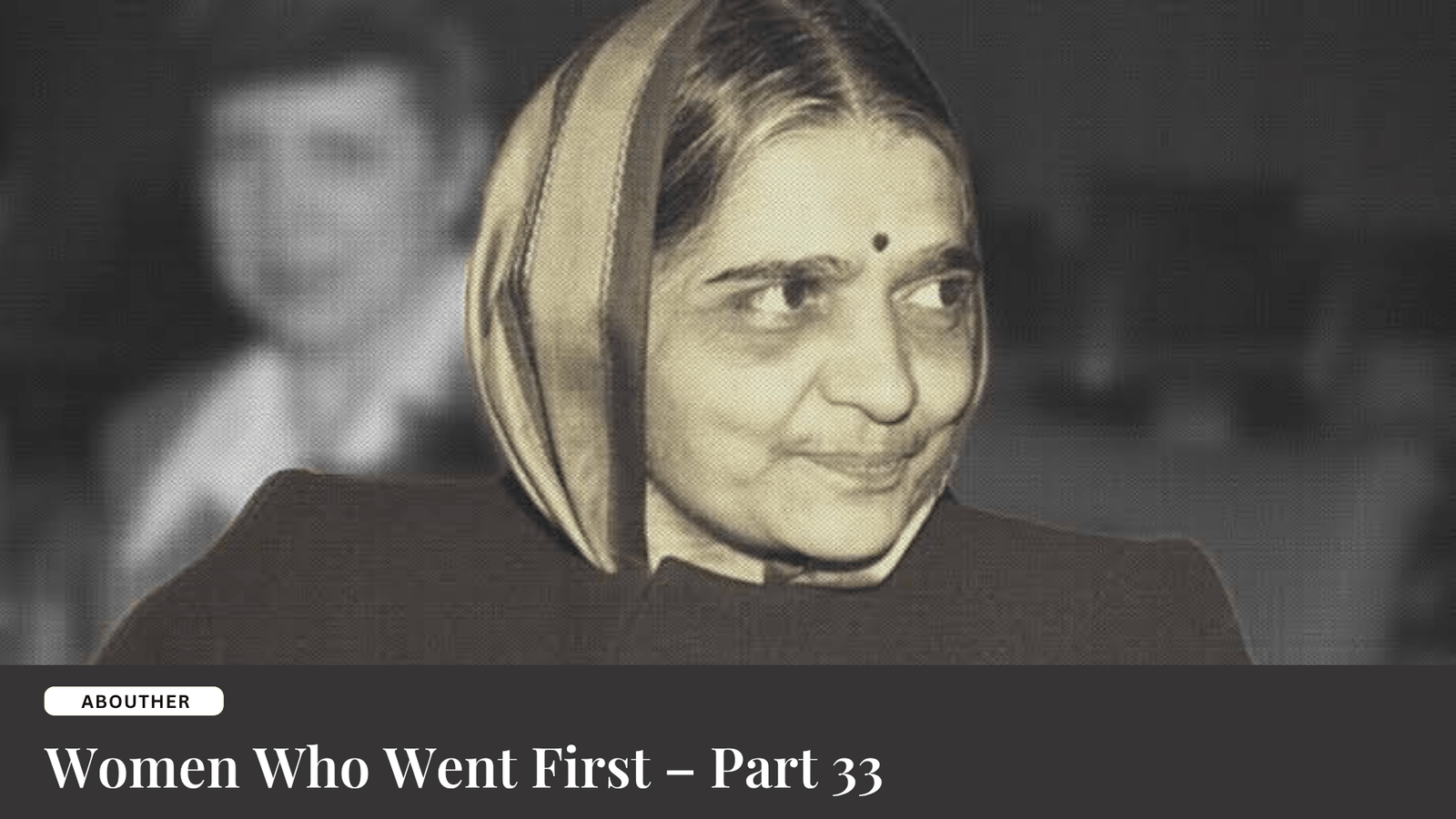
Hansa Mehta
She sat in the United Nations and told the world that the most important human rights document in history had got the first sentence wrong. And she made them change it.
The year is 1947. India has just become independent. Hansa Mehta, one of its first delegates to the United Nations, walks into the drafting sessions for a document that will define the rights of every human being on earth. She reads the opening line: “All men are born free and equal.” She raises her hand and says: that word is wrong. It should say human beings. After considerable debate, the world agreed.
Most people who have heard of the Universal Declaration of Human Rights think Eleanor Roosevelt wrote it. She chaired the drafting committee. But the document you know today, the one that begins “All human beings are born free and equal in dignity and rights” was shaped in a room where Hansa Mehta would not be ignored.
This is a woman who spent decades being told that the law did not quite apply to her, and who spent those same decades proving the law wrong, until she was the one writing it.
Born into Privilege, Trained for Disruption
Hansa Jivraj Mehta was born in 1897 in Surat, into a family of considerable standing. Her grandfather was the Diwan of Baroda. Her father, a noted scholar, believed in educating his daughters. She studied in England and later in Europe, returning to India with the kind of education that made the colonial establishment nervous when it encountered her on the wrong side of the argument.
She joined the Indian independence movement and was arrested multiple times by the British. She was not a sideline figure in the freedom struggle. She organised, marched, edited a Gujarati journal, and wrote about women’s rights at a time when most political organisations treated women’s concerns as secondary to the main project of independence. She refused that framing. For Hansa Mehta, these were not two separate battles.
A LIFE IN FIRSTS
1926 Elected to the Bombay Legislative Council
1945 President of the All India Women’s Conference
1946 Member of the Constituent Assembly of India
1947 Indian delegate to the UN Commission on Human Rights
1947 Proposed the word change in the UDHR that stands today
1949 First woman to chair a national committee in India
1964 Vice-Chancellor of SNDT Women’s University, Mumbai
1959 Founded the cancer institute that became Adyar Cancer Institute
The Room Where the World Was Written
When India joined the United Nations Commission on Human Rights in 1947, Hansa Mehta was the delegate. She arrived at the drafting table for what would become the Universal Declaration of Human Rights with a deep familiarity with how language can exclude. She had lived it.
The phrase “all men are born free and equal” was borrowed from the American and French revolutionary traditions. It was also, she argued, ambiguous at best and exclusionary at worst. In practice, across centuries of legal interpretation, “men” had been used to mean men. She was not being pedantic. She was being precise.
Also Read: The Women Who Went First – Part 32
She did not ask the world to add women to the Declaration. She asked the world to admit that women had always been there, and that the language had simply failed to say so.
ON HANSA MEHTA’S ARGUMENT AT THE UN, 1947
Her proposed revision was adopted. Article 1 of the Universal Declaration of Human Rights, ratified on 10 December 1948, reads: “All human beings are born free and equal in dignity and rights.” Those two words have been the legal and moral foundation for every gender equality argument made in international law since. They are there because Hansa Mehta put them there.
The Constituent Assembly
While she was doing this work at the UN, she was also one of fifteen women members of the Constituent Assembly of India, the body drafting the Indian Constitution. She argued for equal rights for women to be explicitly guaranteed in the Constitution, not assumed. She argued against child marriage. She advocated for the Hindu Code Bill that would eventually give Hindu women inheritance rights, divorce rights, and protections they had never had under personal law.
These arguments were not always popular. Several male colleagues in the Assembly believed that social reform should follow independence, not accompany it. Hansa Mehta’s position was the reverse: you cannot declare a republic of equals and then leave half the population to wait.
WHAT SHE UNDERSTOOD THAT OTHERS DID NOT
The founding generation of independent India contained brilliant men who believed in women’s rights in principle while assuming, in practice, that these could be addressed later. Hansa Mehta understood that constitutions and declarations are not promises for the future. They are the architecture of the present. Every clause left vague, every right not explicitly stated, becomes a gap that courts and governments will fill against you. She had read enough history to know this. She made sure the language was exact.
After the Grand Stages
When the cameras moved on and the founding documents were signed, Hansa Mehta stayed at work. She became Vice-Chancellor of SNDT Women’s University in Mumbai in 1964, one of the country’s oldest universities for women. She fought to have its degrees recognised on equal terms with other universities. She wrote textbooks in Gujarati to make education accessible. She helped establish what would become the Adyar Cancer Institute in Chennai, one of the premier cancer research centres in South Asia.
She also translated literary works into Gujarati, including stories by Rabindranath Tagore. She understood that culture and law both shape what is possible for women, and she worked on both.
1948
YEAR THE UDHR WAS ADOPTED WITH HER AMENDMENT
15
WOMEN IN INDIA’S CONSTITUENT ASSEMBLY OF 299 MEMBERS
193
UN MEMBER STATES NOW BOUND BY HER TWO WORDS
Why You Have Not Heard of Her
Eleanor Roosevelt is remembered as the architect of the UDHR because she chaired the committee. Jawaharlal Nehru is remembered as the voice of independent India because he gave the speeches. Hansa Mehta did not give the speeches. She sat in the rooms and changed the documents.
History tends to remember the voice at the podium and forget the hand that rewrote the text. This is especially true when the hand belongs to a woman.
She died in 1995, at 97, having outlived most of the generation that made the world with her. She had received the Padma Bhushan, India’s third highest civilian honour. It is not enough. But what she left behind is not an honour or an award. It is a sentence. Two words in the most translated document in human history. Sitting there, waiting to be enforced, every time someone needs them.
Cross-Series Connection
In Issue 8 of this series, we profiled Vijaya Lakshmi Pandit, the first woman to chair the United Nations General Assembly. Pandit and Mehta worked in adjacent rooms of the same founding project: the construction of a post-war, post-colonial international order that was supposed to mean something. They had in common a belief that India’s voice at the UN carried a particular obligation, having just broken free of an empire that had made very different promises about rights and equality. Together they represent the Indian women who showed up, in 1947 and 1948, and refused to let the new world be built without them.
Why She Belongs in This Series
The Women Who Went First is about women who entered rooms that were not designed for them and changed what happened inside those rooms. Hansa Mehta did this at the highest possible level. She walked into the drafting of the world’s foundational human rights document and corrected its opening line. She walked into India’s Constituent Assembly and insisted that equality for women be written in, not assumed. She then spent the next four decades doing quieter, harder work: building institutions, writing textbooks, training doctors, translating literature. She did not stop when the historic moments ended.
She is here because every woman who has ever cited the Universal Declaration of Human Rights in an argument about her own rights was citing, without knowing it, the work of Hansa Mehta. The least we can do is learn her name.
ISSUE 33 • PAST PORTRAIT • ABOUTHER MAGAZINE
THE WOMEN WHO WENT FIRST
Share This On Social
About the Author: Sangeeta Relan

Related Posts


I’m Sangeeta Relan—an educator, writer, podcaster, researcher, and the founder of AboutHer. With over 30 years of experience teaching at the university level, I’ve also journeyed through life as a corporate wife, a mother, and now, a storyteller.