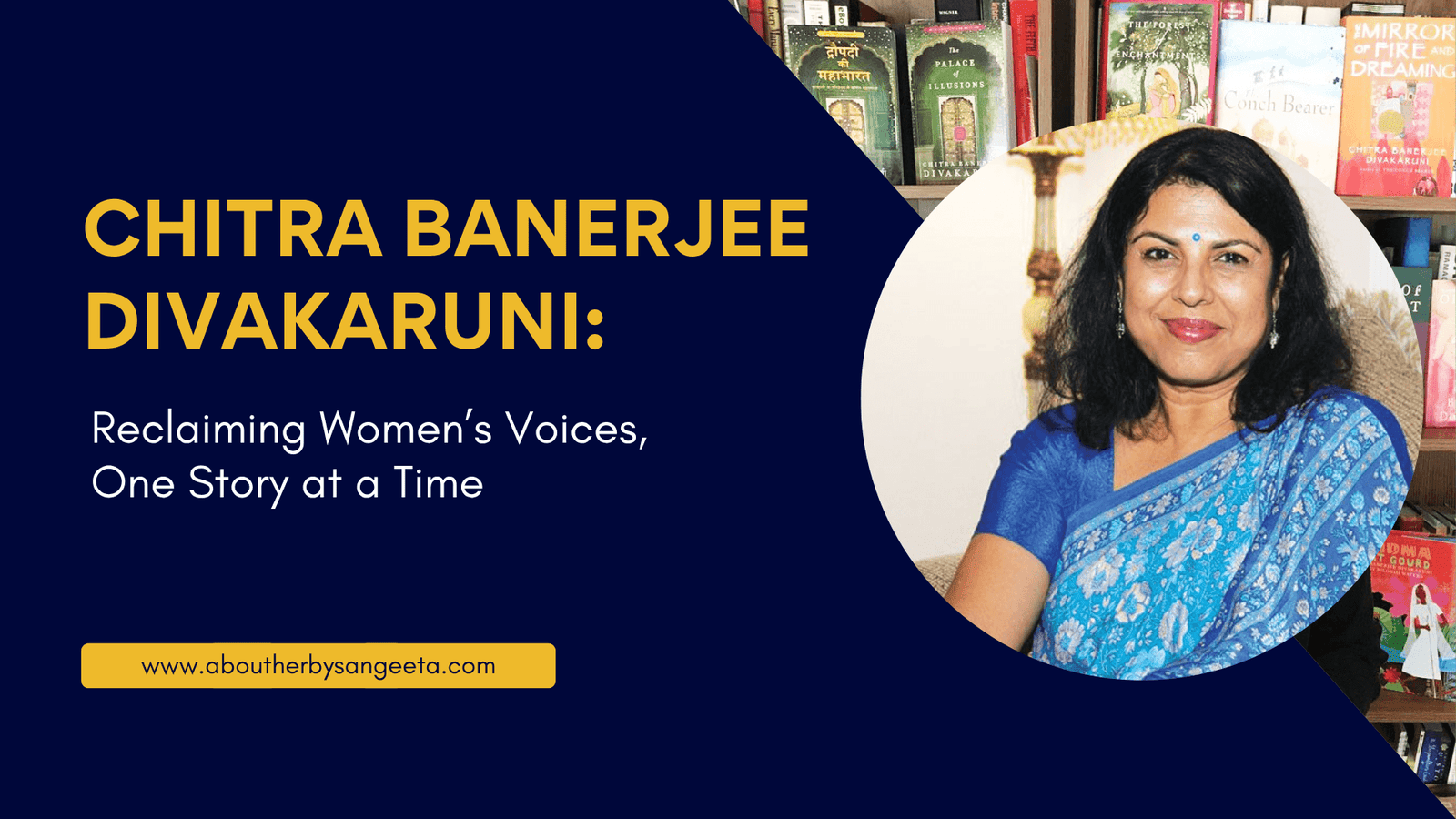
Chitra Banerjee Divakaruni: Reclaiming Women’s Voices, One Story at a Time
There are some writers who do more than tell stories. They reopen old doors, breathe life into forgotten silences, and make us look again at women we thought we already knew.
That is what Chitra Banerjee Divakaruni does.
In this deeply enriching conversation on The AboutHer Show, celebrated author Chitra Banerjee Divakaruni speaks not just about writing, but about memory, identity, mythology, history, and above all, the power of women’s voices. Listening to her is like stepping into a world where stories are not ornamental; they are transformative. They question, heal, empower, and endure.
From The Palace of Illusions to The Forest of Enchantments and The Last Queen, Chitra has consistently returned to women who were present in history, mythology, and memory, but not always fully heard. In her hands, these women do not remain symbols. They become real, thinking, feeling, courageous human beings.
And perhaps that is what makes her work so powerful. She does not simply retell stories. She restores perspective.
When women begin to speak from the centre of the story
One of the most compelling parts of the conversation is Chitra’s reflection on why she chose to retell epics like the Mahabharata and the Ramayana through the voices of women such as Draupadi and Sita.
For generations, many of us have grown up hearing these women described in ways that were convenient to patriarchy: patient, silent, sacrificial, obedient. But Chitra challenges that inherited lens. She reminds us that these characters were never as passive as they were made out to be. They had will, intelligence, endurance, moral clarity, and strength. What changed, over time, was not who they were, but how they were narrated.
That shift is central to her literary project.
By placing women at the centre of the story, Chitra does something quietly radical. She asks: What did these women think? What did they feel? What did they endure? What did they refuse? What did they understand about power, pain, loyalty, exile, and selfhood?
And once those questions are asked, the story itself changes.
A writer shaped by two worlds
Chitra also speaks with nuance about her Indo-American identity and how living away from India sharpened her understanding of it. Distance, she reflects, gave her a new clarity. It allowed her not only to appreciate India more deeply, but also to question what she may once have taken for granted, especially when it came to the position of women.
That dual lens has clearly enriched her writing. Her stories are rooted in Indian culture, history, and mythology, yet they carry a universality that resonates across borders. Whether she is writing about immigrant women in America, women in epics, or historical queens erased from popular memory, her concerns remain strikingly relevant: identity, belonging, power, injustice, resilience, and the search for voice.
The courage to rewrite what we inherit
One of the most memorable insights from the episode is Chitra’s belief that literature can empower women by helping them see courage reflected back at them.
When readers encounter women in fiction who survive, resist, endure, and choose for themselves, something shifts internally. Stories become mirrors. They also become maps.
This is especially true of her interpretation of Sita. In popular culture, Sita is too often reduced to an image of submission. Chitra rejects that flattening. In her reading, Sita is not meek; she is deeply strong. She chooses, she withstands, she raises her children alone, and when pushed too far, she refuses. Hers is not the strength of noise, but of conviction.
That is an important distinction, and one that women continue to need.
The courage to rewrite what we inherit
One of the most memorable insights from the episode is Chitra’s belief that literature can empower women by helping them see courage reflected back at them.
When readers encounter women in fiction who survive, resist, endure, and choose for themselves, something shifts internally. Stories become mirrors. They also become maps.
Also Read: Menaka Raman on Storytelling, Children, and Finding Your Voice Through Words
This is especially true of her interpretation of Sita. In popular culture, Sita is too often reduced to an image of submission. Chitra rejects that flattening. In her reading, Sita is not meek; she is deeply strong. She chooses, she withstands, she raises her children alone, and when pushed too far, she refuses. Hers is not the strength of noise, but of conviction.
That is an important distinction, and one that women continue to need.
Writing as discipline, empathy, and devotion
Another beautiful aspect of the conversation is Chitra’s honesty about the writing life. She does not romanticize it. She speaks of notebooks, routines, listening for a character’s voice, closing the study door, and doing the hard, repeated work of showing up.
She also speaks of self-doubt, of beginning without contacts or confidence, of writing late into the night while teaching full-time, and of continuing despite uncertainty. For aspiring writers, this part of the conversation is especially valuable. It reminds us that even the most accomplished authors begin with faith, persistence, and the willingness to keep going before the world notices.
What stands out is that for Chitra, writing is not just craft. It is empathy in action. To write a character truthfully, she says, one must feel that character from the inside. That principle perhaps explains why her women stay with readers long after the book is over.
Why her work matters so much right now
At a time when conversations around women’s representation are growing louder, Chitra Banerjee Divakaruni’s work feels especially significant. She shows us that representation is not just about inclusion. It is about interpretation. It is about who gets to tell the story, whose inner life is considered worthy of exploration, and whose strength is recognised on its own terms.
Her work reminds us that reclaiming women’s voices is not an act of rebellion for its own sake. It is an act of truth-telling.
And truth, when told well, has the power to unsettle old assumptions and open new possibilities.
Key Takeaways from the Conversation
- Women in mythology were never voiceless, they were simply not always heard.
Chitra’s retellings challenge generations of male-centred storytelling and allow women like Draupadi and Sita to occupy the fullness of their humanity. - Literature has the power to strengthen women from within.
Stories can offer courage, perspective, and the reminder that women across time have faced struggle, injustice, and impossible choices and still found strength. - Distance can deepen understanding.
Living between India and America gave Chitra a layered perspective on culture, identity, and the realities women navigate. - Writing requires both discipline and empathy.
For Chitra, writing begins with deep observation, emotional truth, and the slow process of hearing a character’s voice clearly. - Women do not need to diminish men in order to reclaim their own space.
One of the most powerful threads in the conversation is the idea that elevating women is not the same as putting men down. It is about restoring balance and visibility.
Quotes to Highlight
Here are a few strong pull quotes you can use in the article layout or social creatives:
“You hear about them, but you don’t hear from them.”
“The problems that our epics bring up, the stories they tell, the kinds of characters that populate those worlds, they truly are timeless.”
“Books give us so much strength.”
“For a woman to be respected, it’s not like men need to be disrespected.”
“Read widely, read carefully, read like a writer.”
“I want to write for regular readers because I’m a regular reader.”
Closing Reflection
What makes this episode unforgettable is not just Chitra Banerjee Divakaruni’s literary brilliance, but the clarity and compassion with which she speaks about women, storytelling, and the responsibility of the writer.
Her stories do what the finest literature always does: they help us see more clearly, feel more deeply, and question what we have too easily accepted.
In giving voice to women from myth, history, and lived reality, she also gives something back to the rest of us, language for our own strength.
To listen to this thoughtful and inspiring conversation with Chitra Banerjee Divakaruni, tune in to this episode of The AboutHer Show. Whether you are a reader, a writer, a lover of mythology, or someone interested in how stories can challenge and empower, this is an episode worth experiencing.
Listen now on Spotify, Apple Podcasts, YouTube or Audible.
Share This On Social
About the Author: Sangeeta Relan

Related Posts









I’m Sangeeta Relan—an educator, writer, podcaster, researcher, and the founder of AboutHer. With over 30 years of experience teaching at the university level, I’ve also journeyed through life as a corporate wife, a mother, and now, a storyteller.