
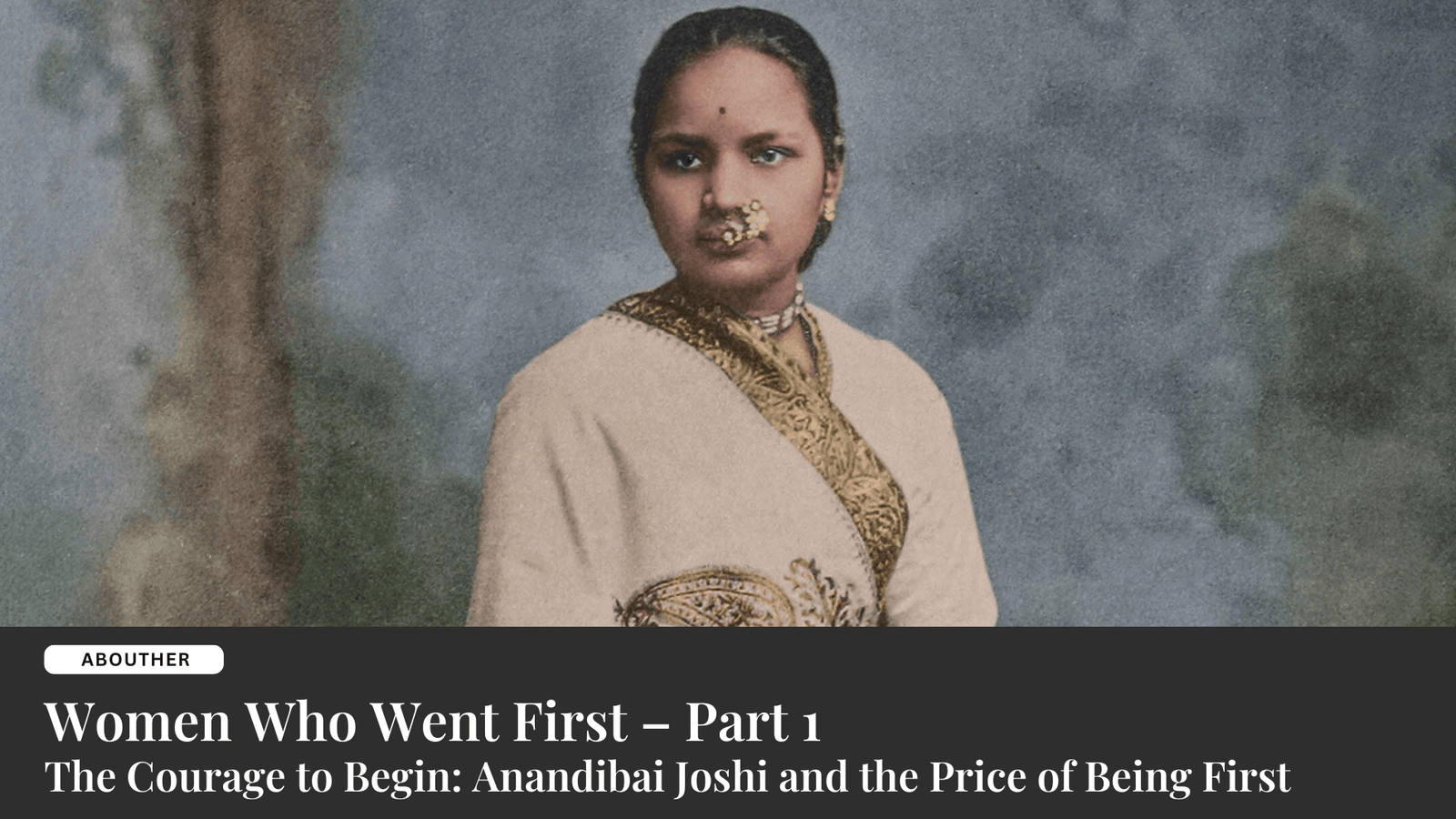
Women Who Went First – Part 1
The Courage to Begin: Anandibai Joshi and the Price of Being First
History remembers the firsts.
But it does not always remember what it cost them to be first.
Today, when we see young women travelling abroad for education, entering medical schools, or building professional careers, it feels almost natural. But every “normal” that we take for granted today began with someone who dared to do something that was once considered impossible.
More than a century ago, one young Indian woman did exactly that.
Her name was Anandibai Joshi.
Born in 1865 in Maharashtra, Anandibai lived in a time when educating girls was still widely questioned. Like many girls of her time, she was married very young, at the age of nine. Her husband, Gopalrao Joshi, was progressive for his time and believed strongly in women’s education. While this support played an important role in her journey, what truly shaped her destiny was a deeply personal tragedy.
At the age of fourteen, Anandibai gave birth to a child who did not survive. The reason was painfully simple, there was no female doctor available to treat her. At a time when social customs often prevented women from seeking treatment from male doctors, the lack of women in medicine was not just an educational gap; it was a matter of life and death.
This loss became the turning point of her life.
Also Read: Princess Indira Devi Kaur of Kapurthala
Instead of accepting her circumstances, Anandibai made an extraordinary decision. She decided she would become a doctor so that other women would not suffer the way she had.
Today, such a decision might sound like ambition. In the 1880s, it sounded like defiance.
When she expressed her desire to study medicine abroad, society reacted strongly. Crossing the seas was considered socially unacceptable. Women who travelled abroad were often judged harshly and seen as abandoning tradition. She faced criticism, social pressure, and even ridicule. People questioned not just her decision but her character.
Yet she did not step back.
At the age of eighteen, Anandibai travelled to the United States to study at the Woman’s Medical College of Pennsylvania. This journey alone required immense courage. Imagine a young Indian woman travelling alone across continents in the nineteenth century, entering a completely unfamiliar culture, and carrying the weight of expectations from a society that was watching her closely, many hoping she would fail.
At the same time, she was battling poor health.
Despite these challenges, she persevered. In 1886, she graduated with a degree in medicine, becoming one of the first Indian women trained in Western medicine. Her achievement was widely acknowledged, both in India and abroad. It is said that even Queen Victoria took note of her accomplishment.
But perhaps what makes her story truly powerful is not just what she achieved, but what she intended to do with that achievement.
She did not pursue medicine for prestige or recognition. Her goal was simple and deeply humane, she wanted to serve women who had no access to proper healthcare.
Unfortunately, her fragile health, worsened by tuberculosis, did not allow her to live long enough to fulfil this vision. She passed away at the age of just twenty-one.
Twenty-one.
At an age when most people are still trying to find direction, she had already altered the course of history.
Her story forces us to ask an important question: what makes someone a pioneer?
Often, it is not the desire for recognition. It is the inability to ignore a problem. It is the courage to act when action is uncomfortable. It is the willingness to walk alone when no path exists.
Anandibai did not set out to become a symbol. She simply responded to a need she had experienced personally. But in doing so, she changed what Indian women could imagine for themselves.
Today, thousands of women graduate from medical colleges across India every year. Women lead hospitals, research laboratories, and healthcare institutions. But every such achievement stands on foundations built by women like Anandibai, women who chose courage over comfort.
Also Read: Main Tenu Phir Milangi – Remembering Amrita Pritam
Perhaps that is what being first really means.
It means accepting that the journey may be lonely.
It means facing resistance without certainty of success.
It means understanding that recognition may come much later, or sometimes not at all.
But it also means expanding what becomes possible.
At AboutHer, as we tell stories of women who lead, create, and inspire today, it is important to also remember the quiet pioneers whose courage reshaped the future long before recognition came their way.
Because progress is rarely sudden. It is built step by step, often by individuals whose names do not always appear in headlines, but whose actions change the direction of society.
Anandibai Joshi was one such woman.
She did not just become a doctor.
She made it possible for many others to become one.
AboutHer Reflection
Being first is rarely comfortable. It often means questioning norms, facing doubt, and stepping into the unknown. But every woman who chooses to go first makes the journey a little easier for those who follow.
And perhaps that is the true legacy of pioneers like Anandibai Joshi, not just what they achieved, but what they made possible.
Share This On Social
About the Author: Sangeeta Relan

Related Posts


I’m Sangeeta Relan—an educator, writer, podcaster, researcher, and the founder of AboutHer. With over 30 years of experience teaching at the university level, I’ve also journeyed through life as a corporate wife, a mother, and now, a storyteller.