
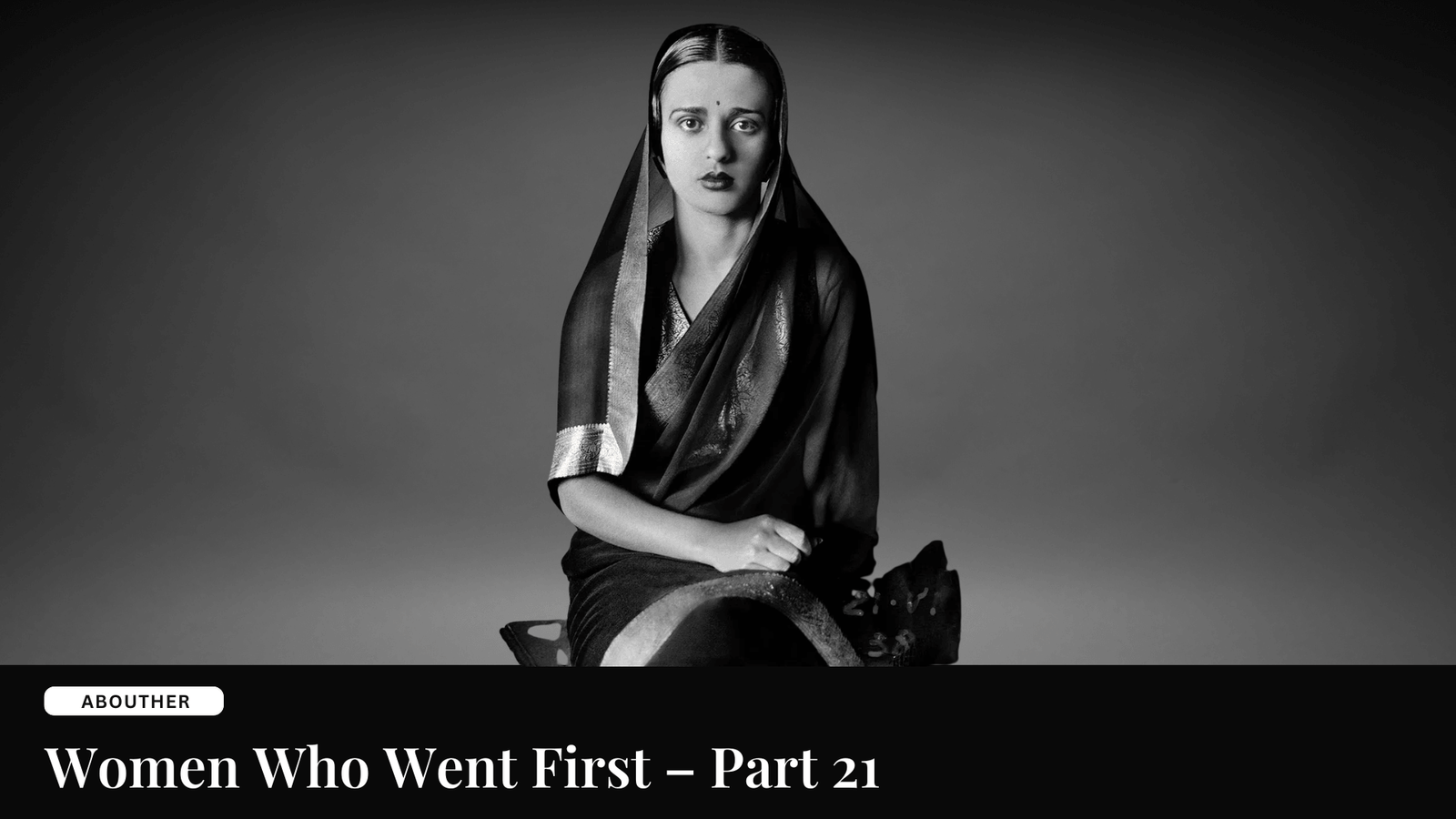
The Women Who Went First – Part 21
AboutHer
STORIES. WOMEN. NOW.
THE WOMEN WHO WENT FIRST ✦ FROM THE PAST
PORTRAIT · ISSUE NO. 21
Amrita
Sher-Gil
Sher-Gil
She had twenty-eight years and fewer than two hundred paintings. She used them to change what Indian art could see, what it could say, and who it could be about. Nothing that came after her was unaffected by what she did.
Amrita Sher-Gil died in Lahore on 5 December 1941, the day before her first solo exhibition in the city was due to open. She was twenty-eight years old. The cause of death has never been definitively established. What she left behind was fewer than two hundred paintings, all of which the Government of India has since declared national treasures, none of which may be taken out of the country. She had been painting seriously for barely a decade. In that decade she had studied in Paris, exhibited at the Grand Salon, returned to India convinced that her true subject was here rather than there, and produced a body of work that placed Indian women, Indian villages, and Indian experience at the centre of the canvas with a seriousness and a tenderness and an unflinching honesty that Indian painting had not attempted in that way before. She did all of this before she was thirty. She is among the most important painters India has produced, and she is almost certainly the most important it has lost so young.
BETWEEN TWO WORLDS
Amrita Sher-Gil was born in Budapest in 1913 to Umrao Singh Sher-Gil, a Punjabi Sikh aristocrat and scholar, and Marie Antoinette Gottesmann, a Hungarian opera singer. She grew up between cultures, spending her early childhood in Hungary and arriving in India at the age of eight. The dual inheritance was not a source of confusion for her but a source of vocabulary: she drew from European modernism and Indian classical traditions simultaneously, not as an act of synthesis but as a natural expression of who she actually was.
She showed exceptional ability from childhood and was sent to study art in Florence at eleven, then in Paris at sixteen, where she enrolled at the École des Beaux-Arts. She was one of the youngest students and one of the few women to be admitted. She studied under Lucien Simon and absorbed the influence of Cézanne, Gauguin, and the Post-Impressionists with the appetite of someone who understood that she was building a toolkit rather than finding a style to imitate.
PARIS AND THE PAINTING THAT CHANGED EVERYTHING
PARIS, 1932: YOUNG GIRLS
In 1932, at nineteen, Sher-Gil painted Young Girls, a large canvas depicting two young women in a moment of quiet intimacy that was both technically accomplished and emotionally complex in ways that stopped people in front of it. The painting was accepted by the Grand Salon in Paris, making her the first Asian artist and one of the youngest ever to have a work selected for the exhibition. She received an associate membership of the Grand Salon, again among the youngest and the very few non-Europeans to be so recognised. The painting announced that something new had arrived, though the full measure of what that was would only become clear when she returned to India and found her true subject.
THE RETURN AND WHAT SHE FOUND
Sher-Gil returned to India in 1934, convinced that Europe had given her the tools she needed and that India had the material she needed to use them on. She travelled extensively through the subcontinent, to South India, to the villages of the Punjab, observing and sketching and absorbing the particular quality of Indian light and Indian faces and Indian life that she felt European painting had never properly seen.
Also Read: The Women Who Went First – Part 20
What she brought to that material was something the Indian art establishment of her time was not entirely prepared for. She painted Indian women not as ornamental figures in traditional compositions but as complete human beings with inner lives, fatigue, longing, dignity, and boredom. She painted village scenes not as picturesque representations of rustic simplicity but as honest records of lives that were hard and beautiful and specific. She used the bold colours and simplified forms she had learned in Paris in the service of subjects that Parisian painting had never considered worthy of that treatment.
WORKS THAT DEFINED A VISION
Young Girls
Three Girls
Bride’s Toilet
Brahmacharis
South Indian Villagers Going to Market
Ancient Storyteller
The Story Teller
1932
1935
1937
1937
1937
1940
1940
HOW SHE LIVED
Sher-Gil lived with the same disregard for convention that she brought to her painting. She was open about her relationships, which included both men and women, at a time when this was not merely unconventional but genuinely dangerous. She was outspoken about her opinions on art, on Indian society, on the work of her contemporaries, with a directness that made her enemies and fascinated everyone who encountered her. She married her Hungarian cousin Victor Egan in 1938, less, by most accounts, out of romantic necessity than out of practical convenience, though the marriage appears to have been genuinely affectionate.
She dressed as she pleased, ate and drank as she pleased, travelled as she pleased, and painted what she wanted to paint without apparent concern for whether the result would be commercially successful or critically approved. She was, in the most complete sense of the phrase, entirely herself, and she seems to have understood from early in her life that being entirely herself was both her greatest asset and the thing most likely to make the establishment uncomfortable.
“I can only paint in India. Europe belongs to Picasso, Matisse, Braque. India belongs only to me.”
AMRITA SHER-GIL
THE FRIDA KAHLO MIRROR
TWO PAINTERS, ONE YEAR, TWO CONTINENTS
Amrita Sher-Gil and Frida Kahlo were born in the same year, 1913, on opposite sides of the world, and died within thirteen years of each other, both young, both leaving behind bodies of work that the art world took decades to fully reckon with. Both painted from intense personal experience with radical honesty. Both refused the terms that their respective art establishments preferred. Both placed women’s inner lives at the centre of their canvases at a time when that was considered a narrow subject. Both are now regarded as among the most significant painters of the twentieth century. Neither knew the other existed. The parallel is not coincidence. It is what happens when a woman of exceptional talent decides to paint what she actually sees rather than what she is expected to see, and does it with complete seriousness, in any country, in any century.
THE DEATH AND THE MYSTERY
On 5 December 1941, the day before her solo exhibition was due to open in Lahore, Amrita Sher-Gil fell gravely ill and lost consciousness. She died that night. She was twenty-eight years old. The cause of her death has been variously attributed to a botched abortion, to peritonitis, to other causes. No definitive account has ever been established. Her husband was present. The exhibition opened without her.
The suddenness of her death meant that a career that had been building toward something even more significant was simply stopped. She had been increasingly influenced by the Ajanta cave paintings and was moving toward a synthesis of Indian classical traditions and modernist technique that might have produced work of extraordinary originality. What that work would have looked like remains one of the most haunting questions in Indian art history.
A NATIONAL TREASURE, LITERALLY
The Government of India has declared all of Amrita Sher-Gil’s paintings national treasures under the Antiquities and Art Treasures Act. None of them may be taken out of India. They are held primarily by the National Gallery of Modern Art in New Delhi, with others in private collections across the country. The legal protection is a measure of how seriously India now regards what it came very close to not understanding at all during her lifetime. She was not fully recognised until after her death. The recognition, when it came, was permanent and complete.
✦ ✦ ✦
WHY SHE BELONGS IN THIS SERIES
Frida Kahlo appeared in this series several issues ago as a woman who painted the interior of female experience with a honesty that changed what painting could address. Amrita Sher-Gil belongs alongside her, not as a lesser version of the same story but as its Indian parallel, equally radical, equally uncompromising, equally recognised late, and in some ways even more isolated in her originality because she was operating in a context where the art establishment had even fewer frameworks for understanding what she was doing.
She went first in the most specific sense available to a painter: she was the first to look at Indian women, Indian villages, and Indian daily life with the full seriousness of a trained modernist eye, and to put what she saw on canvas without softening it for European tastes or prettifying it for Indian ones. She belonged entirely to no tradition and partially to two, and she used that position of belonging partially to both as the source of a vision that neither tradition could have produced on its own.
She had twenty-eight years. She used them completely. The paintings are in Delhi, behind glass, in a climate-controlled gallery, legally prohibited from leaving the country, because India understood too late and then absolutely what it had in her. That understanding, arriving after her death and staying permanent, is the final measure of what she did and how far ahead of her time she was doing it.
“She had twenty-eight years and fewer than two hundred paintings. She used them to change what Indian art could see, who it could be about, and what it owed to the people it had spent too long looking past.”
THE WOMEN WHO WENT FIRST · ABOUTHER MAGAZINE
Share This On Social
About the Author: Sangeeta Relan

Related Posts





I’m Sangeeta Relan—an educator, writer, podcaster, researcher, and the founder of AboutHer. With over 30 years of experience teaching at the university level, I’ve also journeyed through life as a corporate wife, a mother, and now, a storyteller.