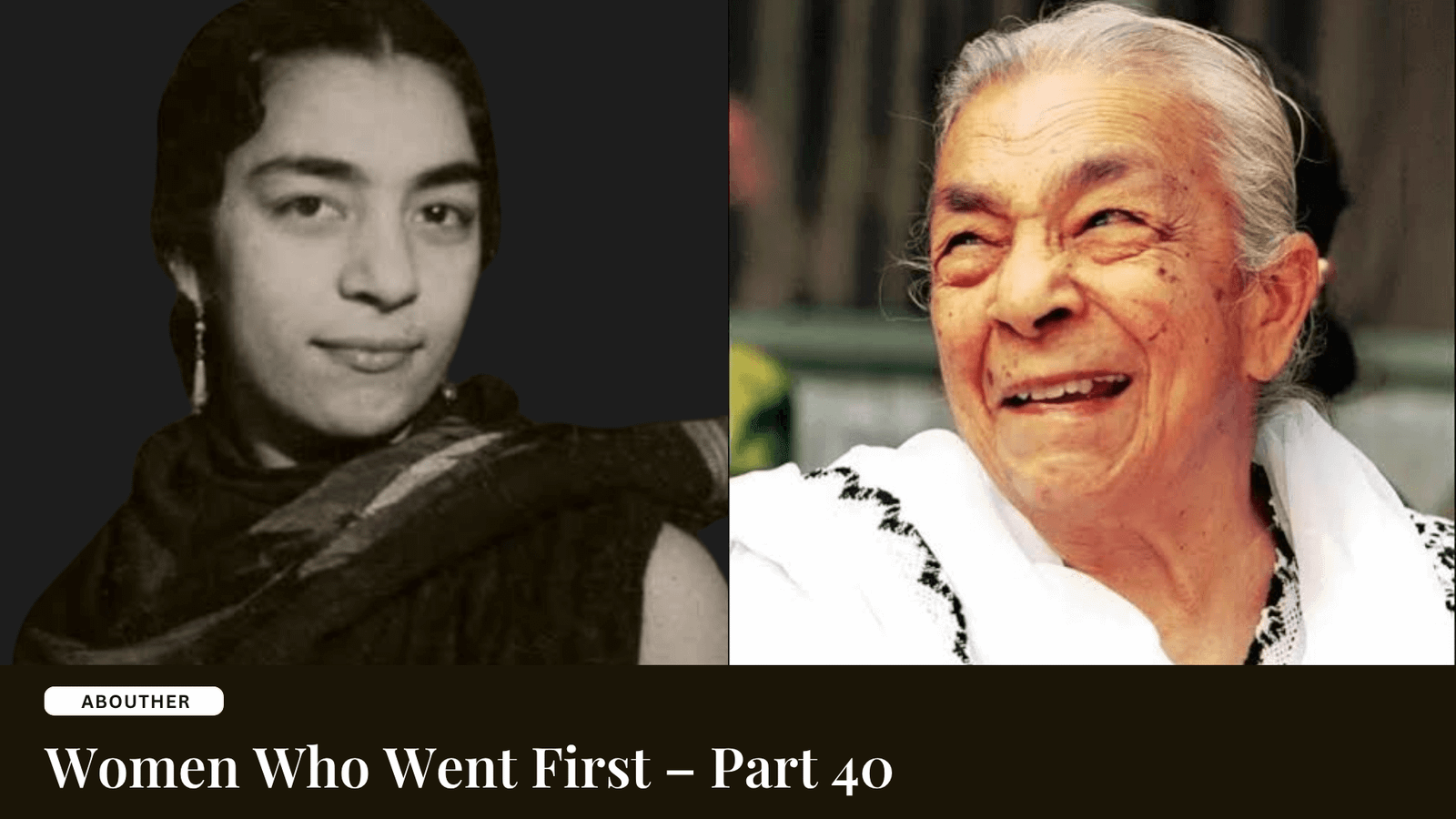
The Women Who Went First – Part 40
ISSUE 40 | THE WOMEN WHO WENT FIRST
PAST PORTRAIT
Zohra
Sehgal
Sehgal
1912 – 2014
She nearly disappeared, and then at seventy she came back and showed everyone what they had almost missed.
102
YEARS SHE LIVED
1935
JOINED UDAY SHANKAR’S TROUPE
70s
AGE WHEN THE WORLD REDISCOVERED HER
2010
PADMA VIBHUSHAN
WHO SHE WAS BEFORE ANYONE KNEW
Zohra Sehgal was born in 1912 in Saharanpur, into a family that was cultured and comfortable and entirely unprepared for what she would become. She was restless from the beginning, curious in a way that couldn’t be contained by drawing rooms, and when she heard that Uday Shankar was running a dance troupe that toured the world, she went to him. Her family was not pleased. She went anyway.
She was twenty-three when she joined Uday Shankar’s company in 1935 and began training in classical Indian dance forms alongside students who would become the foundational names of modern Indian dance. She toured Europe, the United States, Japan, and Egypt. She was performing on international stages at a time when most Indian women of her class were expected to manage households. The world she moved through was entirely of her own making.
“She was performing on international stages at a time when most Indian women of her class were expected to manage households. The world she moved through was entirely of her own making.”
THE LIFE SHE BUILT
1035
Joins Uday Shankar’s troupe; tours internationally for nearly a decade
1940s
Joins the Indian People’s Theatre Association (IPTA) in Lahore; meets and marries choreographer Kameshwar Sehgal; becomes a committed voice for progressive theatre
1945
Moves to London with her husband; performs and teaches dance; builds a life between two cultures
1959
Husband Kameshwar dies; she is in her mid-forties, in London, with two children and no clear path forward
1960s–70s
Works in British television and theatre; small roles, character parts; never quite the recognition her talent deserved
1980s
Returns to India; the Indian film and television industry gradually notices her; the comeback begins
The decades between her departure from Uday Shankar’s troupe and her return to Indian public life are where most stories about Zohra Sehgal become vague. She was in London. She was working. She was raising her children. She was not famous, not celebrated, not particularly sought after. She existed in the margins of two industries, neither of which knew quite what to do with her.
Also Read: The Women Who Went First – Part 39
What those decades reveal, in retrospect, is not a woman waiting to be discovered. They reveal a woman who kept working because work was what she did, regardless of whether anyone was watching.
THE RETURN
THE SECOND ACT
When Zohra Sehgal began appearing in Indian films and television in the 1980s and 1990s, she was already in her seventies. She played grandmothers, matriarchs, comic supporting roles, and tragic elder figures with the same ferocious precision. She stole every scene she was in, not through effort but through the simple fact of being more present than anyone else on screen.
Indian audiences fell in love with her. Directors wanted her. She appeared in Bend It Like Beckham (2002), in Veer-Zaara (2004), in Cheeni Kum (2007) opposite Amitabh Bachchan, in British television series. She worked constantly into her nineties. She gave interviews that were themselves performances, full of laughter and profanity and an absolute refusal to be treated as anything other than exactly what she was.
She received the Padma Shri in 1998, the Sangeet Natak Akademi Fellowship in 2004, and the Padma Vibhushan in 2010. The country was giving her, in her final decades, the recognition it had withheld for fifty years. She accepted it with grace and a certain amount of amusement.
WHAT SHE UNDERSTOOD
Zohra Sehgal gave interviews well into her nineties and they are some of the most remarkable documents in Indian cultural life. She spoke about her body, still dancing, still moving, with pride and without vanity. She spoke about loneliness after her husband’s death without self-pity. She spoke about the decades of obscurity without bitterness. She had, it seemed, made a decision early in her life that her work was the point, not the applause, and she had held to that decision through everything.
She died in Delhi in July 2014, at a hundred and two. She had been working, in some capacity, until very close to the end. The obituaries called her a legend. She would have laughed at that. She was a woman who danced and acted and kept going. The legend part was everyone else’s category, not hers.
“She had made a decision early in her life that her work was the point, not the applause. She held to that decision through everything.”
CROSS-SERIES CONNECTION · ISSUE 38
Read alongside Devika Rani (Issue 38), and two entirely different relationships with fame come into focus. Devika Rani was celebrated at the height of her powers, then chose silence. Zohra Sehgal was overlooked for decades and then found, late, the recognition she had earned long before. One woman walked away from the light. The other waited in the dark until the light finally turned toward her. Both, in the end, were exactly who they had always been.
WHY SHE BELONGS IN THIS SERIES
Most stories about women who go first are stories about arrival: the moment someone breaks through, wins, is recognised. Zohra Sehgal’s story is about the long middle, the decades between the beginning and the recognition, when she kept working in London and nobody in India quite remembered her name. She belongs in this series not because she won late but because she never stopped. A hundred and two years, and she was still dancing in her head if not on her feet. That is not a career. That is a life lived without permission from anyone else.
ISSUE 40 • PAST PORTRAIT • ABOUTHER MAGAZINE
THE WOMEN WHO WENT FIRST
Share This On Social
About the Author: Sangeeta Relan

Related Posts


I’m Sangeeta Relan—an educator, writer, podcaster, researcher, and the founder of AboutHer. With over 30 years of experience teaching at the university level, I’ve also journeyed through life as a corporate wife, a mother, and now, a storyteller.