
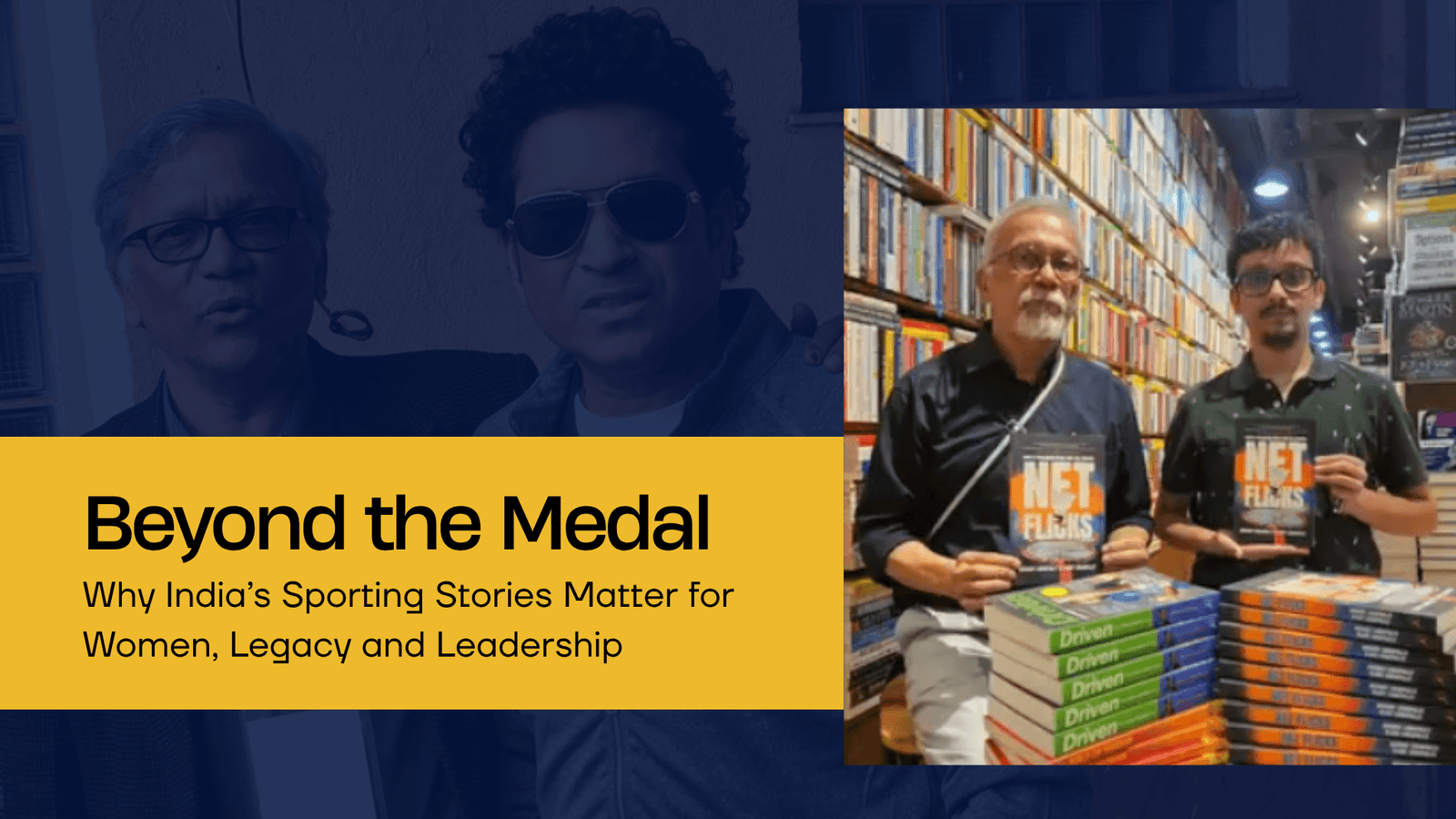
Beyond the Medal: Why India’s Sporting Stories Matter for Women, Legacy and Leadership
The Stories That Stay With Us
After more than three decades in academia and over 140 conversations on The AboutHer Show, one pattern has become impossible for me to ignore: success is remembered only when someone takes the effort to document it.
Whether I speak to women leaders, entrepreneurs, artists, or change-makers, I find that behind every visible achievement lies an invisible storyteller – someone who preserved the journey, the struggle, and the context.
This became particularly evident during my recent conversation with sports journalist Vijay Lokapally and his son Akshay Lokapally. While our discussion began with their writing journey, what emerged was a deeper reflection on legacy, memory, representation, and why storytelling itself is a form of nation-building.
Because when stories are not documented, they are not just forgotten – they are erased from collective memory.
Why Sports Writing Is About More Than Sport
Vijay Lokapally is one of India’s most respected sports journalists, with decades of experience covering international cricket and Indian sport. Through his books and journalism, he has chronicled defining moments that shaped India’s sporting identity.
His son Akshay Lokapally, an educator and writer, brings a research-driven and analytical perspective shaped by his academic background and experience teaching young students.
Together, their work represents something rare in India’s writing ecosystem – an intergenerational collaboration rooted in both experience and fresh thinking.
What struck me most was their shared belief that documenting sport is not merely about matches and medals. It is about preserving stories of resilience.
In a country like India, where infrastructure gaps, social expectations, and financial constraints often shape sporting journeys, these stories become social documents.
They tell us:
- Who succeeded despite limitations
- How families supported ambition
- How women negotiated societal barriers
- How sport becomes a pathway to mobility
This is why sports writing, at its best, becomes social history.
Representation of Women in Indian Sports Media Is Still Catching Up
One of the most important insights from the discussion was how dramatically the visibility of women athletes has changed over time.
Vijay spoke about covering women’s sports at a time when very few journalists attended such events. Today, women’s cricket, badminton, boxing, and athletics receive significantly more coverage.
This reflects a larger shift.
Also Read: Behind the Headlines with Jyotsna Mohan Bhargava- A Journey of Legacy, Resilience & Reinvention
According to recent sports participation trends in India, female participation in competitive sport has steadily increased over the last decade, supported by government initiatives like Khelo India and growing corporate sponsorship.
Yet representation still lags behind achievement.
What changes perception is visibility.
When girls see athletes like Mary Kom, PV Sindhu, or Neeraj Chopra’s female contemporaries succeeding globally, they do not just see medals. They see possibility.
From my own research in gender diversity and leadership, one insight consistently emerges: visibility changes aspiration.
Women do not lack ambition. They often lack visible role models.
Sport, therefore, becomes not just a career path, but a narrative of empowerment.
What Sport Teaches Young Women About Agency
In my years of teaching at Delhi University, I have seen how exposure to stories of resilience changes how young women see themselves.
Sport, perhaps more than any other field, teaches lessons that extend far beyond competition:
- Discipline without supervision
- Resilience after failure
- Confidence built through effort
- Leadership through teamwork
Akshay spoke about how sports stories help young girls see ambition not as arrogance but as possibility.
This aligns with what many educators observe: young women often hesitate to claim space unless they see examples of others who have done so.
Sport provides those examples.
And increasingly, financial independence through sport is also becoming part of this story. Successful athletes today are not only role models – they are also examples of economic empowerment.
This is particularly significant in India, where financial independence remains a key factor in women’s decision-making power.
The Importance of Mentorship and Male Allies
Another powerful thread in the conversation was the role of mentorship and intergenerational learning.
As someone who hosts a platform that amplifies women’s voices, I have also strongly believed in the importance of men as allies in gender progress.
The father–son collaboration here offered a subtle but important example.
It showed:
- Respect across generations
- Openness to learning
- Willingness to be challenged
- Shared intellectual ownership
When men actively participate in documenting women’s achievements and advocating representation, change accelerates.
Gender progress is rarely achieved in isolation. It happens through ecosystems.
And allies matter.
Why Research and Storytelling Must Go Together
In today’s fast-content environment, speed often replaces depth. But what Vijay and Akshay emphasised repeatedly was the importance of research integrity.
Facts build trust. Stories build connection.
Without research, writing loses credibility. Without storytelling, it loses impact.
This balance is something I also emphasise with my students and in my own writing. Thought leadership is not about opinion alone — it must rest on evidence, experience, and interpretation.
This is particularly important for younger readers.
Because how we present stories influences how they interpret success.
If success is shown only as achievement, it inspires comparison.
If success is shown as process, it inspires effort.
That distinction matters.
Patterns Emerging in India’s Sporting Narratives
Looking beyond the individual stories discussed, a few larger patterns become visible:
- Women’s sporting success is rising faster than recognition
Achievements often precede visibility. - Family support remains a decisive factor
Many successful athletes emerge from environments where parents actively support their journeys. - Sport is increasingly seen as a career, not just a hobby
This reflects changing middle-class aspirations in India. - Documentation is shaping legacy
Books and long-form storytelling are becoming critical in preserving sporting history. - Young readers seek inspiration, not just information
Narratives that connect struggle to success resonate more strongly.
These patterns show why such conversations matter beyond literature.
They reflect social change in motion.
Key Takeaways
- Stories preserve achievements that statistics alone cannot capture
- Women’s sports visibility is growing but still needs stronger documentation
- Sport plays a major role in building confidence and agency among young women
- Intergenerational collaboration strengthens knowledge transfer
- Research and storytelling must coexist for credibility
- Representation shapes aspiration for the next generation
- Male allies play an important role in amplifying women’s achievements
The Larger Question: Who Gets Remembered?
If there is one question this conversation left me with, it is this:
Who gets remembered, and who gets forgotten?
History is not just made by winners. It is shaped by those who record the journey.
For women especially, this question carries added weight. For decades, women’s contributions across fields were under-documented not because they were absent, but because they were overlooked.
This is why platforms that document stories – whether in sport, leadership, or social change – play a crucial role in shaping a more inclusive narrative.
Because visibility is not just recognition.
It is validation.
And validation shapes identity.
Also Read: Behind the Headlines with Jyotsna Mohan Bhargava- A Journey of Legacy, Resilience & Reinvention
About the Author
Sangeeta Relan is an Associate Professor at the University of Delhi with over 34 years of teaching experience. She is a researcher in gender diversity and corporate governance and the founder of AboutHer, a platform dedicated to storytelling, dialogue, and women’s voices.
Through The AboutHer Show, she has hosted over 140 conversations with women leaders, creators, and change-makers, as well as men who actively support gender inclusion. Her work focuses on identity, leadership, financial independence, and the evolving role of women in contemporary India.
Share This On Social
About the Author: Sangeeta Relan

Related Posts






I’m Sangeeta Relan—an educator, writer, podcaster, researcher, and the founder of AboutHer. With over 30 years of experience teaching at the university level, I’ve also journeyed through life as a corporate wife, a mother, and now, a storyteller.