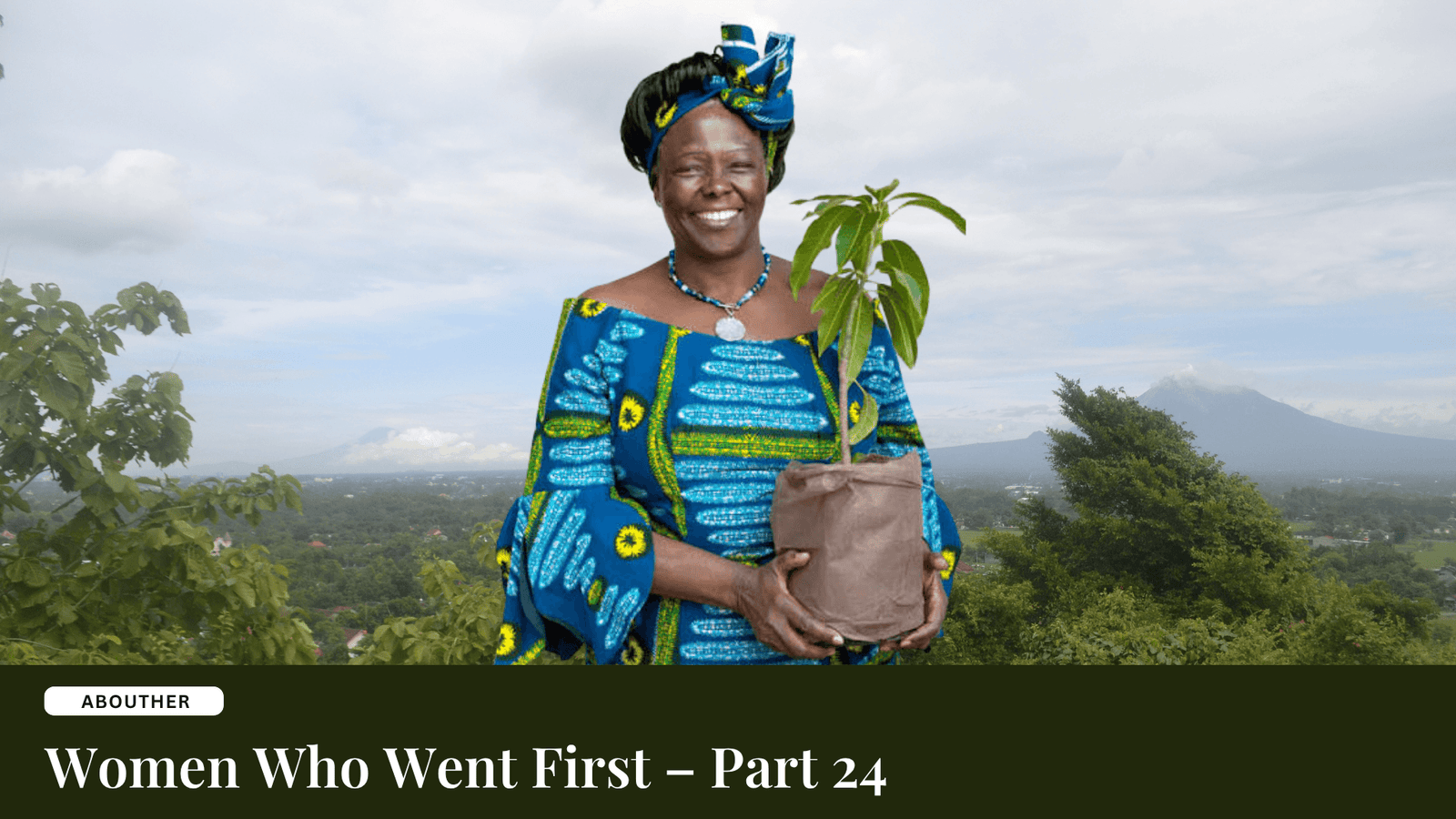
The Women Who Went First – Part 24
AboutHer
STORIES. WOMEN. NOW.
THE WOMEN WHO WENT FIRST ✦ CONTEMPORARY
PORTRAIT · ISSUE NO. 24
Wangari
Maathai
Maathai
She told Kenyan women to plant trees. Then she told them why the trees and their freedom were the same conversation. Then she went to prison for it. Then she won the Nobel Peace Prize. She understood, from the very beginning, that you cannot separate the land from the people who live on it.
In 1977, Wangari Maathai asked a group of women in rural Kenya to plant nine trees. The women were poor, their land was degraded, their rivers were drying up, and the forests that had once held the soil and the water in place had been cleared for export crops and colonial agriculture. Maathai understood something that the development organisations of her time were only beginning to grasp: that the poverty of these women was not separate from the destruction of their environment. It was caused by it. Trees were not an aesthetic or a luxury. They were food, water, fuel, and income. Planting them was not gardening. It was an act of economic self-determination. That first planting became the Green Belt Movement, which over the following three decades planted more than fifty million trees across Kenya, trained tens of thousands of women in forestry and civic education, and connected environmental conservation to women’s rights and democratic governance in ways that the world is still learning from. In 2004 Wangari Maathai received the Nobel Peace Prize, the first African woman to do so. The Nobel Committee cited her contribution to sustainable development, democracy, and peace. She would have said those three things were always the same thing.
WHERE SHE CAME FROM
Wangari Muta was born in 1940 in Nyeri, in the central highlands of Kenya, into the Kikuyu community. She grew up in a landscape of extraordinary natural richness, forests, rivers, and fertile soil, that she would spend much of her adult life trying to restore after it had been stripped away. She was educated at a time when education for African girls was neither common nor encouraged, and she pursued it with the stubbornness that would characterise everything she did. She studied in the United States on a scholarship arranged through the Kennedy Airlift programme, earning a degree in biological sciences from Mount St Scholastica College in Kansas and a Masters from the University of Pittsburgh. She returned to Kenya and completed a doctorate at the University of Nairobi in 1971, becoming the first woman in East and Central Africa to earn a PhD.
She joined the faculty of the University of Nairobi, rose to become chair of the Department of Veterinary Anatomy, and was the first woman to hold that position in the entire region. The pattern was established early and held throughout her life: first woman, first African woman, first in East Africa, first on the continent. She wore the firsts without making a performance of them, treating them as evidence of a gap that needed filling rather than as achievements requiring celebration.
THE GREEN BELT MOVEMENT
FOUNDED 1977, KENYA
The Green Belt Movement began as a practical response to a practical problem. Rural Kenyan women told Maathai that their streams were drying up, their food was less nutritious, and they had to walk further for firewood. She connected these problems to deforestation and soil erosion, and she connected those to the colonial and post-colonial agricultural policies that had prioritised export crops over local food systems and stripped the land of the forest cover that held everything together. Her solution was to pay women a small amount for each seedling they grew and each tree they planted that survived. The payment was modest but real. The trees were real. The restoration of local watersheds was real. And the process of women organising collectively to plant trees, measure their survival, and hold governments accountable for land use was, it turned out, also an education in civic participation that the Kenyan government would eventually find very inconvenient.
51M+
TREES PLANTED BY THE GREEN BELT MOVEMENT ACROSS KENYA
1st
AFRICAN WOMAN TO RECEIVE THE NOBEL PEACE PRIZE, 2004
1971
FIRST WOMAN IN EAST AND CENTRAL AFRICA TO EARN A PHD
THE GOVERNMENT THAT CAME AFTER HER
THE COST OF THE TREES
Daniel arap Moi’s government in Kenya understood, correctly, that the Green Belt Movement was not simply an environmental organisation. Women who had learned to organise collectively to plant trees, to track their survival, to hold local officials accountable for land use, were women who had learned the basic mechanics of civic organisation. When Maathai began advocating against the construction of a sixty-two-storey skyscraper in Uhuru Park, one of Nairobi’s last green public spaces, Moi’s government responded with personal attacks, calling her a threat to men, accusing her of being insufficiently African, and eventually having her beaten by police at a hunger strike she was leading in support of political prisoners. She was arrested multiple times. Her home was raided. She received death threats. She continued. The park was saved. The political prisoners were eventually released. The government that persecuted her is gone. The trees remain.
The pattern of her resistance was consistent across decades. She identified a connection between environmental destruction and political oppression, made that connection visible and actionable, and then refused to stop making it regardless of the personal cost. She was not naive about power. She understood that the forests were being cleared because clearing them served the interests of the powerful, and that planting them back was therefore a political act as much as an environmental one. She never pretended otherwise.
Also Read: The Women Who Went First – Part 23
“It’s the little things citizens do. That’s what will make the difference. My little thing is planting trees.”
WANGARI MAATHAI
THE NOBEL AND WHAT SHE SAID WITH IT
When the Nobel Peace Prize was announced in 2004, many in the environmental and political establishment were surprised that a tree-planting programme had been deemed worthy of the Peace Prize. Maathai was not surprised. She had been making the argument for thirty years that environmental health, democratic governance, and human rights were not separate concerns but aspects of the same one: the question of who controls the resources that sustain life, and whether that control is exercised for the benefit of the many or the few.
Her Nobel lecture was one of the most coherent statements of that argument ever made. She spoke about the fig tree of her childhood, about the streams that had dried up, about the women who had planted trees and in doing so had planted the idea that they had the right to participate in the decisions that shaped their lives. She connected the forests of Kenya to the forests of the Amazon, to the coral reefs of the Pacific, to the grasslands of Central Asia. She connected them all to the question of whether the people who live with natural systems have a say in how those systems are managed. The answer, in every case she described, was that they did not. The answer she spent her life working toward was that they must.
THE JANAKI AMMAL CONNECTION
This series placed Janaki Ammal in the past slot several issues ago: India’s first woman botanist, who spent her career documenting and conserving India’s plant heritage and who argued, decades before it became mainstream environmental thinking, that the biodiversity of the subcontinent was worth protecting as a matter of national urgency. Wangari Maathai made the same argument for Kenya and for Africa, at the same scale of moral seriousness, and paid a far higher personal price for it. Both women understood that the living world is not a resource to be extracted but a system to be sustained, and that the people most dependent on that system, almost always women, almost always poor, almost always politically marginalised, are its most important stewards. Neither got the credit she deserved during the years when the work was hardest.
WHAT SHE BUILT AND WHAT REMAINS
Wangari Maathai served as Assistant Minister for Environment and Natural Resources in Kenya from 2003 to 2005, bringing the same directness to government that she had brought to activism. She founded and chaired the Nobel Women’s Initiative. She wrote four books, including Unbowed, her memoir, and The Challenge for Africa, a sustained argument for a different kind of governance rooted in African values and ecological realities. She died of ovarian cancer in 2011 at seventy-one, still working, still arguing, still planting.
The Green Belt Movement continues. The trees it planted are standing. The women it trained are organising. The connection it drew between environmental health and human freedom is now the foundation of environmental justice movements on every continent. She drew that connection in 1977, in rural Kenya, with nine trees and a small payment per seedling, and spent the rest of her life proving it was the right connection to draw.
WHY SHE BELONGS IN THIS SERIES
The Women Who Went First has told stories of women who went first into institutions, into space, into courtrooms, onto stages, and into hostile territory. Wangari Maathai went first into the understanding that the earth and its people are not separate problems. That the woman who cannot find clean water and the forest that no longer holds the watershed in place are the same problem. That the political prisoner and the cleared hillside are connected. That planting a tree is a political act.
She is the first African woman in this series and the first figure whose primary domain is the environment, and both of those firsts matter. But what matters most is the argument she made and spent her life embodying: that freedom is not only political. It is ecological. A people who do not control the land that sustains them are not free, regardless of what their constitution says. A woman who must walk five miles for water does not have time to participate in the decisions that affect her life. The trees are the democracy. The democracy is the trees. She said this in 1977 and she was right, and the world is still catching up.
She also belongs because of the stubbornness. Beaten by police, arrested, publicly humiliated by a president, subjected to the specific cruelty that powerful men reserve for women who will not be quiet, she planted trees. She organised women. She went back to the park. She continued. That stubbornness, in the service of something larger than herself and rooted in the living world rather than in any ideology, is exactly what this series has been trying to describe for twenty-four issues. She is its most complete expression in the contemporary slot.
“She told women to plant trees and then told them why the trees and their freedom were the same conversation. The government that persecuted her is gone. The trees remain.”
THE WOMEN WHO WENT FIRST · ABOUTHER MAGAZINE
Share This On Social
About the Author: Sangeeta Relan

Related Posts


I’m Sangeeta Relan—an educator, writer, podcaster, researcher, and the founder of AboutHer. With over 30 years of experience teaching at the university level, I’ve also journeyed through life as a corporate wife, a mother, and now, a storyteller.