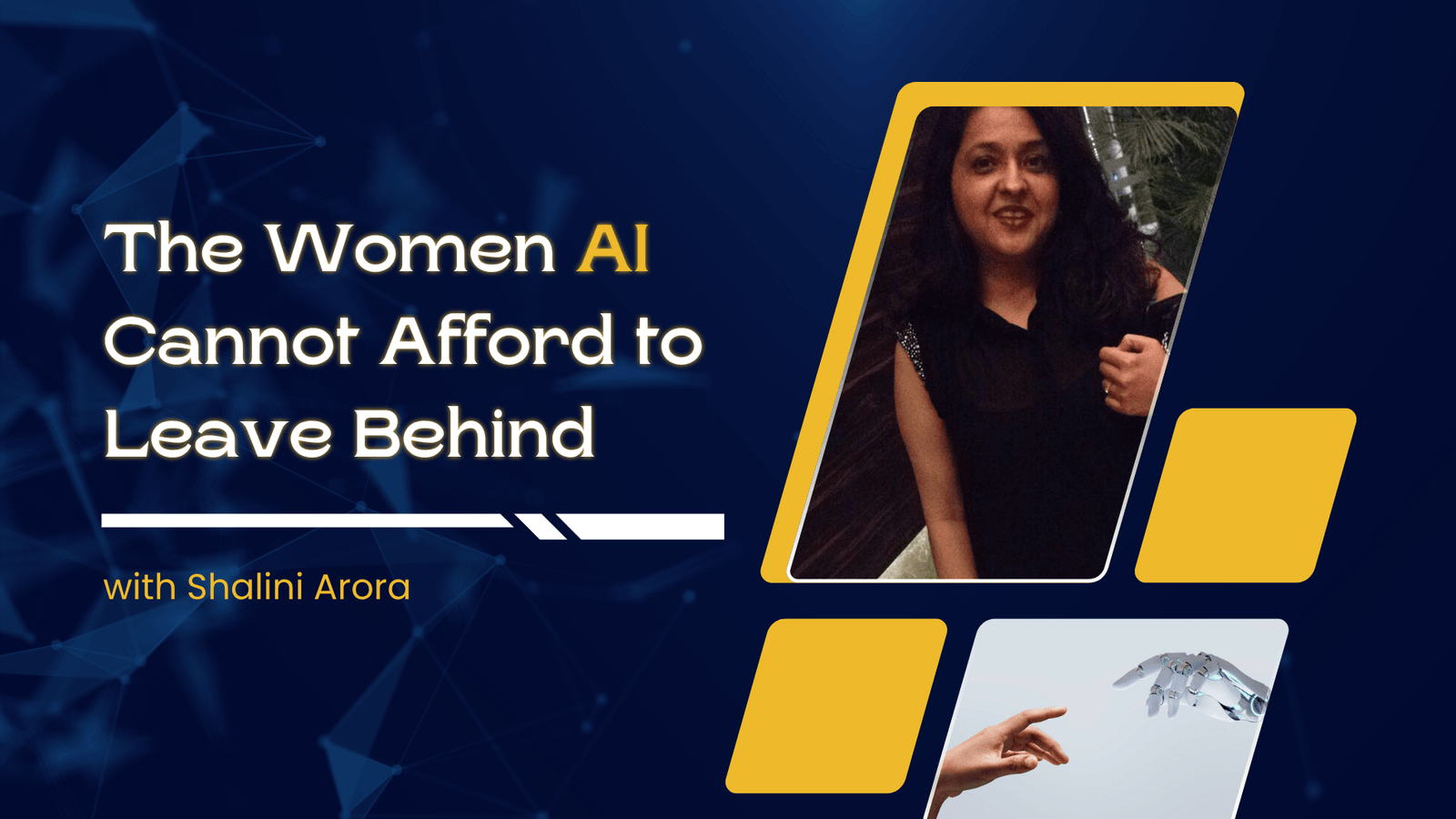
The Women AI Cannot Afford to Leave Behind
TECHHER FORWARD · ABOUTHER MAGAZINE
The Women AI
Cannot Afford
to Leave Behind
Cannot Afford
to Leave Behind
Shalini Arora has spent 25 years riding every wave of digital change. Now, as AI rewrites the rules of banking and work itself, she has an urgent message for women everywhere: this wave is not optional.
● ●
In 1998, Shalini Arora collected her first pay cheque from a bank branch teller. Today, she is building the platforms that have made that branch almost unnecessary. The distance between those two moments is the story of digital banking. And Shalini has been inside it the whole time.
She was one of six women in a batch of 60 engineers. That number has stayed with her. Not because it made her feel small, but because it made her feel the weight of what was possible if more women simply walked through the door. Twenty-five years later, from IBM mainframes to global payments platforms at NatWest Group, Shalini Arora is that door. And she is holding it wide open.
I spoke with Shalini as part of our TechHer Forward series, a space on AboutHer dedicated to women who are not just working in technology but actively shaping it. What followed was one of the most clarifying conversations I have had about AI, not its mythology, but its mechanics, and more importantly, its consequences for women if we choose to stand on the sidelines.
“AI is not going to replace your jobs. But people who do not adopt AI are going to be replaced by people who do.”
SHALINI ARORA · GLOBAL TECHNOLOGY LEADER, NATWEST GROUP
THE INVISIBLE REVOLUTION
Banking Has Become a Technology Platform
Most of us experience digital banking as convenience: tapping to pay, instant transfers, a notification when something looks off on our account. We rarely think about the architecture beneath those moments. Shalini lives in that architecture.
She describes a banking world that has quietly redefined itself. “Banks are now relabelling themselves as technology platforms first, and banks second,” she tells me. The pressure comes from neo-banks like Revolut, which built exceptional digital experiences before even holding a banking licence, and from India’s own UPI ecosystem, which now processes around 20 billion transactions every month, or roughly 700 million every single day.
The customer, she says, has fundamentally changed. They want real-time account opening. They want a virtual card that can be issued and ready to spend within seconds. They want the bank to behave less like a branch and more like an app that truly knows them.
The work that was being done by relationship managers can now be shifted to AI agents who can prompt customers to do things differently.
Shalini Arora
This shift is not purely about convenience. Shalini walks me through personalisation at a level I had not imagined: a bank that notices a deposit has arrived and prompts you with savings options tailored to your patterns; a system that detects you have exceeded a gambling spend threshold and sends a gentle nudge; a fraud detection engine so sophisticated it can distinguish between a routine transaction in Delhi and an unusual one in Latin America, flagging it in real time, not hours later.
But perhaps the most striking example she shares is in financial crime. Anti-money laundering systems, once slow and prone to catching innocent people with names similar to those on sanctions lists, are now being transformed by AI. “A very sophisticated financial crime management system,” she explains, “can now make sure that people who are valid are not stopped, while those who should not be transacting are.” The nuance that once required human intervention is being embedded into the algorithm itself.
700M
digital payment transactions processed daily in India via UPI
22%
women’s participation in Delhi’s workforce, as cited in the conversation
25+
years Shalini has spent at the frontier of digital transformation
THE BIAS IN THE MACHINE
Data Is Biased. And That Is Everyone’s Problem.
Here is where the conversation turns personal. When AI makes decisions about who gets a loan or a mortgage, it draws on decades of historical data. And that data, as Shalini points out, carries the shape of the world that built it, a world designed largely by and for men.
She references Caroline Criado Perez’s book Invisible Women, which documents how male-centred data has become so embedded in our systems that the systems themselves cannot see the gap. Amazon discovered this painfully when its own AI recruitment tool, trained on years of hiring data, surfaced a disproportionate number of male engineers when asked to identify top candidates. The data was not neutral. It was a mirror held up to history.
Also Read: The Woman Who Chose Herself Last Then First
“If there is bias in the data,” Shalini says, “then the algorithms running on that data are going to give you biased responses.” This is why responsible AI frameworks matter. And this is why more women in AI roles is not simply a diversity aspiration. It is a technical necessity.
“If we need responsible AI, that is only possible if more women join that part of the workforce.”
SHALINI ARORA
WHAT WOMEN STAND TO LOSE
The Jobs AI Will Automate First
There is an uncomfortable truth at the centre of this conversation, and Shalini does not soften it. AI is moving fastest toward the kinds of repetitive, structured work that many women have historically gravitated to, often because such roles offered predictability, manageable hours, and the flexibility that caring responsibilities demand. If those roles are automated and women have not moved toward AI-enabled work, the gap widens again.
“Historically, the adoption of technology by women has been lower than that by men,” she says, and names the reasons clearly: imposter syndrome, the belief that technical roles require a particular kind of mathematical genius, the sense that the culture is not built for them. But she also offers a reframe that I found quietly radical.
“The boring part of the job is being done by AI now.” What remains is the interesting part: the judgment, the creativity, the ability to understand both the business and the human need it is trying to meet. Product thinking. Strategic clarity. Cross-disciplinary insight. These are areas where women have long excelled but been undervalued. In an AI-augmented world, they become the premium skills.
The most important skill you need right now is to be change-ready. If you do not try and experiment with technology, you are definitely going to be left behind.
Shalini Arora
WHAT EQUITY REALLY LOOKS LIKE
Organisations Must Move Beyond Equality to Equity
Shalini is precise about language here. Equality, she says, is not enough. “Equity means creating practices and an ecosystem in which women thrive.” The pipeline is not broken at entry. Women and men typically start their careers in near parity. The leak happens in the middle, at the point where caring responsibilities, unconscious bias, and the absence of sponsors quietly redirect women out of the leadership pipeline.
What organisations need to do is not complicated, but it requires genuine will. Flexible working that accommodates caring without stigma. Unconscious bias training that reaches male allies, not just women. Mentorship, yes, but also sponsorship, the difference being that a mentor gives advice while a sponsor uses their own credibility to open a door. And perhaps most critically, creating the conditions in which women feel safe enough to raise their hands for leadership roles they might otherwise second-guess themselves out of.
She also advocates for something less commonly discussed: multigenerational mentoring. A graduate mentoring a senior leader in AI tools, while the senior leader reverse-mentors on strategy and institutional knowledge. “You learn as much from a grad these days,” she says, laughing, recalling her own daughter correcting her on the difference between small and large language models.
KEY TAKEAWAYS
1 AI ADOPTION IS NOT OPTIONAL FOR WOMEN
Women in repetitive roles are most vulnerable to automation. Moving toward AI-enabled, value-added work is urgent, not aspirational. The tools are accessible. The window is now.
2 BIASED DATA PRODUCES BIASED OUTCOMES
AI systems learn from historical data built in a world that centred men. Without diverse teams building and auditing these systems, bias compounds. Women in data and AI roles are a structural correction, not a gesture.
3 THE INTERESTING WORK IS WHAT REMAINS
AI is absorbing the repetitive. Product thinking, creative judgment, and cross-disciplinary insight are becoming premium. These are areas where women have always excelled. The field is finally catching up.
4 SPONSORSHIP OVER MENTORSHIP
Advice is valuable. Access is transformative. Organisations need sponsors who put their own credibility behind the women they believe in, not just mentors who counsel from the sidelines.
5 VISIBILITY IS NOT VANITY. IT IS INFRASTRUCTURE
Every woman who holds a senior role in technology and speaks about it publicly is laying a path for the women who come next. Role models are not a nice-to-have. They are how norms change.
A NOTE TO CLOSE
Follow Your Dream. The Path Will Shape Itself.
I asked Shalini what she would say to a young woman who looks at AI and digital transformation and feels the field is simply not for her. Her answer was immediate and clear. That feeling, she said, is a myth. Not a gentle, polite dismissal of an outdated concern. A myth. Something that was never true to begin with.
The barriers that once felt structural, the mathematical gatekeeping, the coding as a precondition for belonging, are dissolving. What remains is the need for logical thinking, curiosity, and the willingness to keep learning. Every single person, she pointed out, has a logical mind. It is just a question of where it is directed.
She ended with something that felt less like a talking point and more like a lived conviction: that dreams are where this begins. Not strategy. Not positioning. Dreams. And that the world, for all its speed and disruption, still has room for a woman who decides that this is her space and walks into it.
One out of five women in Delhi is in the paid workforce. That number, Shalini says, should unsettle us. It should also move us. Because every platform that makes a woman’s story visible, every conversation that cracks open a door, every mentor who takes the call, is part of how that number changes.
“Know what you dream of. Follow your dreams. And your dreams will then shape your way.”
SHALINI ARORA
Shalini Arora
GLOBAL TECHNOLOGY LEADER · NATWEST GROUP
A 25-year veteran of digital transformation across telecom, manufacturing, and banking, Shalini leads Digital Journey Services and Future Skills Development at NatWest Group. She is also a DEI Gender Balance Lead and an active mentor to women across the technology industry.
Share This On Social
About the Author: Sangeeta Relan

Related Posts


I’m Sangeeta Relan—an educator, writer, podcaster, researcher, and the founder of AboutHer. With over 30 years of experience teaching at the university level, I’ve also journeyed through life as a corporate wife, a mother, and now, a storyteller.