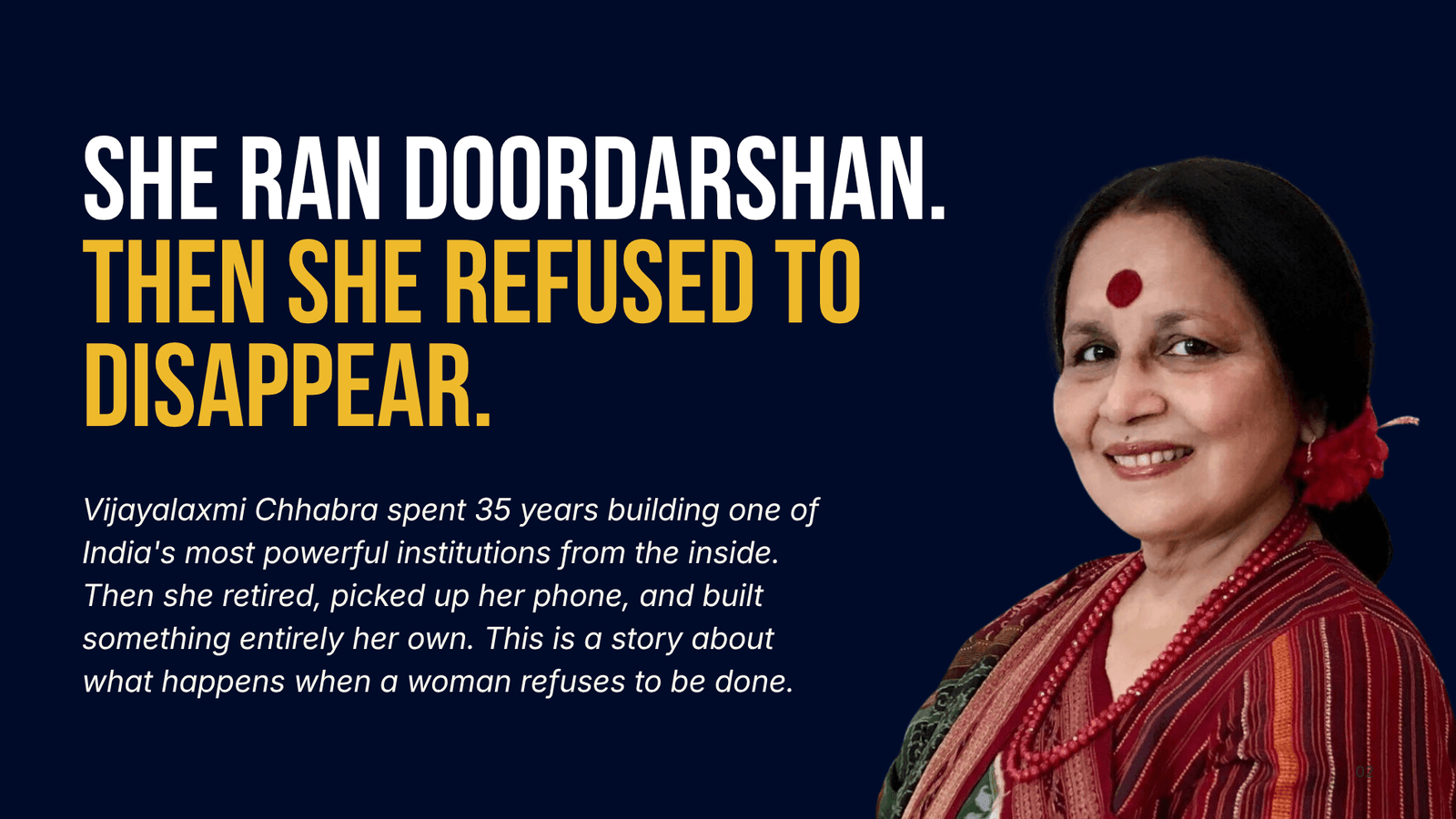
She ran Doordarshan. Then She Refused to Disappear.
WOMEN IN LEADERSHIP · SEASON 4 · VOICE & VISIBILITY
She ran Doordarshan. Then she refused to disappear.
Vijayalaxmi Chhabra spent 35 years building one of India’s most powerful institutions from the inside. Then she retired, picked up her phone, and built something entirely her own. This is a story about what happens when a woman refuses to be done.
There is a photograph that Vijayalaxmi Chhabra keeps in her memory if not on her wall. It is of a newspaper headline — Chhattisgarh ki beti bani Doordarshan ki Mahanideshika — and of her father, standing in Bilai Nagar, with tears in his eyes.
He had dreamed she would be an IAS officer. She became something he had no word for. Director General of Doordarshan — the world’s largest public service broadcaster. The girl who used to climb on a stool to reach the Bush radio on the topmost shelf had ended up running the institution behind it.
I really fell in love with it. I started dreaming whether I could be the voice coming from the radio.
VIJAYALAXMI CHHABRA
The girl who chose differently
Bilai Nagar in the 1960s was a planned township — Nehru’s dream of modern India made steel and concrete — and it was full of engineers, doctors, and their very particular ambitions for their daughters. Vijayalaxmi’s father marked editorials for her to read. He dreamed she would join the civil services. What he did not plan was that the radio on the topmost shelf would become her calling.
She had no roadmap. Her local guardian told her directly that Melville de Souza — the voice she worshipped — was, after all, just a staff artist. Give it up. Keep it as a hobby.
She listened politely, felt terrible about what he said about de Souza, and kept going anyway. She topped her UPSC list. She joined All India Radio. And then, quietly, steadily, she began.
The system wasn’t built for her — but she built inside it anyway
Ask Vijayalaxmi whether institutions worked against her as a woman and she will surprise you. “Government offices are the best places for women,” she says, “because the system, rather than being against them, is in favour of them.” But she is not naive about it. She knows what unfair looks like.
Towards the end of her career, a senior officer used what power he had to place her on what the government calls underposting — a kind of administrative exile. Her husband was unwell. Her parents had been brought to Bombay. The pressure was enormous. She did not sit quietly. She wrote letters. She complained. She went, in her words, right up to the PMO. And she won.
“Women need to know that they can fight it out.”
VIJAYALAXMI CHHABRA
The boldest pivot in public broadcasting
The story of how Vijayalaxmi transformed Doordarshan’s finances begins with a storeroom packed floor to ceiling with postcards and letters from listeners. Millions of people were tuning in to Vividh Bharati, and nobody had thought seriously about what that audience was worth. She started thinking.
After a Commonwealth Fellowship took her to the UK — where she visited twenty private radio stations, each selling advertisements against everything from classical music to drama — she came back with a question nobody at Doordarshan seemed to have asked: why can’t we sell our own programmes?
She started selling. When the CEO of Prasar Bharati called her in, she spent an hour telling him everything. He appointed her head of a new Sales and Marketing Division on the spot. She insisted on Bombay — not Delhi — because the advertising industry was there. The result was staggering: where third parties had been giving Doordarshan 11 crores for a cricket series, her team sold the same inventory for 80 crores in a single day.
“By the end of the day we were selling at two lakh per ten seconds. We were learning about the commercial value of our own organisation. Nobody knew it.”
VIJAYALAXMI CHHABRA
Also Read- The Room Was Never Closed. She Just Walked In.
Pepsi Cup, brought to you by Coca-Cola
Pepsi was the ground sponsor of the series and had the first right of refusal on the broadcast sponsorship. When she reached out, they stalled. They were dismissive. She gave them ten days and a formal letter. They did not respond. She signed with Coca-Cola.
When the Pepsi representative called, furious, she was unapologetic. “I told whoever asked me not to do it — minister, CEO, whoever — that they had to make arrangement for the 20 crores that Coke was going to pay me. Either Pepsi pays it, or Coke does.” Nobody came up with the money. The Pepsi Cup went on air, brought to you by Coca-Cola.
The reinvention nobody saw coming
When Vijayalaxmi retired, a friend added her to a Facebook saree group. She started reading the posts. She noticed that everyone was posting pictures and nothing else. She thought: surely one must write something. She wrote. People responded immediately and in enormous numbers.
She moved to Instagram. She started writing about the history of weaves, about Odisha textiles, about her working life, about what it means to be a woman who has lived fully. She made hashtags — My Good Old Sarees, My Precious Old Sarees — and she posted the cotton sarees she wore to pick up her grandson Mikail, not the silks she had taken to London to photograph on her daughter’s staircase.
Today, women travel two and three hours across the Netherlands to have lunch with her when she visits. Her husband, who is not on social media, tells everyone how many followers she has.
What she wants you to know
When asked what she wants young women to take from her story, Vijayalaxmi does not talk about ambition first. She talks about parents. “This confidence does not come from school or college or anywhere. It comes from my parents. They made me think I could do anything and everything.”
And then, in the clearest formulation of everything her life has demonstrated: “You have to empower yourself — and to empower yourself, you don’t have to always be aggressive.”
“I was visible. And I never had to make myself small to move ahead.”
VIJAYALAXMI CHHABRA
IN HER WORDS
- The system can work for you — if you know how to use it. She didn’t fight Doordarshan. She understood it, worked within its rules, and when the system was unfair, she used the same system to fight back.
- Financial independence is not a lifestyle choice. It is the foundation. She could have stayed home. She worked anyway — because a woman who earns is a woman who is free.
- Visibility is not vanity. In a world that makes older women invisible, choosing to be seen — on Instagram, in sarees, telling your story — is a political act.
- You can pivot at any stage. From programmes to sales. From television to Instagram. The willingness to become something new is the skill that made her extraordinary.
- Empowerment does not require aggression. You can be warm, devoted to your grandchildren, fond of nimbu pani — and still be someone nobody can take for granted.
QUOTES TO REMEMBER
“I was visible and I never had to make myself small to move ahead.”
“Women need to know that they can fight it out.”
“You have to empower yourself — and to empower yourself, you don’t have to always be aggressive.”
“My parents made me think I could do anything and everything.”
“All women need to be financially self-sufficient.”
🏆 TOP 3 INDIAN WOMEN’S LEADERSHIP PODCASTS · FEEDSPOT 2026
Vijayalaxmi Chhabra · S4E160 · The AboutHer Show with Sangeeta Relan · aboutherbysangeeta.com
Share This On Social
About the Author: Sangeeta Relan

Related Posts


I’m Sangeeta Relan—an educator, writer, podcaster, researcher, and the founder of AboutHer. With over 30 years of experience teaching at the university level, I’ve also journeyed through life as a corporate wife, a mother, and now, a storyteller.