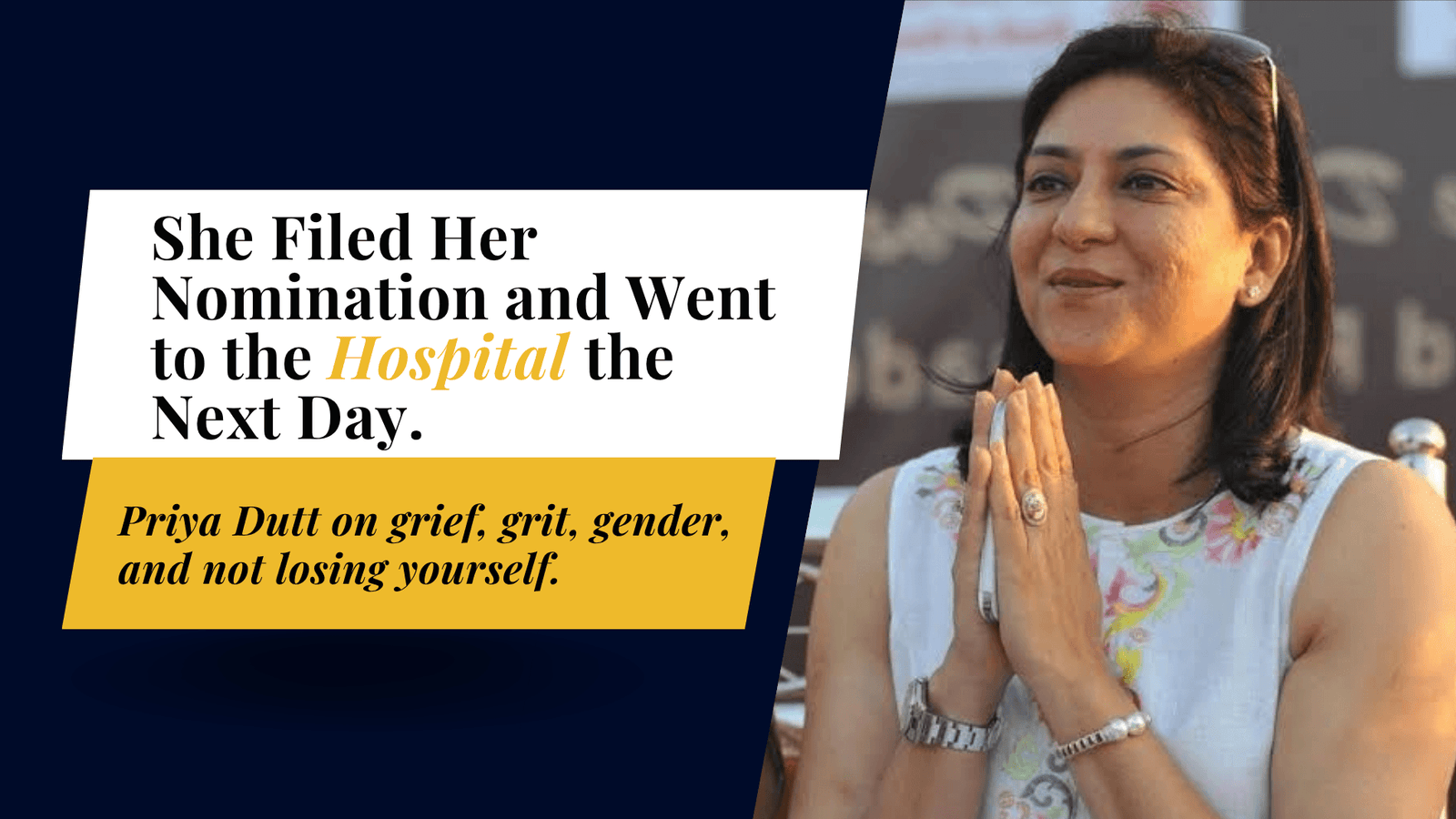
She Filed Her Nomination and Went to the Hospital the Very Next Day
Trailblazer · Politics · Resilience
Former MP Priya Dutt on loss, reinvention, campaigning five days post-surgery, and why she never let politics become her whole identity.
As told to Sangeeta Relan · AboutHer · Season 2
Politics · Women & Gender · Mental Health · Legacy
She was four months pregnant, her father was freshly gone, and the phone kept ringing with one question: who fills the seat? Priya Dutt, daughter of the legendary Sunil Dutt, had no intention of entering politics. She wanted to make documentaries. She wanted to be a journalist. She’d gone on her father’s padyatra not out of political ambition but because sitting over coffee after dropping him off, something stirred — and she was too stubborn to ignore it.
That stubbornness would carry her through four election campaigns, a constituency of 16 lakh voters, a delivery table, and a postoperative hospital stay that she cut short — stitches and all — to stand on a campaign jeep five days later. “I believe only a higher power — or my parents — saw me through that safely,” she says, and there is no drama in the telling. Just fact.
I believe only a higher power — or my parents — saw me through that safely.
— Priya Dutt
Priya’s story begins not in Parliament but in a childhood defined by freedom and then fractured by loss. Her mother died when she was thirteen. Her father became a single parent overnight. Her brother fought addiction at a time when the concept of rehabilitation barely existed in India. “All of us kind of grew up just learning every day how to deal with things,” she says — and you believe her, because nothing in her telling sounds rehearsed.
The padyatra at nineteen — a 78-day walk across states — shook open her worldview. She was the only girl among the walkers. Her college teachers, when she sought permission to go, told her years of education would not teach her what she’d learn on the road. They were right. She returned not as a politician-in-waiting, but as someone who’d seen the diversity and the wounds of the country up close. She wanted to make films about it. She wanted to tell its stories.
I went in knowing this is not my career. That’s what gave me the freedom — I had nothing to lose.
— Priya Dutt
When her father passed, the political machinery moved fast — even as the family was still grieving. Someone had to stand for the seat. Her sister was intensely private. Her brother had ongoing legal matters. All eyes turned to Priya. She refused. Then she listened to her father’s constituents, who came to her and said they felt orphaned. That changed everything.
Also Read: Chitra Banerjee Divakaruni- Reclaiming Women’s Voices, One Story at a Time
She learned Parliament on the job, without a mentor, overwhelmed and new. She arrived to find members across party lines welcoming her with warmth she hadn’t expected. But the harder challenge was closer to home: the men who had known her since she was a teenager serving chai in her father’s house now expected to shape her. “Everybody thought — this girl can be moulded,” she says. “But that didn’t happen.”
She made her work her own. She wore jeans to constituency visits. She wore trousers to Parliament and sparked a national debate. She refused to process the same way her father had — not because she didn’t revere him, but because she was, unmistakably, herself. “The biggest challenge for a woman in public life,” she says, “is to break out of being someone’s daughter, someone’s wife, someone’s sister. To create your own individuality. That is the real fight.”
When I’m with my family, I’m with my family. Nothing else matters. I learned that from my father — and he never missed a birthday in 25 years of politics.
— Priya Dutt
She is candid about what politics cannot give you — financial security if you are honest, a stable career path, the luxury of being fully yourself at all times. She is equally candid about what it can: a platform, access, the ability to raise a child committing suicide after exams in Parliament, the chance to sit across from ministers and say — this is wrong, and here is why.
Today, having stepped back from electoral politics, Priya channels her energy into the Nargis Dutt Foundation — cancer care, scholarships, rural transformation. She has watched girls from poverty graduate, buy houses for their parents, become the first in their families to hold a degree. She finds this more sustaining than any election result. She is also learning to paint, exploring television, running a Persian restaurant filled with her parents’ 80-year-old books, and — at the end of every long day — sitting with her three dogs, who greet her as if they haven’t seen her in years.
Key Takeaways
Share This On Social
About the Author: Sangeeta Relan

Related Posts
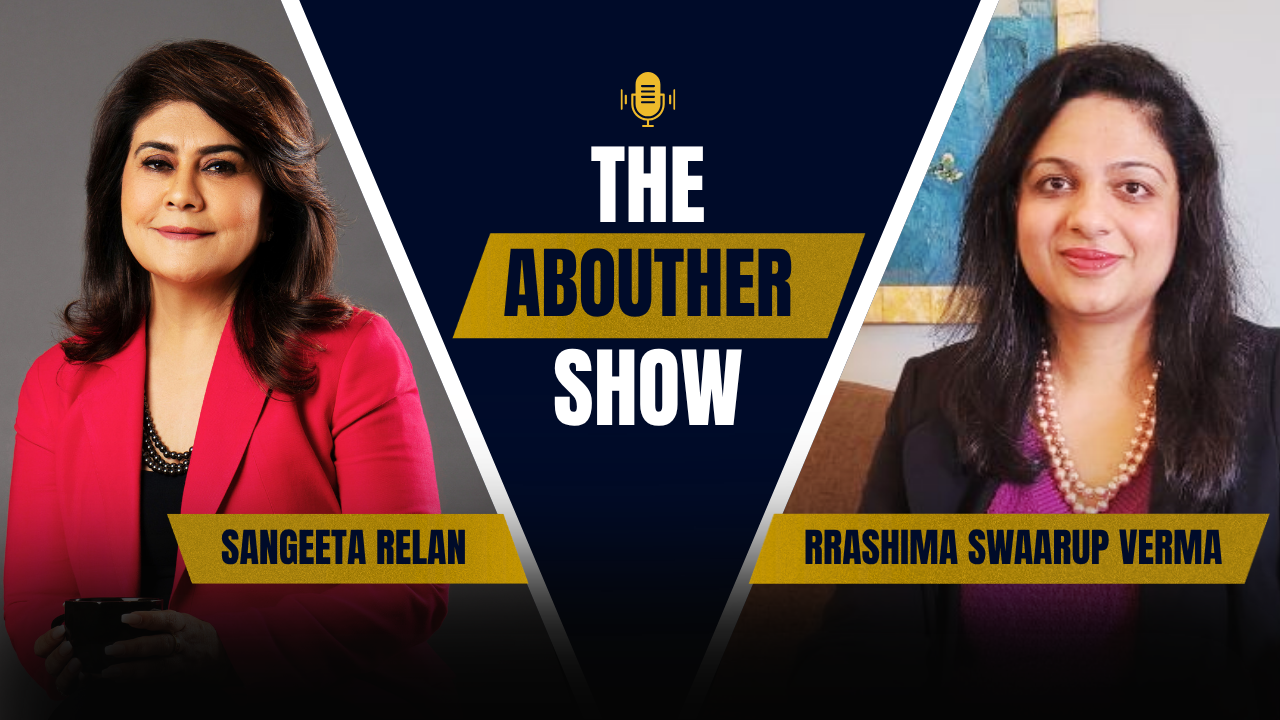


I’m Sangeeta Relan—an educator, writer, podcaster, researcher, and the founder of AboutHer. With over 30 years of experience teaching at the university level, I’ve also journeyed through life as a corporate wife, a mother, and now, a storyteller.