The Women Who Went First – Part 29
ABOUTHER
THE WOMEN WHO WENT FIRST ✦ FROM THE PAST
PORTRAIT · ISSUE NO. 29
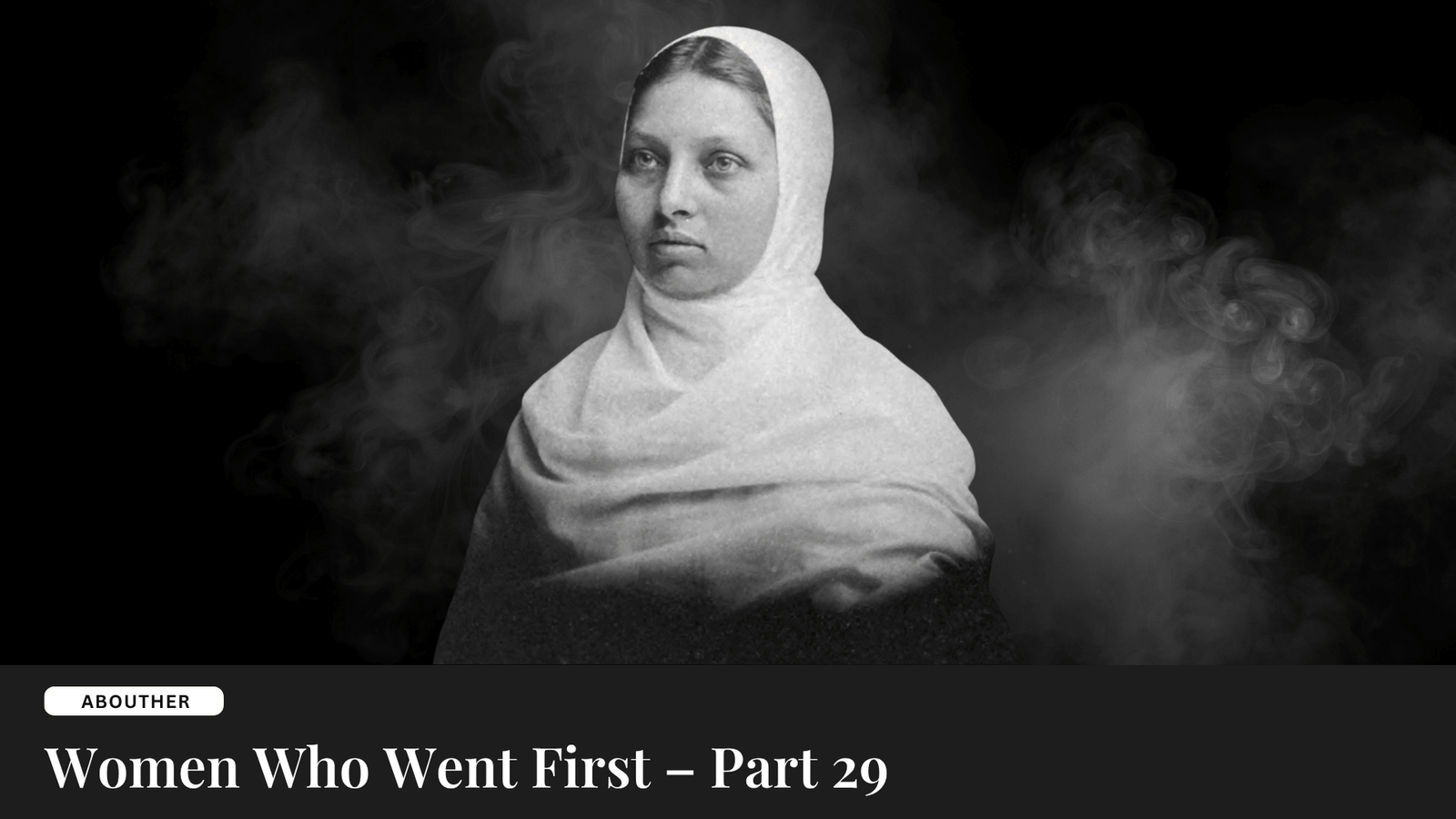
Pandita
Ramabai
Ramabai
The pundits of Calcutta gave her their highest titles for her Sanskrit scholarship. Then she converted to Christianity and they took everything back. She built a home for widows and child brides instead, translated the Bible into Marathi so ordinary people could read it, and answered to nobody’s approval for the rest of her life.
In 1878, a young woman walked into a gathering of Sanskrit scholars in Calcutta and answered their questions. She was twenty years old. She had been taught Sanskrit by her father, a Brahmin scholar who believed that his daughter deserved the same education as any son, a conviction that had made him a social outcast in his own community and that he had held to anyway, teaching her in forests and on riverbanks as the family wandered because they had nowhere they were fully welcome. The pundits of Calcutta were astonished. They awarded her the titles Pandita and Saraswati, the first granted in recognition of her learning, the second in recognition of her eloquence. She was the most accomplished Sanskrit scholar of her generation and she was a woman. Nothing in the tradition had prepared for that. She went on to do things that the tradition was even less prepared for, and she did all of them without asking anyone’s permission.
THE FATHER WHO CHANGED EVERYTHING
Ramabai was born in 1858 in a forest in Karnataka. Her father, Anant Shastri Dongre, was a Brahmin scholar who had made the radical decision to teach his wife to read Sanskrit, a decision for which he faced severe social censure. He made the same decision for his daughter. The family was ostracised repeatedly for this commitment and lived in itinerant poverty as a result, moving from place to place, dependent on the charity of those who respected Anant Shastri’s learning if not his unconventional household.
Both her parents and her sister died in the famine of 1877, leaving Ramabai and her brother Srinivas alone. The two of them walked over four thousand kilometres across India, reciting scriptures for sustenance, before arriving in Calcutta in 1878. Her brother died shortly after. She was twenty, alone, and about to become famous.
THE TITLES AND WHAT THEY COST
CALCUTTA, 1878: PANDITA AND SARASWATI
When the Sanskrit scholars of Calcutta awarded Ramabai the titles Pandita and Saraswati, they were acknowledging something they had not expected to encounter: a woman whose command of Sanskrit scripture was equal to or greater than their own. The titles were the highest recognition available in that tradition. She received them at twenty. She then married a Bengali lawyer, Bipin Behari Das Medhavi, who was from a lower caste, which cost her much of the social standing the titles had given her. He died of cholera in 1882, leaving her a widow with a young daughter at twenty-four. She had survived the deaths of her father, mother, sister, and brother. She had walked four thousand kilometres. She had been awarded the highest scholarly titles available to anyone in her tradition. And now she was a widow in a society that treated widowhood as a condition to be endured rather than a circumstance to be addressed. She began to think seriously about what she could do about that.
ENGLAND, AMERICA, AND THE CONVERSION
Ramabai went to England in 1883 to study medicine, supported by the Wantage Sisters, an Anglican religious community. She was received warmly and observed carefully. She had been moving toward Christianity for some time, drawn by what she described as its insistence on the dignity of every person regardless of caste or gender, a principle that Hinduism as she had experienced it conspicuously failed to apply to women. She was baptised in 1883.
The conversion cost her everything she had accumulated in terms of social standing and the goodwill of Hindu reformers who had supported her work. She went to America in 1886 to raise funds for a home for child widows in India and wrote a book, The High-Caste Hindu Woman, that described the condition of upper-caste Hindu women with an accuracy and a directness that was simultaneously admired by Western audiences and resented by the Indian establishment. She raised the money and came home.
THE CONVERSION THAT CHANGED EVERYTHING
Ramabai’s conversion to Christianity in 1883 is the most contested element of her legacy and the one most often used to diminish it. Hindu nationalists have argued that she betrayed her tradition. Christian missionaries argued, during her lifetime, that she was not orthodox enough in her Christianity. Both were responding to the same quality: her absolute refusal to accept anyone else’s authority over her faith or her work. She did not convert because she accepted the missionaries’ view of Hinduism. She converted because she had read the New Testament in Sanskrit and found in it a vision of human dignity that she had not found in the tradition she had been born into. She then spent the rest of her life arguing with the missionaries who expected her gratitude and compliance. She gave them neither.
MUKTI MISSION AND WHAT SHE BUILT
Ramabai founded the Sharada Sadan in Pune in 1889, a home for high-caste Hindu widows, many of them child brides whose husbands had died leaving them destitute and socially invisible. The institution was significant not only for what it offered its residents but for what it argued: that these women deserved education, economic independence, and a future, not merely shelter.
She moved the institution to Kedgaon, near Pune, and renamed it Mukti Mission, meaning liberation. During the great famines of 1896 and 1900, she opened its doors to thousands of famine survivors, women and children who had no other refuge. At its peak, Mukti Mission housed over 1,500 people. It operated schools, a printing press, farms, and workshops. It gave the women who came to it not just survival but skills, education, and the possibility of an independent life.
MUKTI MISSION: STILL STANDING
The Mukti Mission that Pandita Ramabai founded in Kedgaon in the 1890s continues to operate today, more than a century after her death. It provides care, education, and support to women and children in need, running schools, vocational training programmes, and residential facilities. It is one of the oldest continuously operating women’s welfare institutions in India. Ramabai built it with money she had raised herself, managed it on principles she had developed herself, and staffed it largely with the women it had rescued and educated. The institution outlasted every criticism that was made of it during her lifetime.
“I am a Christian, not because the missionaries wanted me to be, but because I read the New Testament and found in it a Christ who saw women as fully human. That was enough.”
PANDITA RAMABAI
THE BIBLE SHE TRANSLATED
In the last decades of her life, Ramabai undertook one of the most ambitious translation projects in the history of Indian literature: a complete translation of the Bible into Marathi, in a colloquial language that ordinary people could read and understand rather than the formal literary Marathi that educated readers knew but that was inaccessible to most of the population. She taught herself Greek and Hebrew in order to work from the original texts rather than from existing translations.
Also Read: The Women Who Went First – Part 28
The translation took years and was completed shortly before her death in 1922. It remains in use. The printing press she had established at Mukti Mission printed it. Women she had educated and trained ran that press. The translation was the work of a lifetime and it was produced entirely on her own terms, through an infrastructure she had built herself, in a language she had chosen herself, for readers whom the existing translations had not reached.
WHY NOBODY COULD CLAIM HER
What is most striking about Pandita Ramabai, and what made her so uncomfortable to so many different groups during her lifetime, is that she could not be claimed by any of them. Hindu traditionalists could not claim her because she had converted. Hindu reformers could not claim her because she refused to confine her criticism of Hindu social practice to the limits they found acceptable. Christian missionaries could not claim her because she refused their doctrinal authority and ran her institution on principles that frequently diverged from theirs. Western feminists could not claim her because she insisted on the specifically Indian dimensions of the problems she was addressing. Colonial administrators could not claim her because her work was explicitly directed at the damage that both Indian tradition and British policy had done to Indian women.
She belonged to no movement that could be neatly labelled and therefore managed. She was her own project, rooted in convictions she had developed through her own reading and her own experience, and she pursued those convictions with a consistency that lasted forty years and produced institutions that outlasted every controversy she generated.
THE SAVITRIBAI PHULE CONNECTION
This series featured Savitribai Phule several issues ago: a woman who walked to school through a gauntlet of stones to teach girls who had been told that learning was not for them, who built schools in Maharashtra in the 1840s and 1850s for the children her society had decided did not deserve education. Pandita Ramabai was doing something parallel and connected in the decades that followed: building homes and schools for the women, widows and child brides, whom her society had decided did not deserve a future. Both women worked in Maharashtra. Both faced organised opposition from communities invested in the existing order. Both built institutions that outlasted that opposition. The conversation between their two lives, across a generation, is the conversation of what women in 19th century India did with their anger and their vision when they refused to accept the terms they were given.
WHY SHE BELONGS IN THIS SERIES
The Women Who Went First has told stories of women who built institutions, crossed borders, broke silences, and refused the terms their eras offered them. Pandita Ramabai did all of these things with a completeness and a stubbornness that is rare even in this series.
She went first into Sanskrit scholarship as a woman and was honoured for it. She then went first into the refusal to be limited by what that honour was supposed to mean, onverting to a faith that cost her every relationship she had built, building an institution that nobody asked her to build, translating a text that nobody had asked her to translate, and running it all on principles she had arrived at herself through decades of reading, observing, and refusing to look away from what she saw.
She also went first into the specific courage of belonging to no one’s camp. In a world that prefers its reformers to have a clear institutional home and a predictable set of positions, she was consistently and deliberately ungovernable. The Hindu establishment found her too Christian. The Christian establishment found her too Hindu. The colonial establishment found her too independent. The nationalist establishment found her too international. She was all of these things simultaneously and she seems to have regarded the discomfort she caused each of them as broadly appropriate.
The pundits gave her the title Pandita at twenty. She spent the next forty-two years demonstrating what that title actually meant when it was held by someone who refused to be told what to do with it. That is the most complete definition of going first that this series has encountered. She deserves to be here.
“The pundits gave her their highest titles at twenty. She spent the next forty-two years demonstrating what those titles meant when held by someone who refused to be told what to do with them.”
THE WOMEN WHO WENT FIRST · ABOUTHER MAGAZINE
Share This On Social
About the Author: Sangeeta Relan

Related Posts


I’m Sangeeta Relan—an educator, writer, podcaster, researcher, and the founder of AboutHer. With over 30 years of experience teaching at the university level, I’ve also journeyed through life as a corporate wife, a mother, and now, a storyteller.