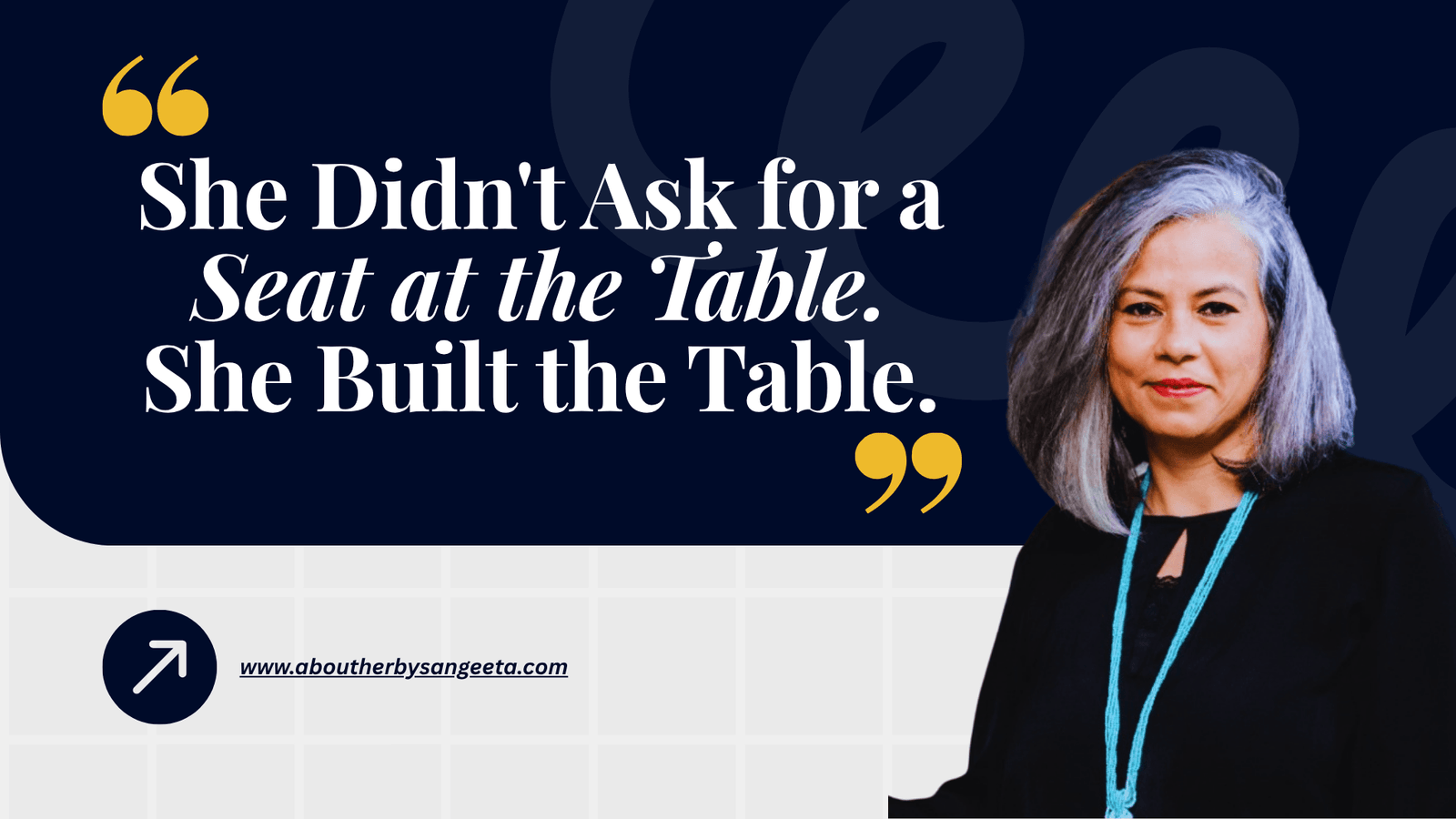
She Didn’t Ask for a Seat at the Table. She Built the Table.
ABOUTHER
POWER & LEADERSHIP | VOICE & VISIBILITY
She Didn’t Ask for a
Seat at the Table.
She Built the Table.
Seat at the Table.
She Built the Table.
Meenu Handa spent 35 years shaping narratives at Google, Amazon and Microsoft. What she learned about power, truth, and staying true to yourself is something no leadership manual will ever teach you.
THE ABOUTHER SHOW — SEASON 3
✦ ✦ ✦
There is a particular kind of woman who does not announce herself when she walks into a room. She doesn’t need to. Meenu Handa is that woman. For three and a half decades, she was the person the C-suite called when a crisis threatened to unravel everything, when a reputation needed to be rebuilt from the ground up, when an organization needed someone who could see around corners. She was the communications leader at Microsoft India, the woman who built Amazon India’s communications function from scratch, and most recently, the VP of Corporate Communications for Google across the Asia-Pacific. She has played basketball for India, dived deep into open water despite a fear of the sea, and raised a child as a single mother while holding down some of the most demanding roles in corporate Asia. She was named one of the 20 Rising Stars in PRovoke’s global Influence 100 report and recognized among the 50 most influential women business leaders in India by Impact magazine. And yet, when I asked her what success means to her now, she paused, and said: “making memories with people that matter to me.”
That answer tells you everything about how Meenu Handa has lived her life. Not performing success, but inhabiting it. Not chasing validation, but building something durable. This is the conversation she and I have long owed each other, two women who have known each other for more than thirty years, though time and careers took us on different paths. Sitting across from her, I found myself struck not by how much she had achieved, but by how lightly she seemed to carry it.
“Any leader to be successful, there has to be clarity of purpose. And the element that really adds credibility is what you may call ethics, integrity, principles, values. That authenticity comes with that.”
MEENU HANDA, FORMER VP, CORPORATE COMMUNICATIONS, GOOGLE APAC
On What Leadership Actually Means
I asked Meenu what she thought truly defined credible leadership in communications, after all those years at the highest levels. Her answer surprised me with its simplicity. “Credible leadership in communications is no different from any credible leadership,” she said. It was not the answer I expected from someone who had spent decades navigating the distinct pressures of the communications world. But it was the right answer.
For Meenu, leadership distills to a handful of non-negotiables: clarity of purpose, the ability to bring people along, and at the very core, an unswerving commitment to ethics and integrity. “That authenticity comes with that,” she said. “When you are guided by a certain set of values and principles which are applied no matter what the situation, that is what really makes for credible leadership.”
She is equally clear on what separates a leader who truly listens from one who merely hears. “When a leader is very self-assured, not insecure, not threatened, that is when they are actually able to listen to another point of view.” Security, she insists, is the prerequisite for genuine openness. A leader who is anxious about their own position cannot possibly be present enough to hear what the room is really saying.
“You get your first job based on your skills. But your second job is based on your delivery and reliability.”
Meenu Handa
What Crisis Exposes
Meenu is globally recognized for crisis and issues management, and so I asked her what crisis reveals about organizations that success tends to hide. Her response was immediate and unflinching. “In a crisis, if you forget your values just to get over a crisis or cut a news cycle short, that is when your real character shows up.”
She pointed to the recent IndiGo turbulence as an illustration, an airline known for efficiency and punctuality that found itself exposed when its conduct fell sharply below what passengers expected of it. The brand equity loss was significant, and the CEO’s resignation spoke volumes. Contrast that, she said, with Amazon’s enduring commitment to the customer, even in moments when some customers were clearly taking advantage of liberal return policies. “The belief was simple: to put a policy in place to solve for one customer is bad for the other 999.” That clarity of value, held under pressure, is what separates organizations that endure from those that don’t.
“In a crisis, if you forget your values just to kill a news cycle, that is when your real character, or the real issues, show up.”
Meenu Handa
On Being a Woman in the Room
We could not have this conversation without addressing what it has meant to be a woman navigating these spaces. At senior levels, women are often expected to be composed, empathetic, unflappable, often held to a higher standard of emotional regulation than their male peers. Did Meenu feel this? “I think the expectation is similar from both men and women,” she said, “it’s just that when women tend to be a little bit more assertive, they’re seen as being aggressive, whereas a man can get away with a bit of that.”
Her response was not bitterness, but clear-eyed pragmatism. She has lost her cool on occasion, she admits freely. She has come across as aggressive when she didn’t intend to. She learned from those moments, adjusted her delivery, but never her conviction. “You’ve still got to find ways of impact and influence that serve your purpose,” she said. “But you can’t back away from not being true to yourself.”
The tension between being respected and being liked is one she has thought deeply about. “It’ll be naive to say nobody cares about being liked. We all like to be liked.” But she has never allowed that desire to override her judgment. “I’m not here to win a popularity contest. If there is a faith and belief in what I’m saying, and that may be against popular opinion, I will still say it.” How you say it, she adds, is where the craft lies. Not whether you say it.
As a single mother working in some of the most demanding corporate environments in Asia, Meenu is also candid about what made her path possible. A support system: her mother, her sister, friends, and most significantly, a home helper who has been with her for thirty years. “There is no way I could have gotten to where I got to had it not been for her, because I always had somebody in the house who I could trust with my children.” She says this without apology or romanticization. It is simply true, and she wants other women to hear it: building that system is not a luxury, it is infrastructure.
“Don’t let anybody else define your boundaries for you. And if you’re good at what you do and you’re able to show impact, a lot of those discouragements drop by the wayside.”
MEENU HANDA
Power, Culture, and the Renaissance Person
Across Google, Amazon, Microsoft, and the fifteen years she spent at IPAN Hill and Knowlton counselling clients from Hindustan Lever to Boeing, Meenu has absorbed a masterclass in how power actually operates inside different kinds of organizations. Her conclusion: every company has a different culture, and the skill is not in imposing your style upon it but in understanding its logic well enough to work within and around it.
“If you are at a leadership level, you have to be able to impact and influence, and different organizations require different ways to do that. When it is a data-driven company, you better have your data right. If it is customer-focused, you better be clear that what you are talking about is actually beneficial to the customer.” She describes this as adaptability, but it is more than that. It is the ability to read a room at an institutional scale.
The communications leaders she has always most admired, and tried to build teams of, are what she calls “renaissance people.” Her first boss planted this phrase in her mind early, and it never left. “To be a communications person, you need to be a renaissance person, because you work with every single department in the company.” The best practitioners, in her view, are not narrow specialists. They are people who can connect the dots across an entire business, who understand regulation and marketing and finance and human behaviour and what is happening in the world outside, all at once.
She built Amazon India’s communications function from scratch on exactly this philosophy, grounding it in three non-negotiables: hiring people who can connect the dots, building a culture of speaking truth to power, and never losing sight of the business objective. “You don’t do comms just for the sake of comms,” she says. “It’s always got to be tied to a business objective.”
Sport as a School for Life
If leadership was her vocation, sport was her formation. Meenu represented India in basketball, waking before dawn to take a DTC bus to school, practising before the school day had even begun. She speaks of those years with undisguised warmth, and credits them for shaping almost every quality she has drawn on in her professional life: hard work, teamwork, resilience, adaptability, and the ability to think on her feet.
“You can be the most talented, but unless you put effort into it, it is not going to work,” she says. Sport also taught her to handle failure without flinching. You do not win every match. You get back on the court and try again. “That resilience, that ability to live with failure, is what sports teaches you.” And perhaps most valuably, it taught her adaptability: every opposing team has a different strategy, and you have to be able to adjust yours, sometimes within minutes.
Also Read: From Air Force One to the Written Word
She is now a ceramicist. There is something fitting about that. Someone who spent decades shaping narratives and reputations has turned her hands to shaping clay. Both require patience, pressure, and the willingness to start again when something cracks.
KEY TAKEAWAYS FROM MEENU HANDA
1. Values are your compass in a crisis
Organizations and leaders who abandon their values to manage short-term fallout always pay a longer-term price. Your principles are not for good days only.
2. Your first job: skills. Your second job: reliability.
Getting hired opens a door. What keeps it open is your track record of delivering on your commitments, and having the integrity to say upfront when you cannot.
3. Security in yourself makes you a better leader
The leaders who genuinely listen are the ones who are not threatened. Self-assurance is not arrogance. It is the prerequisite for openness.
4. Build your support system as seriously as your career
The infrastructure of your personal life makes your professional life possible. Do not be ashamed of needing help. Build it deliberately.
5. Be a renaissance person, not a narrow specialist
The most enduring careers belong to those who can connect the dots across an entire business, not just their own domain. Curiosity is a professional skill.
6 True to yourself, always
You were hired to deliver impact, not to be the most popular person in the room. Adapt how you say things. Never what you genuinely believe needs to be said.
CAREER MILESTONES
IPAN Hill & Knowlton (15 years) · Microsoft India · Amazon India (built function from scratch) · Google APAC, VP Corporate Communications
RECOGNITIONS
PRovoke Influence 100: Rising Stars 2020 · Impact: 50 Most Influential Women Business Leaders in India · SABRE Asia Pacific Individual Achievement Award 2016
BOARD ROLES
Independent Director, SRL Limited (medical diagnostics) · Advisory Board Member, Kickoff Solutions & GAME
BEYOND THE BOARDROOM
Basketball player for India
Advanced open water diver
Ceramicist
As our conversation wound to a close, I found myself thinking about what it means to have watched someone from a distance over thirty years, tracking a career through the fragments that social media offers, and then finally, sitting with them properly. What strikes me about Meenu Handa is not the sheer scale of what she has done, though it is considerable. It is the coherence of it. The same woman who got on a DTC bus before dawn to practice basketball is the same woman who built a communications function from nothing, counselled C-suites through crises, and now shapes clay with her hands. The throughline is the same: show up, do the work, stay true, deliver.
In a world that often rewards performance over substance, Meenu Handa is a reminder that the deepest credibility is built quietly, over years, and it shows up exactly when it matters most.
✦
Share This On Social
About the Author: Sangeeta Relan

Related Posts





I’m Sangeeta Relan—an educator, writer, podcaster, researcher, and the founder of AboutHer. With over 30 years of experience teaching at the university level, I’ve also journeyed through life as a corporate wife, a mother, and now, a storyteller.