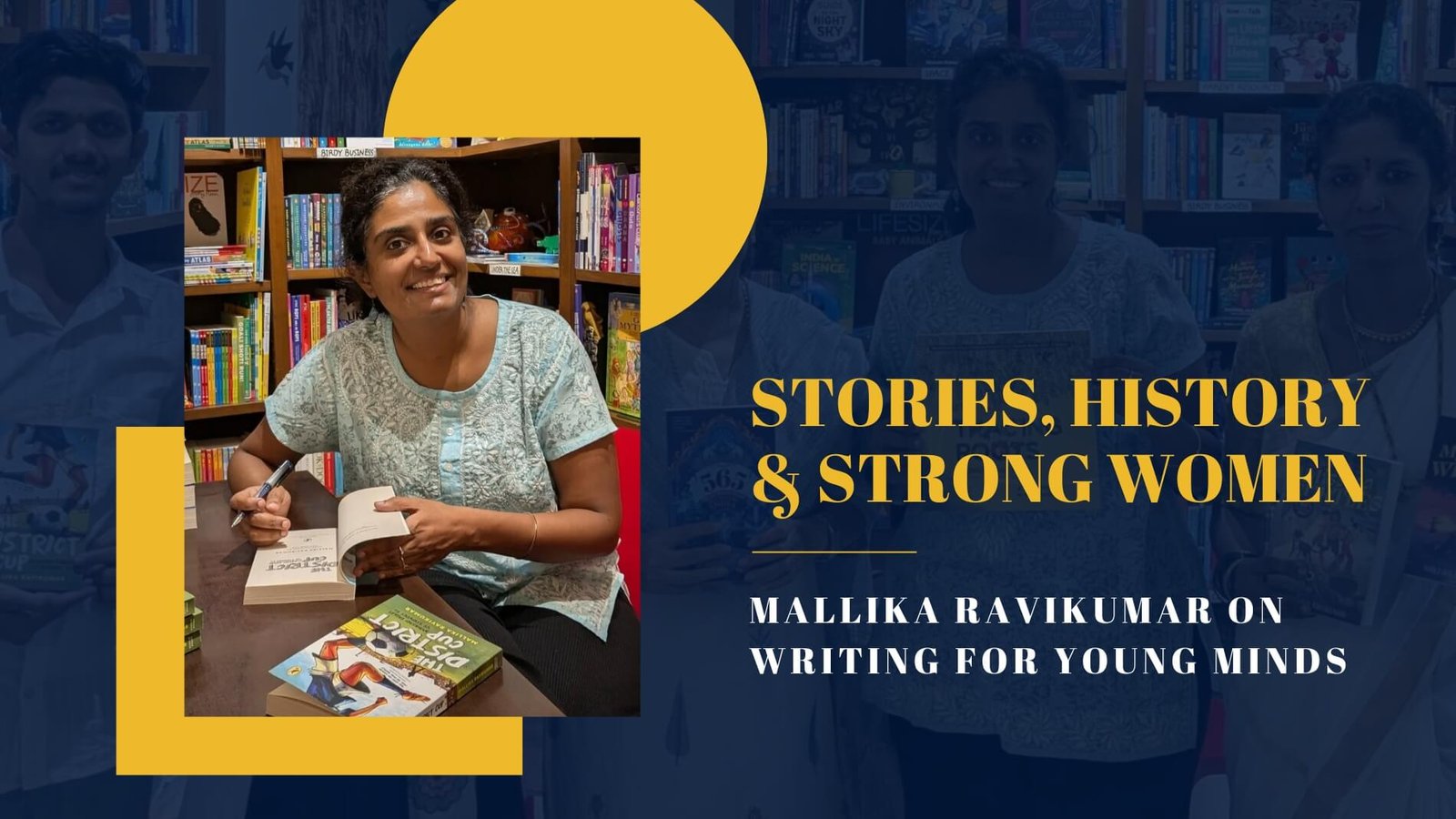
Stories, History & Strong Women, Mallika Ravikumar on Writing for Young Minds
Some writers don’t just tell stories, they restore what’s missing from the narrative. Mallika Ravikumar is one of them.
An award-winning author and historian, Mallika brings together disciplines that rarely sit in the same room: law, history, children’s literature, and ecology. Winner of the Atta Galatta Bangalore Literature Festival Award for Best Children’s Fiction (2023) and the Binod Kanoria Children’s Book Award (2023) in the Young Adult category, she writes with the kind of clarity and care that young readers deserve, and adults quietly admire.
In this episode of The AboutHer Show, Mallika takes us through her journey from the Bombay High Court to the writing desk, from the accession of princely states to the Battle of Baramulla, and from historical archives to the living archive of trees through her YouTube channel, Tree Talk with Mallika Ravikumar. What emerges is a conversation that is grounded, powerful, and deeply relevant to the times we live in.
Why you should read (and listen to) this episode
Because we’re living in an age where opinions travel faster than facts, and where history is constantly being reshaped to suit the present.
Mallika makes a compelling case for why young people need stories that are truthful, engaging, and emotionally intelligent, especially when the subject is complex. She speaks about the responsibility of writing history for children, the power of representation, and why women’s perspectives are not a “nice-to-have” but a necessary lens.
This conversation also fits beautifully into AboutHer’s author-series theme: Healing Through Words, because healing can come not only from personal memoir, but also from carefully told stories that help us understand identity, conflict, and resilience.
Key Takeaways from the Conversation
1. Awards validate, but they also liberate
Mallika shares how recognition doesn’t erase self-doubt (something every creative person knows too well), but it can give writers the confidence to take bigger risks, especially when writing about sensitive, layered themes like Kashmir.
Also Read: Main Character Energy- Bold, Unfiltered, and Unapologetically You
2. The leap from law to literature was personal, and practical
Her writing journey began in the most organic way: motherhood, storytelling, and wanting to explain complex ideas (like adoption) in a sensitive way to young children. It’s a reminder that many women don’t “switch careers”, they evolve into themselves.
3. History doesn’t have to be kings-and-dates
Mallika explains how her academic training shaped her interest in histories that feel lived-in: the history of food, clothing, ideas, language, and everyday people. This is exactly the kind of history that makes children lean in instead of zoning out.
4. The Battle of Baramulla deserves attention
One of the most compelling parts of the episode is Mallika’s discussion on why she wrote about the Battle of Baramulla, and how she explains the origins of a long and complex conflict in a way young readers can understand, without sensationalising it.
5. Writing for children requires both honesty and tenderness
She speaks about the fine balance between accuracy and accessibility, including the difference between historical fiction and creative non-fiction, and why transparency with the reader is ethical writing.
6. Women’s visibility isn’t only external, it’s also internal conditioning
Mallika offers a refreshing take: she hasn’t personally experienced direct discrimination in the way many women do, and she credits part of that to upbringing, confidence, and being surrounded by strong women. At the same time, she acknowledges safety and mobility realities women must consider, especially while researching in remote settings.
7. Strong female characters should feel normal, not “special”
Mallika intentionally places women in active roles, sometimes subtly, in the background—because normalising women’s agency is just as important as highlighting it. It shapes what girls believe they can be, and what boys learn to accept as everyday reality.
8. Trees are part of her storytelling ecosystem
Her passion for trees isn’t separate from her writing, it’s an extension of how she sees the world. She uses stories, myths, and folklore to make children curious about trees, because once curiosity awakens, care follows.
Listen to the episode:
Words that stayed with me
“Self-doubt is a very big part of the creative journey. You’re constantly asking yourself, is this good enough?”
“History has largely been told by powerful men, and so many women’s stories have simply not been written about or spoken of.”
“When girls see themselves in stories, doing things, making decisions, it changes how they see their own possibilities.”
“Children are naturally curious about the past. We often lose them by turning history into a dull list of dates instead of stories.”
“When you tell a story, whether about history or trees, it stays with people far longer than just facts ever do.”
Call to Action
If this episode sparked something in you, curiosity, reflection, a new reading list, or a deeper desire to look at history differently, share it with someone who loves books, learning, or raising thoughtful young minds.
And if you haven’t already, follow AboutHer across platforms for more conversations that celebrate women’s voices, ideas, and lived experiences:
✅ Follow AboutHer on Instagram, Facebook, LinkedIn, Twitter, and Pinterest
🎧 Subscribe to The AboutHer Show on Spotify, Apple Podcasts, or Audible or Amazon
📩 For collaborations and queries: web.abouther@gmail.com
Share This On Social
About the Author: Sangeeta Relan

Related Posts



I’m Sangeeta Relan—an educator, writer, podcaster, researcher, and the founder of AboutHer. With over 30 years of experience teaching at the university level, I’ve also journeyed through life as a corporate wife, a mother, and now, a storyteller.