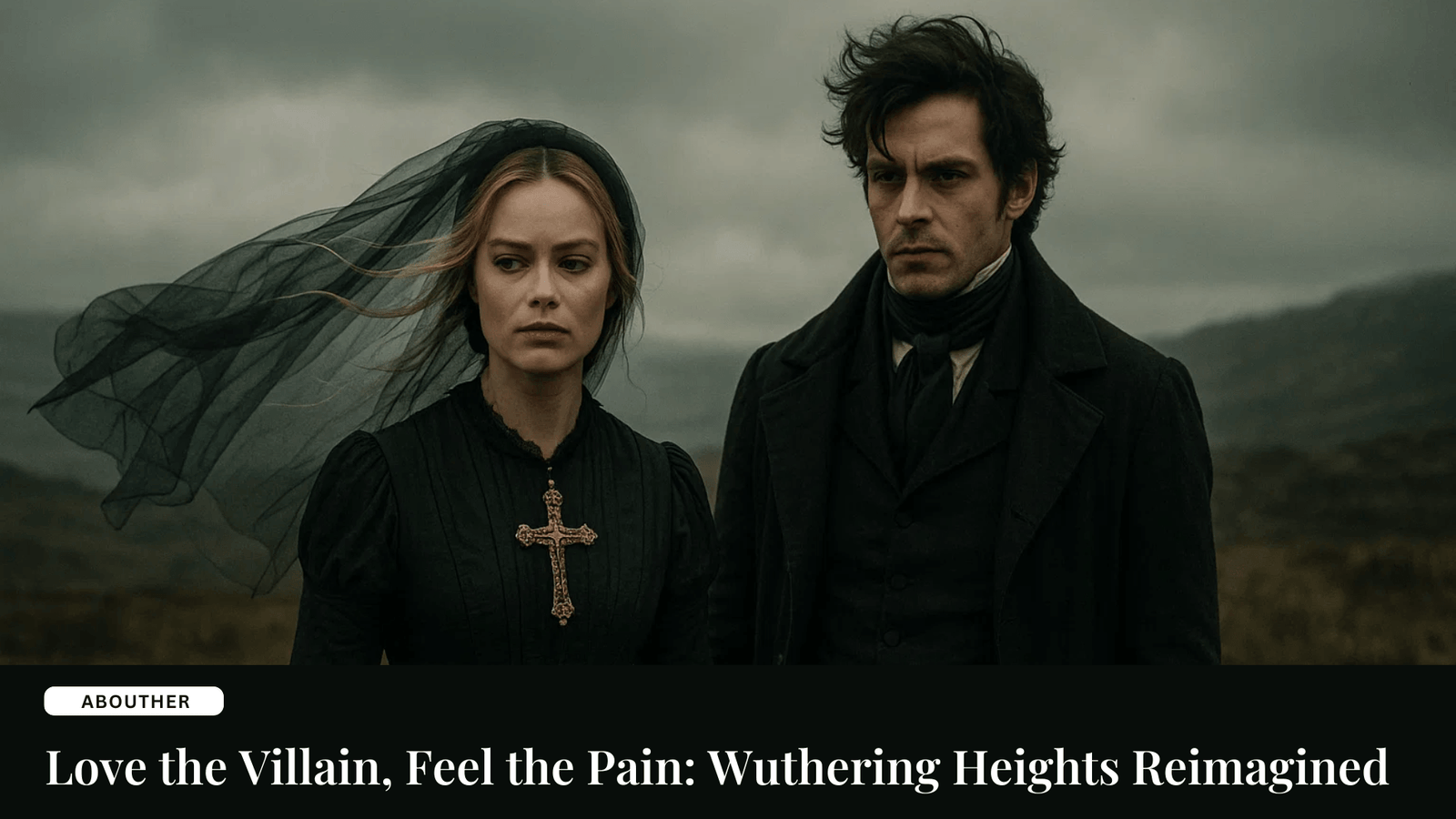
Love the Villain, Feel the Pain: Wuthering Heights Reimagined
You know that story that sticks in your chest long after the credits roll? That’s exactly what the February 2026 adaptation of Wuthering Heights does. Directed by Emerald Fennell, with a running time of 2h 16m, this reimagining of Emily Brontë’s tragic love story doesn’t whisper; it smolders.
And let me tell you, it’s not your high school English teacher’s moody, brooding Heathcliff slog. This is cinema you sink into. The kind that makes you lean forward, sip your coffee more slowly, and quietly question what you thought you knew about love, choices, pride, and emotional damage.
The story remains rooted in 18th-century England, where tragedy strikes when Heathcliff falls in love with Catherine Earnshaw, a woman whose world will never fully make space for him. Rejection, longing, ego, it’s all here. But filtered through a modern romantic lens.
Let’s talk casting.
Jacob Elordi steps into Heathcliff’s boots, and yes, he leans into the danger. This Heathcliff is softened compared to the novel’s more brutal incarnation, but he’s still magnetic. You see the boy shaped by exclusion, the man fueled by wounded pride, the lover undone by obsession. He’s morally grey in a way that feels tailored for today’s audience: intense, emotionally volatile, but human enough that we can’t quite look away. You understand him. You may even want him. And that complicity? Delicious.
Margot Robbie plays Catherine Earnshaw with fire and fragility intertwined. She’s not a passive romantic heroine; she’s sharp, restless, ambitious, and painfully aware of the choices in front of her. Catherine doesn’t shrink, she calculates, she yearns, she resists, she aches. Watching her navigate love versus security, desire versus dignity, feels uncomfortably relatable. Because how many women have been told to choose wisely rather than wildly?
Supporting performances deepen the emotional terrain. Shazad Latif’s Edgar Linton is the polished alternative. The safe choice. Soft-spoken, refined, emotionally available in a socially acceptable way. The man who offers comfort instead of combustion. And let’s be honest, we’ve all met an Edgar. Stable. Kind. Sensible. The one you should choose. But placed next to Heathcliff’s intensity, he almost feels like a warm room when you’ve already tasted lightning. The film quietly asks: Is security enough when your heart craves something wilder?
Also Read: “Partner Track”: The Truth on Ambition, the Boys’ Club, and the Cost of Playing Nice
And then there’s Isabella Linton Edgar’s pampered, privileged younger sister, played here with a fragile sharpness that makes her more than just a pawn. In the novel, Heathcliff despises her and marries her for revenge and access to her fortune. The film keeps that manipulation but adds another layer: jealousy. He doesn’t just use Isabella to hurt Edgar. He uses her to provoke Catherine. To remind her that he can wound too. It’s cruel. Strategic. Painfully human.
Isabella becomes collateral damage in a love story that was never gentle.
Now here’s where the conversation gets interesting.
Reviews are mixed. Some critics praise the visuals; the windswept moors are cinematic poetry, and the atmosphere is lush and intoxicating. Others return to the same refrain: it’s not a faithful adaptation. It softens the violence. It romanticizes the darkness. It leaves aside some of the novel’s most brutal, psychologically complex edges.
And they’re not wrong.
But here’s the thing: not being a perfect adaptation does not make it a bad film.
This movie isn’t trying to recreate every gothic shadow Brontë carved into the page. It’s creating an experience. One that centers emotional intensity over literary austerity. One that asks us to feel first and dissect later.
Heathcliff here is more approachable, more modern in emotional framing. Catherine’s agency feels amplified. Trauma is present but not grotesquely foregrounded. And that’s where the film quietly wins.
It explores how women and men process pain differently. Catherine internalizes, weighs, and performs strength. Heathcliff externalizes, combusts, and retaliates. Same hurt. Different expressions. Different consequences.
And love? Oh, it’s still consuming. But it’s packaged in a way that makes the audience complicit. You’re not recoiling, you’re leaning in. You’re asking yourself uncomfortable questions:
Would I choose safety or passion?
Would I mistake intensity for destiny?
Can love heal what trauma shaped?
Jealousy burns. Dignity flickers. Emotional intelligence, or the lack of it, drives everything.
And let’s be clear: part of the appeal is the villain factor. Women are increasingly drawn to morally grey characters not because we excuse their behavior, but because we crave complexity. We want layered humanity. We want flawed, emotionally charged, unpredictable energy. Heathcliff delivers that in a way that feels thrilling without tipping into pure monstrosity.
By the final scene, you’re not applauding a perfect adaptation. You’re sitting with a feeling.
It’s emotional without being melodramatic. Romantic without being naive. Visually lush. Psychologically accessible. And Catherine, most importantly, is given space. Voice. Weight.
So here’s my advice: go see Wuthering Heights (2026) for what it is. Go for the romance, the stormy glances, the morally grey allure, the emotional electricity between Robbie and Elordi. Don’t walk in expecting to relive every dark, violent, deeply unsettling layer of Brontë’s novel. That book remains untouchable in its depth.
But as a film? It’s messy. It’s divisive. And it’s absolutely worth the conversation.
Dark romance lovers, villain sympathizers, women who understand that love and choice are never simple, this one’s for you.
Share This On Social
About the Author: Sara Yahia

Related Posts






I’m Sangeeta Relan—an educator, writer, podcaster, researcher, and the founder of AboutHer. With over 30 years of experience teaching at the university level, I’ve also journeyed through life as a corporate wife, a mother, and now, a storyteller.