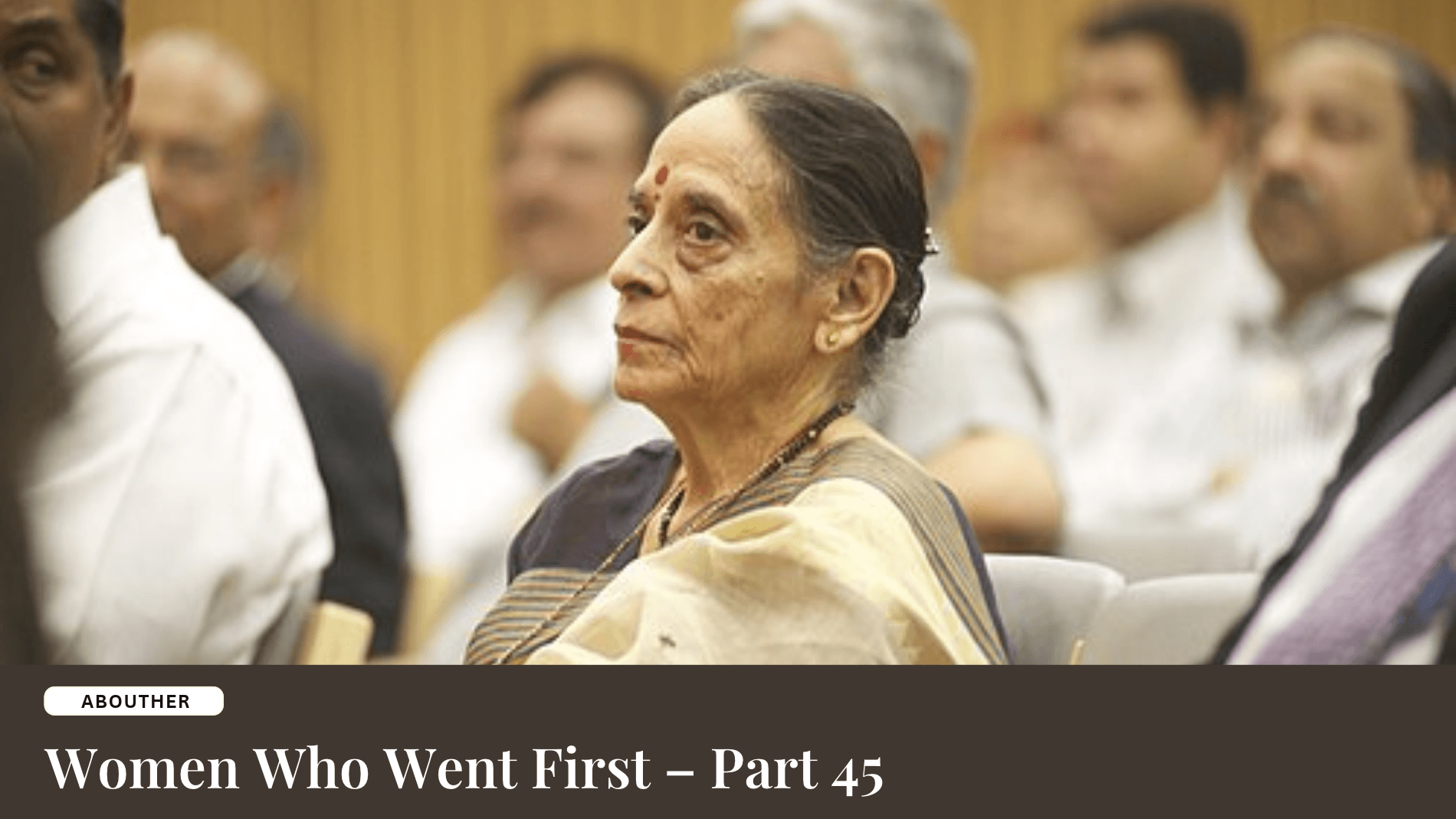
The Women Who Went First – Part 45
ISSUE 45 | THE WOMEN WHO WENT FIRST
CONTEMPORARY PORTRAIT
Leila
Seth
Seth
She topped the bar exam in England in 1958, became the first woman Chief Justice of an Indian High Court, sat on the Supreme Court bench, and then spent her retirement writing the law that protects children. She did not stop.
1958
TOPPED THE LONDON BAR EXAM
1978
FIRST WOMAN JUDGE OF DELHI HIGH COURT
1991
FIRST WOMAN CHIEF JUSTICE OF A HIGH COURT
2012
POCSO ACT DRAFTED UNDER HER GUIDANCE
THE BEGINNING
Leila Seth was born in Lucknow in 1930 and lost her father when she was eleven. The family had little money. She was educated partly on scholarships, married young, and followed her husband Prem Seth to London when he went to work there in the 1950s. In London, with two small children and a household to run, she decided to study law.
In 1958, she sat the bar examination at Lincoln’s Inn. She came first. Not first among the women, not first in her year from India. First overall, among all candidates. She was the first woman ever to top that examination. She returned to India and built a legal career that would span four decades and reshape what was possible for women in the Indian judiciary.
“She came first in the bar examination at Lincoln’s Inn in 1958, the first woman ever to do so. She returned to India and spent the next forty years making sure she was not the last.”
THE FIRSTS
A LIFE OF FIRSTS
1958 First woman to top the bar examination at Lincoln’s Inn, London
1978 First woman judge of the Delhi High Court
1991 First woman Chief Justice of any High Court in India, appointed to the Himachal Pradesh High Court
1992 Elevated to the Supreme Court of India, one of the first women to serve on the bench
2000 Member of the Law Commission of India, contributing to criminal law reform
2012 Member of the committee that drafted the Protection of Children from Sexual Offences Act (POCSO)
Also Read: The Women Who Went First – Part 44
Each of these firsts was not simply a personal milestone. Each one changed the visible horizon for every woman who came after. When Leila Seth walked into a courtroom as Chief Justice, something shifted in what was considered possible, not because she announced it, but because she was simply there, doing the work, in a role that had never held a woman before.
THE LAW SHE BUILT
POCSO · THE LAW THAT PROTECTS CHILDREN
In 2012, Leila Seth served on the committee that drafted the Protection of Children from Sexual Offences Act, one of the most significant pieces of child protection legislation in India’s history. POCSO created, for the first time, a comprehensive legal framework specifically addressing sexual abuse of children: clear definitions, mandatory reporting requirements, child-friendly court procedures, and stringent penalties.
Before POCSO, cases of child sexual abuse were prosecuted under general provisions of the Indian Penal Code that had not been designed for the purpose and were widely considered inadequate. The Act Leila Seth helped write gave prosecutors, courts, and survivors a framework that actually fit the crime.
She was eighty-two when she did this work. Retired from the bench, she could have considered her contribution complete. Instead she joined the committee, brought her decades of judicial experience to bear, and helped produce legislation that has since been used in tens of thousands of cases. This is what sustained commitment to justice looks like.
THE OTHER LIFE
Leila Seth’s son is the novelist Vikram Seth, author of A Suitable Boy. She wrote her own memoir, On Balance, published in 2003, which is frank and warm and entirely without self-importance. It covers her childhood, her marriage, her career, and also her son Shantum Seth’s Buddhism and her son Vikram’s homosexuality, which she discussed openly and with complete acceptance at a time when that required real courage in India.
She was publicly supportive of LGBTQ rights throughout her life and spoke against Section 377 of the Indian Penal Code, which criminalised homosexuality, with the clarity and authority that came from both her legal expertise and her personal investment. She understood that justice was not divisible: you could not spend a career building a fairer legal system and then look away when it was used to harm people you loved.
She died in Noida in May 2017, at eighty-six. The tributes were extensive and deserved. What they tended to emphasise was the string of firsts. What is worth also noting is the consistency of character across a very long life: the same precision, the same warmth, the same refusal to draw a line between professional obligation and personal integrity.
“She understood that justice was not divisible. You could not build a fairer legal system and then look away when it was used to harm people you loved.”
CROSS-SERIES CONNECTION · ISSUE 45
Read alongside Vimi (Issue 45), and the contrast is precise and painful. Vimi existed in an industry with no rules protecting her: no contract she could enforce, no recourse when she was discarded, no legal framework that recognised what had been done to her. Leila Seth spent her career building exactly the kind of legal protections that Vimi never had. The POCSO Act she helped write in 2012 was designed for children, but the impulse behind it, that the vulnerable deserve enforceable protection, is the answer to everything that happened to Vimi and to the countless women the film industry consumed and forgot.
WHY SHE BELONGS IN THIS SERIES
Leila Seth went first so many times that listing the firsts begins to feel inadequate. What the list does not capture is what it cost, in a profession that had been entirely male for its entire history, to walk into those rooms and do the work without making the fact of her presence the point. She was not interested in being a symbol. She was interested in getting things right. She topped an examination, sat on a bench, wrote legislation, and then went home and spoke plainly about her son’s homosexuality in a country that was still debating whether to criminalise it. She belonged in every room she entered, and she spent her life making sure the door stayed open behind her.
ISSUE 45 • CONTEMPORARY PORTRAIT • ABOUTHER MAGAZINE
THE WOMEN WHO WENT FIRST
Share This On Social
About the Author: Sangeeta Relan

Related Posts




I’m Sangeeta Relan—an educator, writer, podcaster, researcher, and the founder of AboutHer. With over 30 years of experience teaching at the university level, I’ve also journeyed through life as a corporate wife, a mother, and now, a storyteller.