The Women Who Went First – Part 18
AboutHer
STORIES. WOMEN. NOW.
THE WOMEN WHO WENT FIRST ✦ CONTEMPORARY
PORTRAIT · ISSUE NO. 18
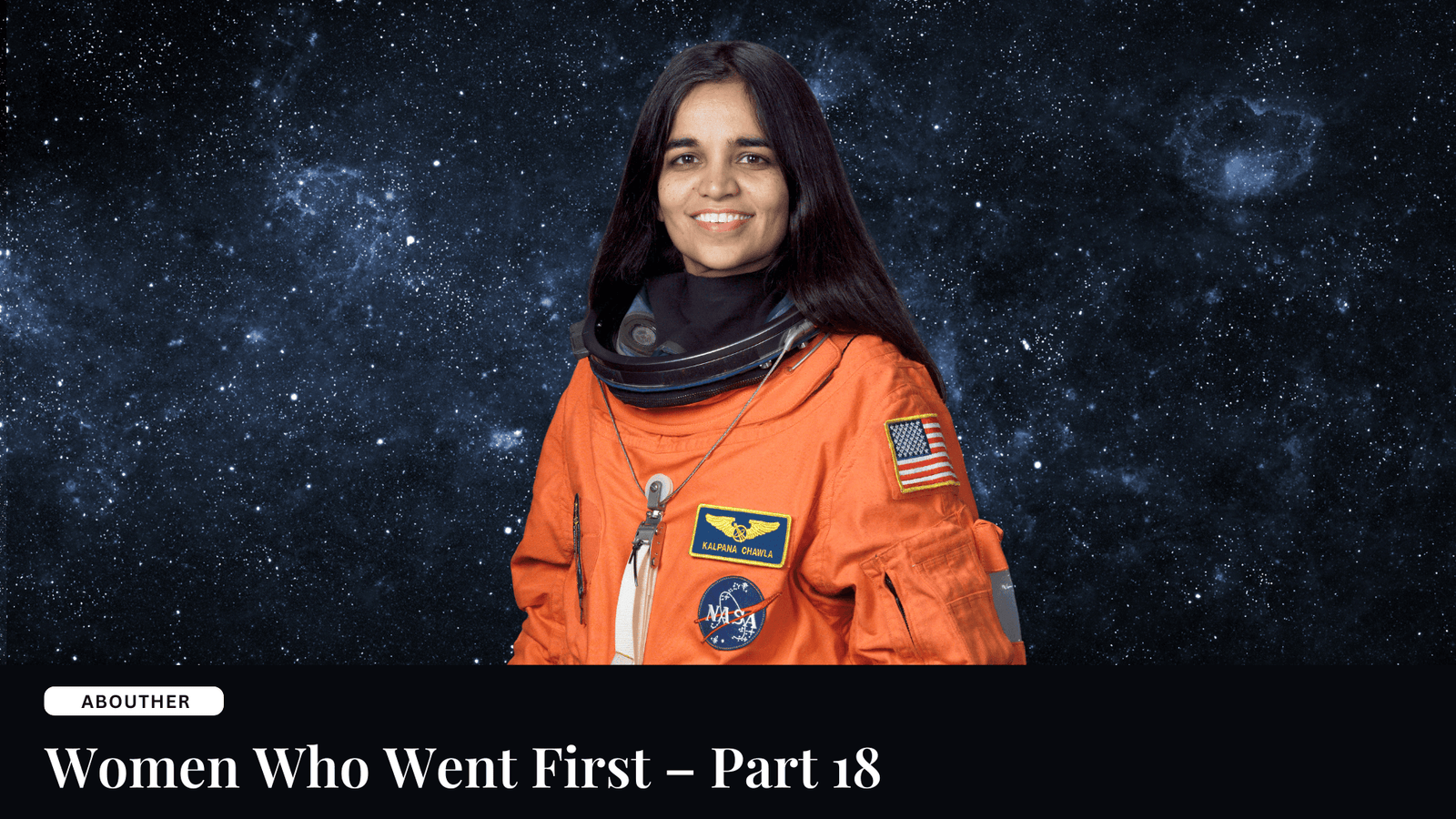
Kalpana
Chawla
Chawla
She grew up in Karnal watching planes overhead and decided, with complete seriousness, that she would one day be among the stars. She was right. She went twice. She did not come back from the second time.
On 1 February 2003, the Space Shuttle Columbia broke apart during re-entry into the Earth’s atmosphere, sixteen minutes before it was scheduled to land at Kennedy Space Center. All seven crew members died. Among them was Kalpana Chawla, forty-one years old, mission specialist, the first woman of Indian origin to travel to space. She had spent 30 days, 14 hours, and 54 minutes in space across two missions. She had logged over 375 hours beyond the Earth’s atmosphere. She died on the way home from the place she had spent her entire life trying to reach. This is her story, and it belongs in this series not because of how it ended but because of everything she did to get there.
THE GIRL FROM KARNAL
Kalpana Chawla was born on 17 March 1962 in Karnal, Haryana. She was the youngest of four children. From early childhood she was fascinated by aircraft, persuading her father to take her to the local flying club to watch small planes take off and land. She drew aircraft. She read about flight. She enrolled at Tagore Baal Niketan Senior Secondary School, where teachers remember her as quiet, focused, and completely certain about what she wanted.
She studied aeronautical engineering at Punjab Engineering College in Chandigarh, graduating in 1982, and then did something that required both courage and clarity: she left India for the United States to pursue her ambition at a level the infrastructure available to her in India at the time could not support. She completed a Masters in Aerospace Engineering from the University of Texas Arlington in 1984, and a second Masters and then a doctorate from the University of Colorado Boulder in 1988. By the time she joined NASA’s Ames Research Center, she was one of the most qualified aerospace engineers on staff.
THE ROAD TO NASA
She became a certified flight instructor, a licensed pilot for single and multi-engine aircraft, seaplanes, and gliders, and logged over 2,000 hours of flight time before NASA selected her as an astronaut candidate in December 1994. She became a United States citizen in 1990. The selection was the culmination of a decade and a half of deliberate, patient preparation, the kind that does not make for dramatic storytelling but that is in fact the substance of most serious achievement.
2,000+
FLIGHT HOURS
LOGGED BEFORE
NASA SELECTION
375+
HOURS SPENT IN
SPACE ACROSS
TWO MISSIONS
1997
YEAR SHE BECAME FIRST WOMAN OF INDIAN ORIGIN IN SPACE
THE FIRST MISSION
STS-87, NOVEMBER 1997
Kalpana Chawla’s first spaceflight was aboard Space Shuttle Columbia on mission STS-87, launched on 19 November 1997. She was the mission specialist and prime robotic arm operator. The mission focused on studying how the Sun’s outer atmospheric layer behaves and logged over 376 hours in space. During a spacewalk on the mission, a satellite malfunction occurred during deployment. Chawla was not responsible for the error, and a subsequent NASA investigation cleared her entirely. She spoke about the experience of being in space with a simplicity that those who heard it never forgot: looking down at the Earth, she said, she could not see the borders between countries. Only the planet, whole and undefended.
“The path from dreams to success does exist. May you have the vision to find it, the courage to get on to it, and the perseverance to follow it.”
KALPANA CHAWLA
WHAT SHE MEANT TO INDIA
When Kalpana Chawla launched into space in 1997, she became the first woman of Indian origin to do so, and the response in India was something beyond pride. She represented a specific possibility that had not existed in that form before: that a girl from a small city in Haryana, from an ordinary family, with a specific and unfashionable obsession, could follow that obsession all the way to space. Not as a fantasy. As a fact.
Girls named their ambitions after her. Schools put her photograph on walls. Parents who had been uncertain about their daughters’ impractical dreams found themselves reconsidering. She did not ask to be a symbol. She was one anyway, because the image of her in that NASA suit, having actually gone where she said she was going to go, was more persuasive than any argument anyone could make about what Indian girls were capable of.
PT USHA AND KALPANA CHAWLA
This series placed PT Usha in the previous issue, a woman who reached for something extraordinary on a track in Los Angeles and missed it by one hundredth of a second. Kalpana Chawla reached for something extraordinary beyond the Earth’s atmosphere and arrived. Both came from small-town India with large ambitions and inadequate infrastructure. Both refused to accept the limits their starting points suggested. The difference in their destinations, a running track and outer space, only makes the shared quality more vivid: the particular stubbornness of an Indian woman who has decided, quietly and completely, that she will go where she said she was going.
THE SECOND MISSION AND WHAT HAPPENED
STS-107, JANUARY 2003
Kalpana Chawla’s second spaceflight launched on 16 January 2003, again aboard Columbia. The mission carried a crew of seven and focused on science experiments across multiple disciplines. During launch, a piece of foam insulation broke off from the external tank and struck the leading edge of the shuttle’s left wing, damaging the thermal protection system. NASA engineers raised concerns during the mission. Their concerns were not acted upon. On 1 February 2003, as Columbia re-entered the Earth’s atmosphere, superheated gases penetrated the damaged wing and the shuttle disintegrated. Kalpana Chawla and her six crewmates died. She was forty-one years old. She had been in space for fifteen days, twenty-two hours, and twenty minutes on that final mission.
The investigation that followed identified both the technical failure and the institutional failures at NASA that allowed known risks to go unaddressed. The Columbia Accident Investigation Board was direct in its findings: the disaster was not simply the result of a piece of foam. It was the result of an organisation that had, over time, normalised risk in ways that made the unacceptable seem manageable. Kalpana Chawla and her crew died because of a technical failure that a different kind of decision-making culture might have caught.
None of this diminishes what she did or who she was. It is part of her story, and she would have wanted it told accurately.
WHAT SHE LEFT BEHIND
A satellite launched by ISRO carries her name. So does a meteorological satellite, a supercomputer at NASA Ames, a dormitory at the University of Texas, a road in Karnal, and several schools across India. The Kalpana Chawla Award for young women in science and technology is given annually. These are the visible parts of a legacy.
Also Read: The Women Who Went First – Part 17
The less visible part is harder to measure but more important. She is the reason certain conversations in certain families in India became possible. The daughter who wanted to study engineering instead of something more conventional. The girl who drew aircraft on her notebooks and was told it was not practical. The specific permission that comes from seeing someone who looks like you do the thing you said was impossible. Kalpana Chawla gave that permission to a generation of Indian girls, and the effects of that are still moving through the world.
WHY SHE BELONGS IN THIS SERIES
The Women Who Went First is about going somewhere no one who looks like you has gone before. Kalpana Chawla went to space. That is the most literal version of that premise this series has encountered, and it belongs here for exactly that reason.
But she also belongs here for something quieter. She belongs because she did the work. Not the dramatic work, not the work that makes for a single defining moment, but the long, patient, decade-spanning work of becoming qualified for the thing you want to do. The flight hours. The degrees. The certifications. The years at NASA before the selection, the years after the selection before the mission. She was not handed her place in space. She built it, qualification by qualification, hour by hour, with the kind of sustained seriousness that makes the dream look inevitable only in retrospect.
She went first. She went twice. On the way home from the second time, she did not make it back. We remember her going, because that is what mattered, and because the going changed what was possible for every Indian girl who came after her, and because the stars she went to see are still there, unchanged, and she knew them by name.
“She was not handed her place in space. She built it, qualification by qualification, hour by hour. And when she finally got there, she looked down and could not see the borders between countries. Only the planet, whole and undefended.”
THE WOMEN WHO WENT FIRST · ABOUTHER MAGAZINE
Share This On Social
About the Author: Sangeeta Relan

Related Posts


I’m Sangeeta Relan—an educator, writer, podcaster, researcher, and the founder of AboutHer. With over 30 years of experience teaching at the university level, I’ve also journeyed through life as a corporate wife, a mother, and now, a storyteller.