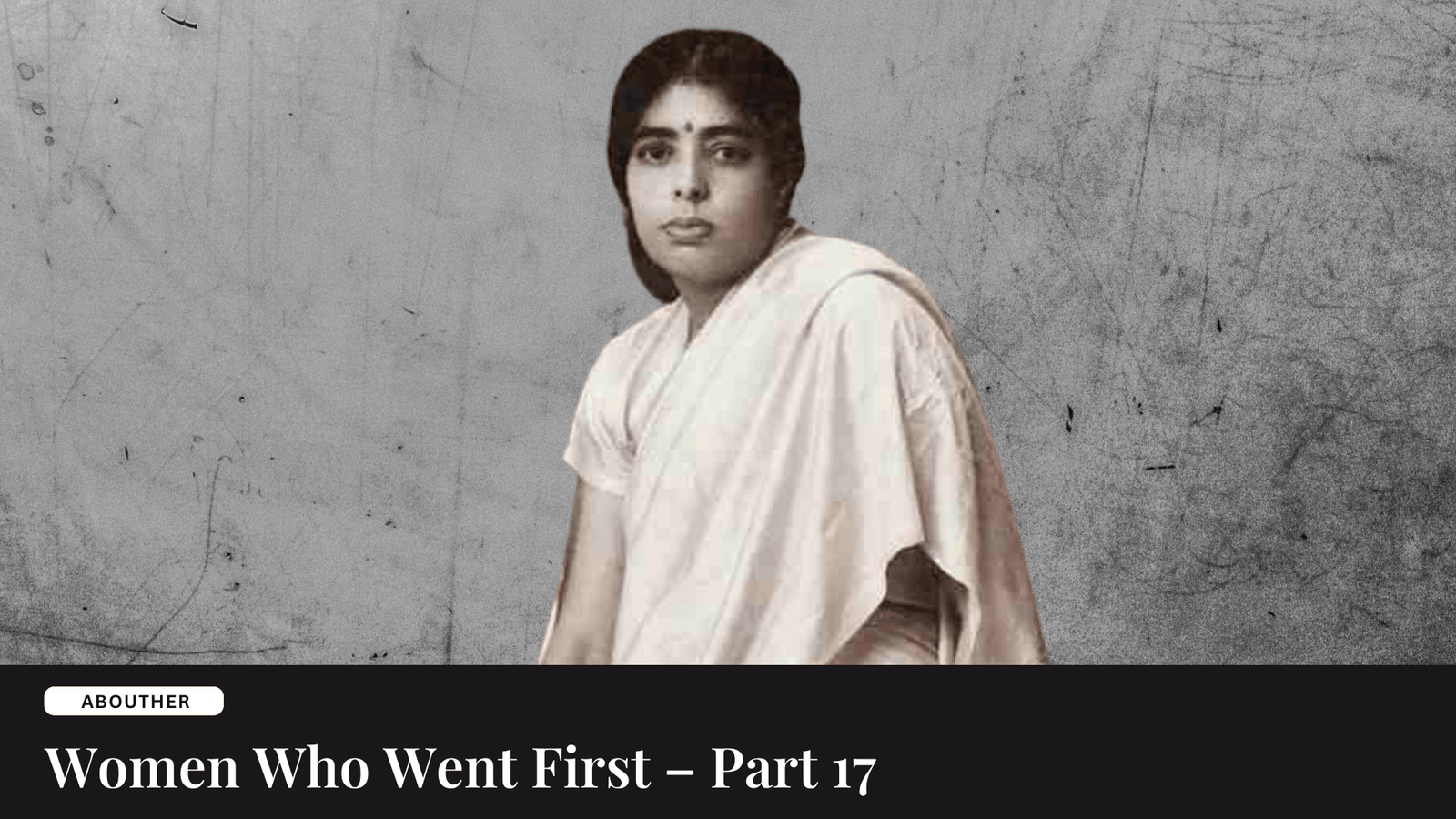
The Women Who Went First – Part 17
AboutHer
STORIES. WOMEN. NOW.
THE WOMEN WHO WENT FIRST ✦ FROM THE PAST
PORTRAIT · ISSUE NO. 17
Janaki
Ammal
Ammal
She mapped the chromosomes of sugarcane and magnolias at a time when Indian women were not expected to do science at all. Then she came home and spent the rest of her life making sure India’s botanical heritage survived.
There is a magnolia that carries her name. Magnolia kobus Janaki Ammal, named by the botanist E. K. Janaki Ammal herself in collaboration with colleagues at Kew Gardens in London, where she spent years doing research of the highest international standard while remaining, to most of the world, essentially invisible. She was one of India’s first women scientists. She worked in genetics and cytology at a time when both fields were young and when the idea of an Indian woman contributing to them was considered, in most quarters, implausible. She did it anyway, produced work that mattered, and then returned to India to build the botanical infrastructure that the country needed and did not yet have.
WHERE SHE CAME FROM
Edavaleth Kakkat Janaki Ammal was born in 1897 in Thalassery, in what is now Kerala, into a family that took education seriously enough to send her to school at a time when this was not universal for girls of any background. She graduated from Queen Mary’s College in Madras, then completed a honours degree in botany from Presidency College. She was awarded a Barbour Scholarship, given to women of Asian origin for study in the United States, and completed a Masters degree at the University of Michigan in 1925, followed by a doctorate in 1931, the first Indian woman to receive a doctorate in botany from an American university.
The education was exceptional. What she did with it was more so.
THE SCIENCE SHE DID
Janaki Ammal’s primary scientific contribution was in cytogenetics, the study of chromosomes and their role in heredity. She worked on sugarcane hybridisation at the Sugarcane Breeding Institute in Coimbatore, producing hybrids that combined the high sugar content of northern varieties with the hardiness of tropical ones. The work had direct practical consequences for Indian agriculture, improving yields for farmers across the country, though her name was rarely attached to those consequences in any visible way.
At Kew Gardens, where she worked from 1940, she collaborated on a landmark work called the Chromosome Atlas of Cultivated Plants, published in 1945. The atlas documented the chromosome numbers of cultivated plant species across the world, a foundational reference work for plant genetics that scientists still use today. She was the first Indian woman to be appointed to a permanent position at Kew, and she was there at a time when the institution was not especially designed to welcome either women or Indians.
KEW GARDENS, LONDON, 1940S
The Royal Botanic Gardens at Kew is among the most prestigious botanical research institutions in the world. When Janaki Ammal joined its staff in 1940, she was navigating an institution shaped by empire, working in a country that had colonised her own, in a field that had very few women at any level of seniority. She produced research there of lasting scientific value, collaborated with leading botanists, and contributed to publications that defined the field for a generation. She did this without the institutional support, the social ease, or the simple assumption of belonging that her male British colleagues carried with them as a matter of course.
THE RETURN AND WHAT SHE BUILT
In 1951, Jawaharlal Nehru personally invited Janaki Ammal to return to India to reorganise the Botanical Survey of India, which had fallen into considerable disarray since independence. The invitation was itself a measure of her standing. She accepted and spent the following decades working to build Indian botanical science into something worthy of the country’s extraordinary biodiversity.
She was appointed Director General of the Botanical Survey of India, the first woman to hold that position. She fought consistently for the conservation of India’s plant species at a time when development pressures were beginning to threaten ecosystems that had taken millennia to form. She was an early and vocal opponent of the Silent Valley hydroelectric project in Kerala, which would have flooded one of the last undisturbed tropical rainforests in India. Her advocacy contributed to the eventual decision to protect Silent Valley, which became a national park in 1980.
Also Read: The Women Who Went First – Part 16
WHAT SHE CONTRIBUTED
- Sugarcane hybridisation — developed high-yield, high-sugar varieties that improved agricultural output across India
- Chromosome Atlas of Cultivated Plants — co-authored the foundational reference work in plant cytogenetics, still in use today
- Botanical Survey of India — reorganised and rebuilt the institution after independence as its first woman Director General
- Silent Valley conservation — her advocacy helped save one of India’s last undisturbed tropical rainforests from a hydroelectric project
- Magnolia kobus Janaki Ammal — a magnolia variety named in her honour, a permanent mark in the botanical record
“Every plant has a story. Our work is to listen carefully enough to hear it.”
E. K. JANAKI AMMAL
RECOGNITION, PARTIAL AND LATE
Janaki Ammal received the Padma Shri in 1977, when she was eighty years old. The honour was real and deserved and arrived four decades after the work that most warranted it. She died in 1984 in Chennai. A research institute in Srinagar carries her name. A national award for plant taxonomy is given in her honour. Her face appeared on a postage stamp in 2000.
These are not nothing. They are also not proportionate to the contribution. She was a scientist of genuine international standing who worked at the highest levels of her field across three countries, produced research that shaped plant genetics and Indian conservation, and spent her career doing it without the recognition, the resources, or the institutional backing that male scientists of equivalent achievement received as a matter of course. The gap between what she did and what she received for it is part of her story, and naming it is not complaint. It is accuracy.
THE SCIENTIST THE WORLD FORGOT TO REMEMBER
Janaki Ammal is not a household name in India, let alone internationally. This is a specific kind of erasure that happens to women scientists with particular frequency: their work enters the record, is used and built upon, and their names quietly detach from it. The Chromosome Atlas is cited. The sugarcane hybrids were grown. The Silent Valley was saved. Her name did not travel with any of these outcomes in the way it should have. This series exists, in part, to correct that kind of forgetting, one portrait at a time.
✦ ✦ ✦
WHY SHE BELONGS IN THIS SERIES
Science has been absent from the past slot in this series until now, and Janaki Ammal is the right person to fill it, not because she is the most famous Indian woman scientist, but because she is among the most significant and the least known. That gap between significance and visibility is itself the argument for including her.
She went first in the most literal sense available to a scientist: she went to places, institutions, and disciplines where no Indian woman had gone before, did work of lasting value there, and came home to build something that would outlast her. She did this without making a performance of the difficulty, without the kind of public profile that would have made her story easier to tell and harder to forget. She simply worked, carefully and seriously, for nearly sixty years, on plants and chromosomes and ecosystems and the question of what India’s natural world was worth protecting.
A magnolia carries her name. A rainforest survived because she argued for it. A generation of Indian botanists was trained in institutions she helped build. That is not invisibility. That is a legacy written in living things, which is perhaps the most fitting kind for a botanist, and the kind that this series is glad to put into words.
“A magnolia carries her name. A rainforest survived because she argued for it. A generation of botanists was trained in institutions she built. That is not invisibility. That is a legacy written in living things.”
THE WOMEN WHO WENT FIRST · ABOUTHER MAGAZINE
Share This On Social
About the Author: Sangeeta Relan

Related Posts




I’m Sangeeta Relan—an educator, writer, podcaster, researcher, and the founder of AboutHer. With over 30 years of experience teaching at the university level, I’ve also journeyed through life as a corporate wife, a mother, and now, a storyteller.