
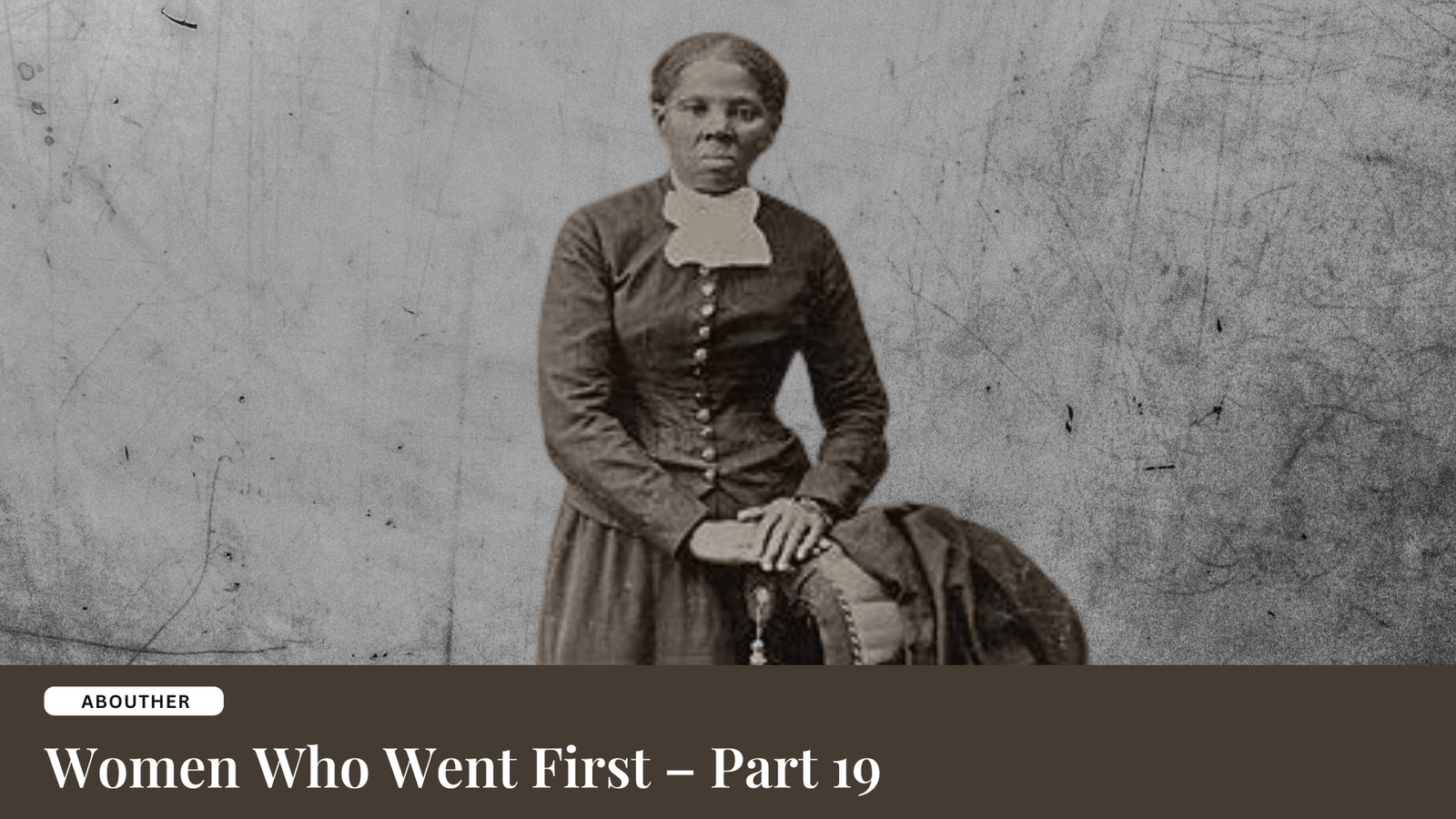
The Women Who Went First – Part 19
AboutHer
STORIES. WOMEN. NOW.
THE WOMEN WHO WENT FIRST ✦ FROM THE PAST
PORTRAIT · ISSUE NO. 19
Harriet
Tubman
Tubman
She escaped slavery alone and could have stayed free. Instead she went back. Thirteen times. She never lost a single person she was leading to freedom, and she did it as a fugitive with a price on her head.
Harriet Tubman was born into slavery, escaped it alone at the age of approximately twenty-seven, walked nearly ninety miles through darkness to reach freedom in Philadelphia, and then did something that no logic of self-preservation could explain: she went back. Not once. Thirteen times. Over the following decade she led approximately seventy people out of slavery through the Underground Railroad, a network of safe houses and secret routes that threaded through hostile territory where she was a wanted fugitive with a substantial bounty on her head. She never lost a single person she guided. She never allowed anyone to turn back. She is, by any measure, one of the most extraordinary human beings in recorded history, and she spent the first thirty years of her life as someone else’s property.
WHERE SHE CAME FROM
She was born Araminta Ross around 1822 in Dorchester County, Maryland, on a plantation. The approximate date matters: enslaved people’s births were rarely recorded with the care given to property of other kinds, and her exact age was never known with certainty. Her parents were Harriet Green and Benjamin Ross. She was one of nine children. She would later take her mother’s name as her own.
At thirteen she suffered an injury that would affect her for the rest of her life. An overseer, attempting to restrain another enslaved person who was fleeing, threw a two-pound lead weight that struck Tubman in the head. The injury caused narcoleptic episodes, sudden losses of consciousness that she experienced unpredictably throughout her life. She described them as visions. She navigated her entire career as a conductor on the Underground Railroad, her work as a spy, and her life as a public figure, with this condition, which could incapacitate her without warning, and which she treated not as a limitation but as a source of spiritual guidance.
THE ESCAPE
MARYLAND TO PHILADELPHIA, 1849
In 1849, fearing she was about to be sold further south, Tubman escaped. She travelled primarily at night, using the North Star to navigate, moving through safe houses operated by free Black people and white abolitionists who were part of the Underground Railroad. She covered roughly ninety miles on foot through territory where her capture would mean severe punishment or death. She arrived in Philadelphia alone. She later wrote that when she crossed into Pennsylvania she looked at her hands to see if she was the same person, because everything felt so different. She was free. She immediately began planning to go back for the people she had left behind.
THE CONDUCTOR
Between 1849 and 1860, Tubman made thirteen missions into slave territory and led approximately seventy people to freedom, including several of her own siblings and, eventually, her elderly parents. She operated under conditions of extraordinary danger. The Fugitive Slave Act of 1850 meant that escaped enslaved people could be captured and returned even from free states, which pushed her routes further north into Canada. The bounty on her head eventually reached the equivalent of hundreds of thousands of dollars in today’s terms.
Also Read: The Women Who Went First – Part 18
Her methods were precise and without sentiment. She moved groups at night, in winter when people were less likely to be outdoors. She carried a gun, not only for protection against slave catchers but, by her own account, to ensure that no one in her group could turn back and put others at risk. She said she would tell anyone who wanted to quit that they could go forward or die, because a person who turned back could be captured and tortured into revealing information about the routes and the safe houses that protected everyone else. She never had to use it. Nobody turned back.
13
MISSIONS INTO SLAVE TERRITORY TO LEAD PEOPLE TO FREEDOM
70+
PEOPLE SHE
PERSONALLY GUIDED
TO FREEDOM
0
PEOPLE LOST
ON ANY MISSION
SHE LED
“I never ran my train off the track and I never lost a passenger.”
HARRIET TUBMAN
THE SPY AND THE SOLDIER
THE CIVIL WAR, 1861 – 1865
When the American Civil War began, Tubman did not step back. She served the Union Army as a nurse, a cook, and then as a spy and intelligence operative, one of the first women in American history to lead an armed military raid. In June 1863 she guided Colonel James Montgomery and 150 Black Union soldiers up the Combahee River in South Carolina, having gathered intelligence about Confederate positions and the locations of underwater mines in the river. The raid freed more than 700 enslaved people in a single night. She received no military pension for this work for over thirty years after the war ended, and had to fight repeatedly for recognition that was eventually, partially, granted.
AFTER THE WAR
Tubman settled in Auburn, New York, after the war, in a house she had bought for her parents. She remained active in public life, working with Susan B. Anthony and others in the women’s suffrage movement, attending conventions, and speaking about her experiences. She established the Harriet Tubman Home for the Aged in Auburn in 1908, a residence for elderly Black people who had nowhere else to go. She continued working for the causes she believed in into her eighties.
She died in 1913, surrounded by friends and family, reportedly saying as she died: “I go to prepare a place for you.” She was approximately ninety-one years old. She had been born property. She died a legend, though the full scale of what she had done was not completely documented until decades after her death.
THE SAVITRIBAI PHULE CONNECTION
This series placed Savitribai Phule several issues ago: a woman who walked to school through a gauntlet of stones and dung, who understood that education was the instrument of liberation, and who built schools for the people her society had decided did not deserve to learn. Harriet Tubman understood the same thing about physical freedom. Both women operated in the 19th century. Both faced organised, violent opposition to the liberation they were pursuing. Both refused to stop. Both built for others rather than for themselves. The distance between a road in Pune and a swamp in Maryland is enormous. The moral clarity that drove both women is identical.
✦ ✦ ✦
WHY SHE BELONGS IN THIS SERIES
Every person in this series went first into a space that was not built for them. Harriet Tubman went first into a space that was actively trying to kill her, repeatedly, by choice, for other people. That is a different order of going first, and it belongs here.
She belongs here also because her story is about what leadership looks like when the stakes are absolute. She did not lead from a position of authority or institutional support. She led from knowledge, from courage, from the trust she had earned by going first herself, and from a clarity of purpose so complete that the people she guided trusted her with their lives and were right to do so. Not a single person she led was captured. That record, held over thirteen missions through hostile territory over more than a decade, is one of the most remarkable in the history of human leadership of any kind.
She also belongs because of what she did after the escapes were done. She did not retire into the safety of her own freedom. She turned to the next cause, and the next, because she understood that freedom is not a destination you arrive at and stay. It is a condition that has to be built, maintained, and extended to everyone who does not yet have it. She spent her entire life building it, for one person at a time, and then for everyone she could reach.
Savitribai Phule held the door open in all weather. Harriet Tubman went back through it, again and again, in the dark, to bring people through who could not find it alone. The series has been saying, in different ways and different languages and different centuries, that this is what going first actually means. Tubman is its most complete expression.
“She never lost a single person she was leading to freedom. She did this thirteen times, as a fugitive, in the dark, with a price on her head. That is not courage as an abstraction. That is courage as a practice, sustained over a decade, in the service of other people.”
THE WOMEN WHO WENT FIRST · ABOUTHER MAGAZINE
Share This On Social
About the Author: Sangeeta Relan

Related Posts



I’m Sangeeta Relan—an educator, writer, podcaster, researcher, and the founder of AboutHer. With over 30 years of experience teaching at the university level, I’ve also journeyed through life as a corporate wife, a mother, and now, a storyteller.