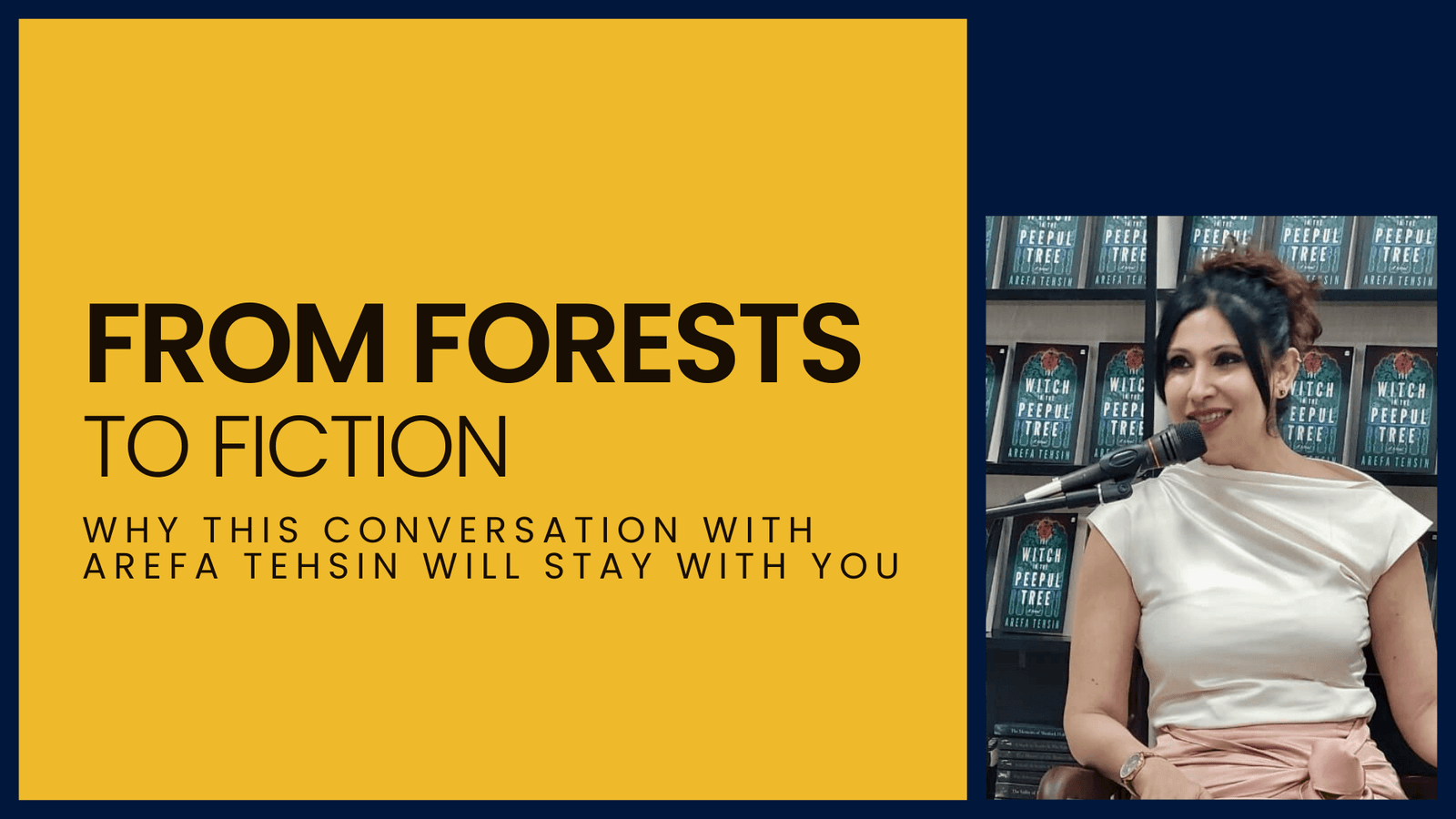
From Forests to Fiction: Why This Conversation With Arefa Tehsin Will Stay With You
We live in an age where children are growing up surrounded by screens, yet increasingly disconnected from the living world, trees that don’t have a name, birds that are only “background sound,” and forests that feel like something distant, seen only on a weekend trip or in a documentary. In that context, this conversation is not “just” about books. It is about how stories can rebuild the bridge between humans and nature, and why imagination, often dismissed as frivolous, is actually one of the most powerful tools we have.
In this episode of The AboutHer Show, author and conservationist Arefa Tehsin reminds us that conservation doesn’t begin with preaching. It begins with connection. And connection begins with stories.
If you love literature, wildlife, strong voices, or simply conversations that feel wise without being heavy, this one is for you.
Meet Arefa Tehsin: A Writer Raised by the Wild
Arefa Tehsin is an author of 19+ books for children and adults, spanning fantasy, fiction, nature writing, and stories that carry the textures of Indian culture with a rare authenticity. She has contributed columns, features, and travel writing to leading publications, and her work has travelled far beyond borders: translated widely, read aloud across India, and even adopted by schools as textbooks and supplementary readers.
But what makes Arefa’s storytelling truly distinctive is where it comes from. She grew up exploring forests, caves, and wilderness landscapes with her father, the renowned naturalist Dr. Raza Tehsin. Yet, as she shares in the episode, what shaped her most wasn’t only the wild itself—it was his belief in imagination.
He didn’t push her toward better marks. He pushed her toward better thinking. And perhaps that’s why her writing, across audiences and genres, eels so alive.
Key Takeaways from the Conversation
1) A writer’s superpower is empathy
Arefa describes her process in a way that’s both striking and unforgettable: she doesn’t simply write characters, she becomes them. That’s how she moves between children’s books and adult fiction so seamlessly. It’s a reminder that great writing isn’t about vocabulary. It’s about entering another life honestly.
Also Read: Stories, History & Strong Women, Mallika Ravikumar on Writing for Young Minds
2) Imagination isn’t an escape—it’s evolution
One of the most profound ideas she shares is the role imagination plays in human progress. It’s not a soft skill; it’s a survival skill. It shapes everything, from civilisation to storytelling, and is often the very thing adults forget to nurture.
3) You can’t “teach” children to love nature—you have to help them feel it
Arefa makes a powerful point: children won’t connect with nature through instruction alone. Stories and lived experiences are what create lasting bonds. This idea runs through her work and her philosophy as a writer and conservationist.
4) Universal stories are built on universal emotions
When Arefa speaks about The Elephant Bird, read across thousands of locations, she explains its resonance through emotion: loss, hope, and the desire to save what matters. Those feelings transcend language, country, and age.
5) Women’s barriers are often social, not professional
In a refreshing twist, Arefa shares she didn’t experience gender bias in the expected ways while writing on wildlife and wilderness, she was often welcomed precisely because it was uncommon. Yet she also underscores what truly holds many women back: lack of support, time, and space to pursue a passion that may not pay immediately.
6) Success becomes quieter, and more personal, with time
Awards and readership matter, she acknowledges. But true satisfaction, for her, comes from one thing: becoming better than she was before. It’s a deeply grounded definition of success—and one worth borrowing.
Quotes to Take With You
Here are a few lines from the conversation that deserve to be underlined:
“If you have to connect children with nature and wildlife, it cannot be through preaching and teaching. It has to be through stories and through experiences.”
“Every child in every culture knows the ache of losing and the hope of saving.”
“I believe that we do not have to save nature. Nature is saving us, but for how long depends on our collective actions as a species.”
“What gives me true satisfaction… is doing better than what I have done before, writing better than what I have done before.”
“I feel as a woman much more comfortable in a forest alone at night than I would in a city.”
Listen to the Episode:
Follow AboutHer + The AboutHer Show
If this conversation moved you, I invite you to stay connected with the AboutHer community—because every episode is built around stories that spark reflection, courage, and possibility.
✅ Follow AboutHer on Instagram, Facebook, LinkedIn, Twitter, and Pinterest for clips, quotes, articles, and updates
✅ Follow The AboutHer Show on Spotify, Apple Podcasts, or Audible
✅ For collaborations and queries: web.abouther@gmail.com
✅ And if you know a remarkable woman, or an inspiring man who champions women’s journeys, write to us. We’d love to bring their story to life.
Your support matters. When you subscribe, rate, review, and share, you help these voices travel further.
Share This On Social
About the Author: Sangeeta Relan

Related Posts



I’m Sangeeta Relan—an educator, writer, podcaster, researcher, and the founder of AboutHer. With over 30 years of experience teaching at the university level, I’ve also journeyed through life as a corporate wife, a mother, and now, a storyteller.