Women Who Went First – Part 3
In this AboutHer series, we spotlight women across time who changed what was possible by daring to be first. Some challenged social norms. Others broke professional barriers. All expanded the horizon for the women who followed.
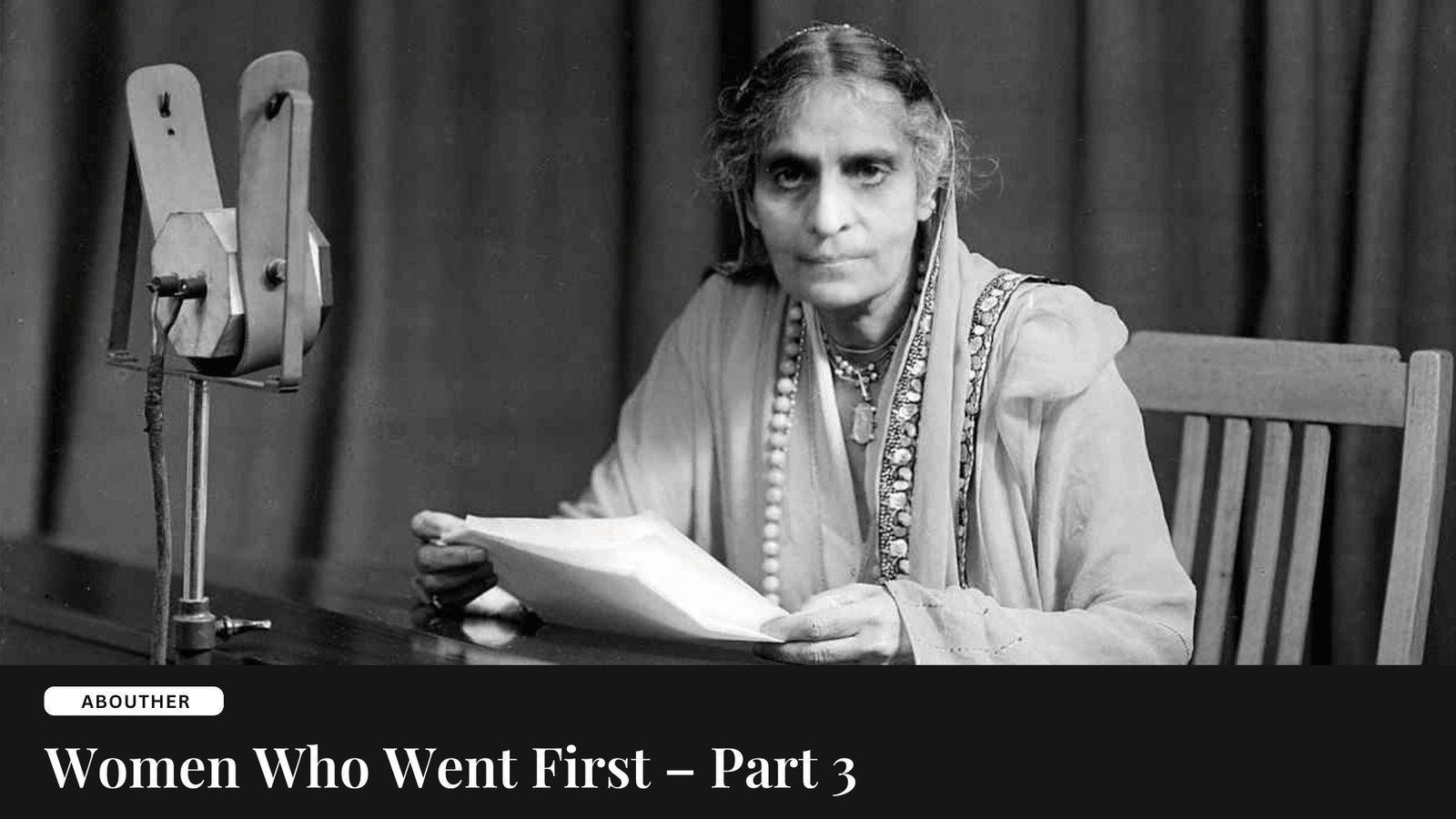
The Woman Who Gave a Voice to the Voiceless: Cornelia Sorabji
Some barriers are visible.
Others are deeply embedded in systems, so much so that those affected by them are not even seen.
In colonial India, there existed a group of women who lived behind physical and social boundaries. They were bound by the practice of purdah, often confined to their homes, unable to step into public spaces, and more importantly, unable to access legal systems that governed their lives.
They had property.
They had rights.
But they had no voice.
And then came a woman who changed that.
Her name was Cornelia Sorabji.
Born in 1866, at a time when women’s education itself was still contested, Cornelia grew up in an environment that valued learning. Encouraged by her family, she pursued education with determination and excellence, eventually becoming the first woman to study law at the University of Oxford.
This achievement alone was remarkable.
But it was only the beginning.
Despite completing her legal education, Cornelia was not allowed to practice law in India because women were not recognised as advocates at the time. She had the qualification. She had the knowledge. But the system did not yet have space for her.
It is here that her story becomes truly significant.
Instead of stepping away, she stepped in in a way that few others could.
Cornelia began working with women in purdah, particularly widows and women from wealthy households who owned property but were legally and socially restricted from interacting with male lawyers or appearing in court. These women were often vulnerable to exploitation because they could not directly assert their rights.
Cornelia became their bridge.
Also Read: Women Who Went First – Part 2
She advised them, represented their interests informally, and helped them navigate a system that was never designed to include them. She worked tirelessly, often without formal recognition, to ensure that these women were not silenced by circumstance.
Her work was not just about law.
It was about access.
It was about visibility.
It was about dignity.
Over time, as legal restrictions on women began to ease, Cornelia Sorabji went on to become the first woman advocate to practice law in India. What had once been denied to her became a space she helped open for others.
But perhaps what makes her journey so powerful is the nature of the barrier she broke.
Unlike professions where entry itself is the challenge, law is about representation, about whose voice is heard, whose rights are protected, and whose presence is acknowledged within systems of power.
By entering the legal profession, Cornelia did not just build a career.
She changed who could be represented.
She expanded who could be heard.
And in doing so, she addressed a form of inequality that was both invisible and deeply entrenched.
Her story also reminds us that being first is not always about recognition. For many years, her contributions were not widely acknowledged. Her work existed in the margins of formal systems, quietly impacting lives without the visibility that often accompanies achievement.
Yet impact does not require visibility to be real.
Today, women in law are visible across courtrooms, corporate firms, and judicial institutions. They argue cases, shape policies, and influence decisions. But the idea that women belong in these spaces had to begin somewhere.
It began with women like Cornelia Sorabji.
At AboutHer, when we reflect on women who went first, we often think of those who broke into professions. But her story invites us to think differently.
Sometimes, being first is not just about entering a system.
It is about changing how that system works.
It is about ensuring that those who were never meant to be part of it finally find a way in.
Cornelia Sorabji did not just become a lawyer.
She made the law accessible to women who had none.
AboutHer Reflection
Not all barriers are broken loudly. Some are dismantled quietly, case by case, life by life.
Cornelia Sorabji reminds us that true change is not just about occupying space, but about expanding it, so that others, especially those unseen and unheard, can finally step into it.
And in doing so, she did not just find her voice.
She gave one to many others.
Share This On Social
About the Author: Sangeeta Relan

Related Posts


I’m Sangeeta Relan—an educator, writer, podcaster, researcher, and the founder of AboutHer. With over 30 years of experience teaching at the university level, I’ve also journeyed through life as a corporate wife, a mother, and now, a storyteller.