The Women Who Went First – Part 23
AboutHer
STORIES. WOMEN. NOW.
THE WOMEN WHO WENT FIRST ✦ FROM THE PAST
PORTRAIT · ISSUE NO. 23
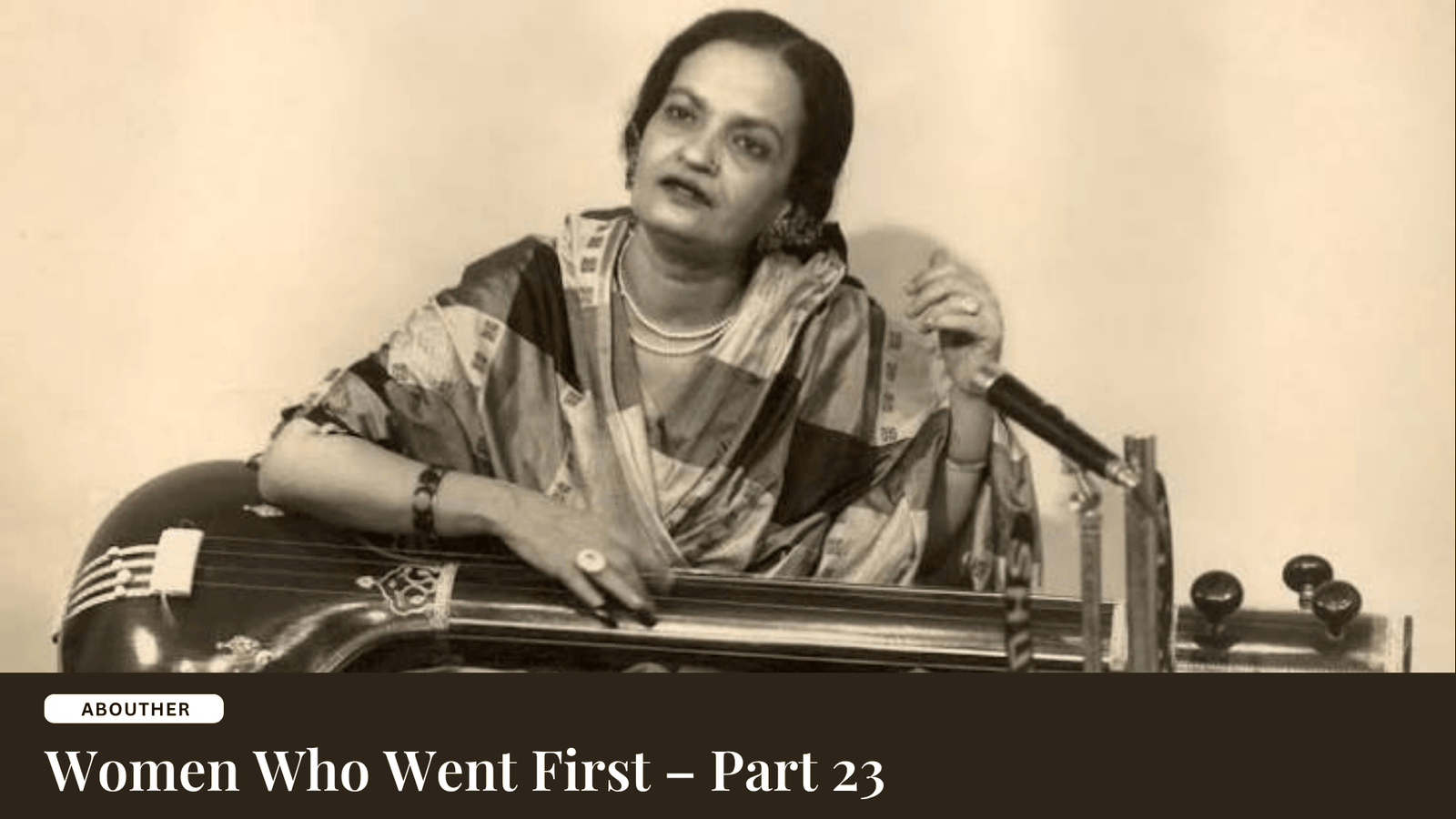
Begum
Akhtar
Akhtar
She was simultaneously the most celebrated and the most socially excluded woman in Indian classical music. The same voice that made her immortal made her, in the eyes of her era, unmarriageable. She sang anyway. She always sang anyway.
There is a recording of Begum Akhtar singing the ghazal Ae mohabbat tere anjam pe rona aaya that stops people the first time they hear it. Not because of its technical accomplishment, though the accomplishment is extraordinary, but because of what it communicates beyond technique: a complete emotional honesty, a willingness to carry grief in the voice without protecting the listener from its full weight, a quality that Hindustani classical music recognised as rare and that the society surrounding that music simultaneously celebrated and punished her for. She was the greatest ghazal singer of the twentieth century. She was also, for most of her life, considered socially beyond the pale by the same culture that adored her art. She navigated this contradiction with a dignity and a stubbornness that produced, over six decades, a body of recorded work that is among the most emotionally complete in the history of Indian music.
WHERE SHE CAME FROM
Bibbi, as she was called in childhood, was born Akhtaribai Faizabadi in 1914 in Faizabad, in what is now Uttar Pradesh. Her mother Mushtari Bai was a tawayaf, a courtesan and classical musician, which meant that Akhtar was born into a tradition that was simultaneously the custodian of some of the most refined musical culture in India and the object of profound social stigma. The tawayaf tradition had for centuries preserved and transmitted Hindustani classical music, ghazal, thumri, dadra, and related forms with a seriousness and a rigour that formal institutions rarely matched. It had also been systematically attacked by colonial reform movements and nationalist social reformers who, as with the devadasi tradition in South India, conflated the women’s art with their social position and sought to abolish both.
Akhtar received her training from some of the finest musicians of her time, including Imdad Khan and Ata Mohammed Khan, and later the great Abdul Wahid Khan of the Kirana gharana. The training was serious, sustained, and gave her a technical foundation of exceptional depth. What she added to it was entirely her own: a quality of emotional directness, a way of inhabiting the lyric from the inside rather than performing it from the outside, that distinguished her from every other singer of her generation.
THE SOCIAL CONTRADICTION
THE TAWAYAF AND HER ART
The tradition Begum Akhtar came from was among the most musically sophisticated in India and among the most socially stigmatised. Tawayafs were the primary custodians of ghazal and thumri in the Mughal and post-Mughal courts of North India, trained from childhood in music, poetry, and performance to a standard that few formal institutions approached. The colonial period and the nationalist reform movements that followed it attacked the tradition on moral grounds, passing legislation that drove tawayafs out of public performance and systematically dismantled the cultural infrastructure they had maintained for centuries. Akhtar inherited both the music and the stigma, and spent her life navigating a world that wanted to consume the former while pretending the latter did not exist.
THE MUSIC SHE MADE
Begum Akhtar’s primary forms were ghazal, thumri, and dadra, with occasional forays into chaiti and kajri. She sang in Urdu and Braj Bhasha with equal authority, and her interpretations of the great ghazal poets, Mir, Ghalib, Faiz, Jigar Moradabadi, became the standard against which all subsequent interpretations are measured. She did not merely sing the words. She inhabited the emotional world they described with a completeness that made the distinction between the singer and the song difficult to locate.
Also Read: The Women Who Went First – Part 22
THE FORMS SHE MASTERED
What she brought to all of these forms was a tonal quality, a roughness at the edges of an otherwise pure voice, that communicated something no technically perfect voice can communicate: the evidence of having actually felt what the lyric describes. Her voice carried longing, loss, and desire not as performed emotions but as lived ones, and audiences heard the difference immediately. She could silence a room not by commanding it but by inhabiting it so completely that the room had nowhere else to go.
“When I sing a ghazal, I am not singing about love. I am love, for those minutes. Nothing else exists.”
BEGUM AKHTAR
THE MARRIAGE AND THE SILENCE
THE YEARS SHE DID NOT SING
In 1945, Begum Akhtar married Ishtiaq Ahmed Abbasi, a barrister in Lucknow. The marriage required her to give up public performance, which was the condition her husband placed on it. She agreed and spent several years in domestic life without singing publicly. By most accounts these years were deeply difficult for her. Music was not incidental to who she was. It was the substance of her. The silence made her ill, physically and psychologically, and eventually her husband relented and allowed her to perform again. She returned to the stage and to the recording studio and produced, in the years that followed, some of her finest work, as though the enforced absence had clarified rather than diminished what she had to express. The episode is a familiar one in the lives of women artists of her era: the requirement to choose between the art and the marriage, the cost of making either choice, and the particular resilience required to reclaim what had been surrendered.
THE LATER YEARS AND THE RECOGNITION
Begum Akhtar received the Sangeet Natak Akademi Award in 1972 and the Padma Shri in 1968, followed by the Padma Bhushan in 1975, awarded posthumously. The recognition came relatively late for an artist of her stature, which is not unusual for women in the classical traditions, and was complicated throughout by the social position she came from, which polite cultural institutions preferred not to acknowledge even as they celebrated the art it had produced.
She died on 30 October 1974 in Ahmedabad, shortly after performing at a concert. She had been unwell and had been advised not to perform. She performed anyway. It was reported that she sang with exceptional beauty that evening, and that she collapsed after leaving the stage. She was sixty years old. Her recordings are all that remain of a voice that those who heard it live have described as unlike anything else in Indian music before or since.
THE AMRITA SHER-GIL PAIRING
This series placed Amrita Sher-Gil two issues ago: a painter who inhabited her subjects with complete emotional honesty and whose art came from personal experience rather than technical distance. Begum Akhtar did the same thing in a different medium. Both women were simultaneously celebrated for their art and stigmatised for the life from which that art came. Both refused to separate the two, understanding that the honesty was not incidental to the quality but its source. Both are now regarded as among the most significant figures in their respective traditions, recognised fully only after the social discomfort they caused had faded enough to allow the work to be seen clearly.
✦ ✦ ✦
WHY SHE BELONGS IN THIS SERIES
Music has not appeared in this series before, across twenty-two issues, and Begum Akhtar is the right person to bring it in because her story is not only about music. It is about the particular position of the woman artist who comes from a tradition that her society simultaneously depends on and despises, who produces work of the highest order from that position, and who navigates the contradiction between being celebrated and being excluded with a dignity that the celebrating society did not particularly earn or deserve.
She went first in the sense that matters most for this series: she went first into the full emotional range of her art, without the protection of social respectability, without the institutional support that her male contemporaries took for granted, and without the willingness to soften what she had to express in order to make it more comfortable for the people receiving it. Her voice carried everything she had lived, and she offered it without apology to anyone willing to listen.
She also belongs here because of what happened after the marriage and the silence. She came back. She sang again. She produced work in the years of her return that stands among the finest in the tradition. The resilience required to reclaim a voice that had been surrendered, to return to an art that had been taken away by the conditions of a marriage and then recovered, is its own kind of first. Not dramatic. Not public. But real, and hard, and entirely hers.
The last evening of her life she performed when she had been told not to. She sang with exceptional beauty. Then she left the stage. That is the complete shape of a life given entirely to music, and it belongs in this series without qualification.
“Her voice carried everything she had lived, and she offered it without apology to anyone willing to listen. The same quality that made her immortal made her, in the eyes of her era, impossible to fully accept. She sang anyway.”
THE WOMEN WHO WENT FIRST · ABOUTHER MAGAZINE
Share This On Social
About the Author: Sangeeta Relan

Related Posts


I’m Sangeeta Relan—an educator, writer, podcaster, researcher, and the founder of AboutHer. With over 30 years of experience teaching at the university level, I’ve also journeyed through life as a corporate wife, a mother, and now, a storyteller.