The Women Who Went First – Part 32
AboutHer
STORIES. WOMEN. NOW.
THE WOMEN WHO WENT FIRST ✦ CONTEMPORARY
PORTRAIT · ISSUE NO. 32
Avni
Chaturvedi
Chaturvedi
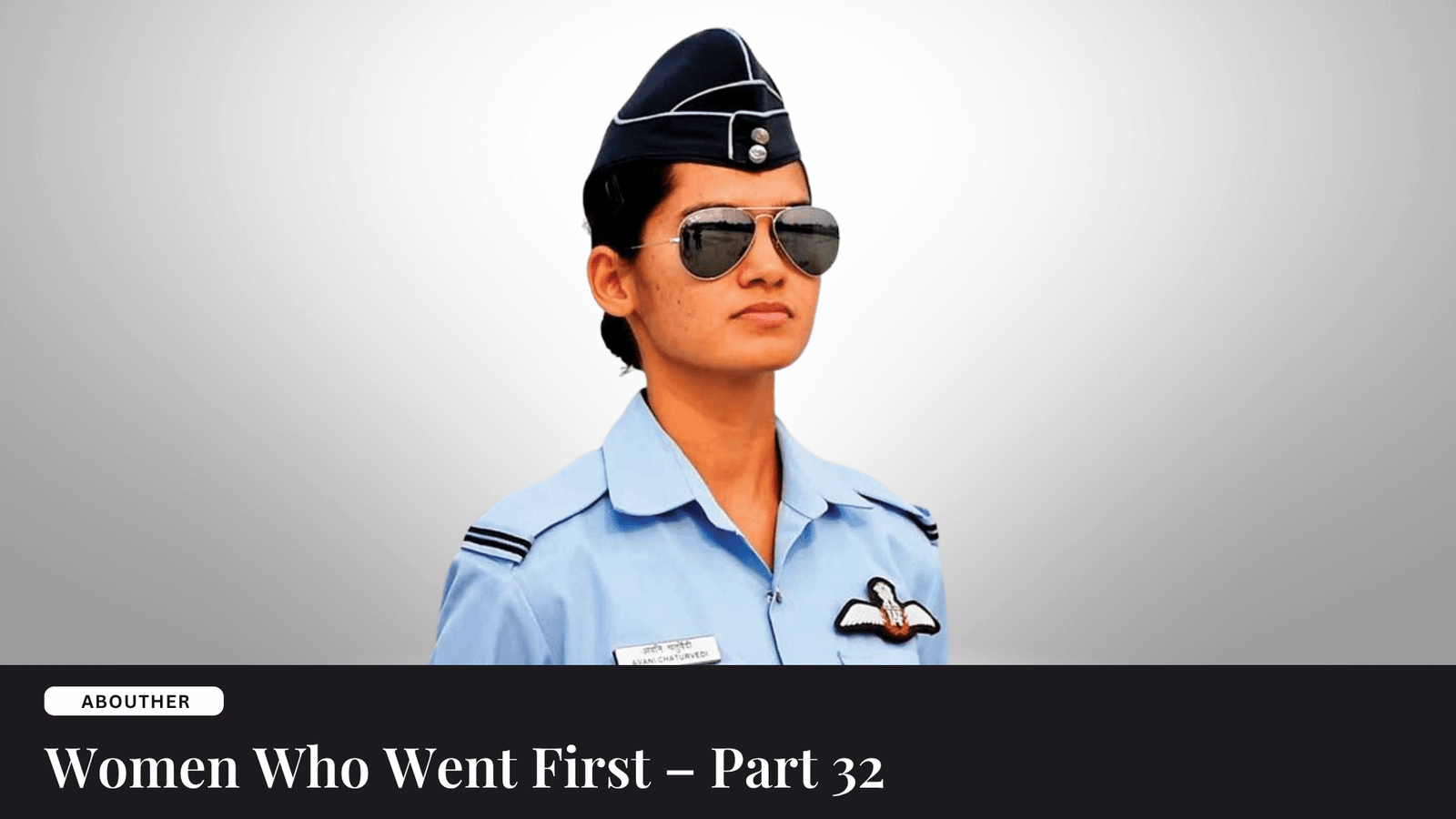
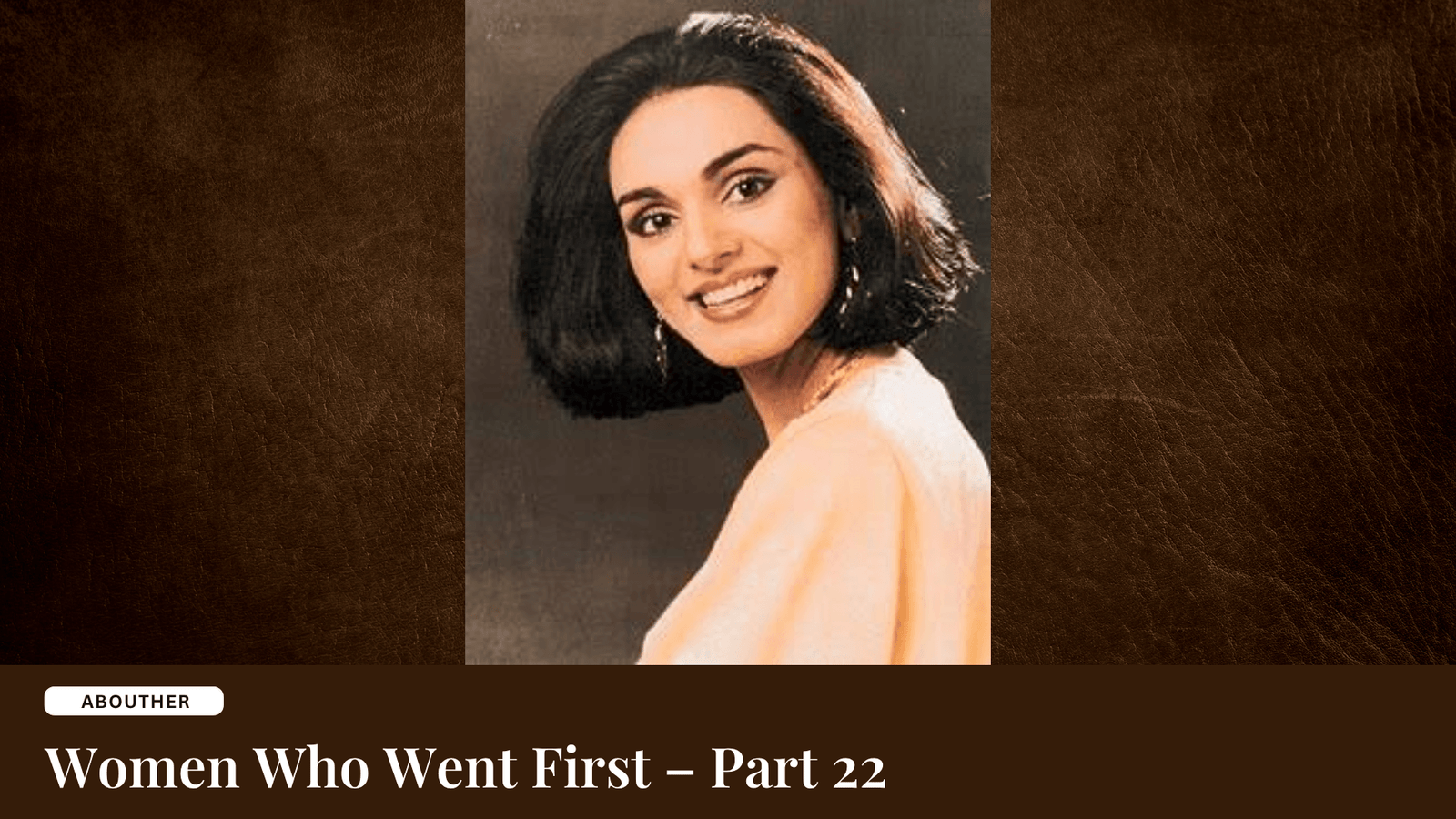
In February 2018, a twenty-four-year-old woman from Madhya Pradesh took a MiG-21 Bison into the air alone. No Indian woman had ever done that before. The Indian Air Force had existed for eighty-six years. She became its first.
The MiG-21 Bison is not a forgiving aircraft. It is fast, demanding, and unsparing of errors. Indian Air Force pilots call it the flying coffin, not affectionately, because of its accident record over decades of service. On a February morning in 2018, Flight Lieutenant Avni Chaturvedi climbed into one at Jamnagar air base in Gujarat and flew it alone. She was twenty-four years old. She was the first Indian woman to fly a combat aircraft solo, and she did it in one of the most technically demanding jets in the IAF fleet. The Indian Air Force had been flying since 1932. In eighty-six years, no woman had sat alone in a fighter cockpit and taken it into the air. Avni Chaturvedi did it on an otherwise ordinary February morning, and the barrier that fell that day had been standing for the entire history of Indian military aviation.
WHERE SHE CAME FROM
Avni Chaturvedi was born in 1993 in Vadnagar, Madhya Pradesh. Her father, Dinkar Chaturvedi, was a state government employee. She grew up in a household that valued education and ambition without any particular connection to the military or to aviation. She completed her engineering degree and applied to the IAF through the competitive selection process that screens thousands of candidates for a handful of places. She was selected.
She has spoken about wanting to fly since childhood, the way children sometimes fix on something enormous and refuse to let it go. Aviation as a career for a woman in India was already unusual. Combat aviation was not a career for women in India at all, because the IAF did not admit women to fighter pilot roles. That changed in 2015, when the government announced that women would be inducted into combat roles on an experimental basis. The first batch of three women completed their training and received their wings in June 2016. Avni Chaturvedi was one of them.
THE SOLO FLIGHT
JAMNAGAR AIR BASE, FEBRUARY 2018
A solo flight in a combat aircraft is a significant milestone in any pilot’s career. It is the moment when the instructor steps back and the pilot is fully alone with the machine and the sky. For Avni Chaturvedi, that milestone happened to coincide with a historical first. When she took the MiG-21 Bison up from Jamnagar in February 2018, she became the first Indian woman to fly a fighter jet solo. The flight itself was not announced as a landmark event. It was a scheduled training flight, part of the process of qualifying on the aircraft. The history it made was a consequence of her presence in the cockpit, not a ceremony arranged around it. She flew. She landed. And a barrier that had stood for eighty-six years was gone.
WHAT THE BARRIER ACTUALLY WAS
WHY IT TOOK UNTIL 2016
Women had served in the Indian Air Force for decades before 2016, in non-combat roles including transport and helicopter flying. The argument against admitting women to fighter pilot roles was not openly stated as a question of capability. It was framed in terms of infrastructure, of the physical demands of high-G manoeuvres, of the practical difficulties of deploying women in combat zones. Most of these arguments had been made against women in military roles in other countries and had been retired as those countries admitted women and found them fully capable. India admitted women to fighter pilot training in 2015 on an experimental basis, which itself was a form of hedging, as though the experiment might fail and the decision might be reversed. The experiment did not fail. Avni Chaturvedi, Bhawana Kanth, and Mohana Singh completed their training, received their wings, and went on to qualify on operational aircraft. The experimental basis has since become permanent policy.
THE FIRST THREE
Avni Chaturvedi, Bhawana Kanth, and Mohana Singh received their fighter pilot wings together at Dundigal Air Force Academy in June 2016, the first women in IAF history to do so. All three have since gone on to qualify on operational combat aircraft. Bhawana Kanth became the first woman cleared for day combat missions in 2020. Mohana Singh has qualified on the Hawk advanced jet trainer and has flown the MiG-21. Each of them has extended what the others made possible, which is exactly how firsts work when they are done with this kind of consistency and seriousness.
“The sky does not know your gender. The aircraft does not know your gender. Only the system knew, and now the system has changed.”
AVNI CHATURVEDI
Also Read: The Women Who Went First – Part 31
WHAT FLYING A MIG-21 ACTUALLY MEANS
The MiG-21 Bison is a supersonic jet fighter, originally designed in the Soviet Union in the 1950s and upgraded over successive decades. It flies at speeds exceeding Mach 2. It is highly responsive and requires constant active management by the pilot. The IAF has operated it since 1963 and has also suffered significant losses with it over the years, both in accidents and in combat. It is not a jet that forgives inattention or inexperience.
Qualifying to fly it solo requires months of training, first in simulators, then in dual-seat variants with an instructor, then finally alone. The physical demands include tolerating high gravitational forces during manoeuvres that can briefly multiply a pilot’s effective body weight several times over. The cognitive demands involve managing navigation, weapons systems, communications, and aircraft performance simultaneously at high speed. Avni Chaturvedi did all of this, and the fact that she is a woman is relevant only because the system had previously decided, without evidence, that women could not.
WHAT SHE REPRESENTS BEYOND THE FIRST
Avni Chaturvedi’s significance is not only in the solo flight. It is in what the solo flight represents about the relationship between institutional assumption and actual capability. The Indian Air Force assumed for eighty-six years that women could not be fighter pilots. That assumption was not based on testing women and finding them unable. It was based on not testing them at all, on simply not imagining them in the cockpit, on the accumulated weight of a tradition that had excluded them from the beginning.
When the assumption was finally set aside and women were trained and tested, what the IAF found was that they could do it. Avni Chaturvedi, Bhawana Kanth, and Mohana Singh did not just become fighter pilots. They demonstrated that the eighty-six years of exclusion had been based on nothing. That is a significant demonstration, and it has implications far beyond aviation.
AVNI CHATURVEDI AND PRIYA JHINGAN: A GENERATION OF FIRSTS
This series featured Priya Jhingan earlier: the first woman commissioned into the Indian Army, who joined in 1992 after writing a letter to the Army Chief asking why women were excluded and receiving, eventually, the answer that they would not be any longer. Avni Chaturvedi represents the next generation of the same argument, pushed further. Priya Jhingan opened the Indian Army to women officers. Avni Chaturvedi opened combat aviation to Indian women. Both broke barriers that had existed for the entire history of the institutions they entered. Between the two of them, across a generation, they changed what it means to serve India in uniform.
✦ ✦ ✦
WHY SHE BELONGS IN THIS SERIES
The Women Who Went First has told stories of women who went first into scholarship, into space, into courtrooms, into resistance, and into the most demanding versions of public and private courage. Avni Chaturvedi went first into a fighter cockpit, which is as literal a version of going first as this series has encountered since Valentina Tereshkova orbited the Earth in 1963.
She belongs here because she did something the entire history of Indian military aviation said could not be done, and she did it on a Tuesday morning in February as part of a scheduled training programme, without ceremony, without announcement, and without any indication that she found the occasion unusual. That quality of treating the extraordinary as simply the next thing to be done is, in this series, one of the clearest marks of someone who genuinely went first.
She belongs here also because she is young, still flying, still serving, and still part of a story that is not finished. The IAF’s permanent induction of women into combat roles means that the first she achieved will eventually be joined by many others, which is exactly what a good first produces. She broke a barrier so that the barrier would cease to exist. It has. The sky, as she has said herself, never knew the difference.
“She flew a MiG-21 Bison alone on a February morning and eighty-six years of institutional assumption ended quietly in the air above Jamnagar. The sky did not notice. Only history did.”
THE WOMEN WHO WENT FIRST · ABOUTHER MAGAZINE
Share This On Social
About the Author: Sangeeta Relan

Related Posts


I’m Sangeeta Relan—an educator, writer, podcaster, researcher, and the founder of AboutHer. With over 30 years of experience teaching at the university level, I’ve also journeyed through life as a corporate wife, a mother, and now, a storyteller.