The Woman Who Chose Herself Last Then First
ABOUTHER
Care & Choices | Season 3 | The AboutHer Show
— CARE & CHOICES —
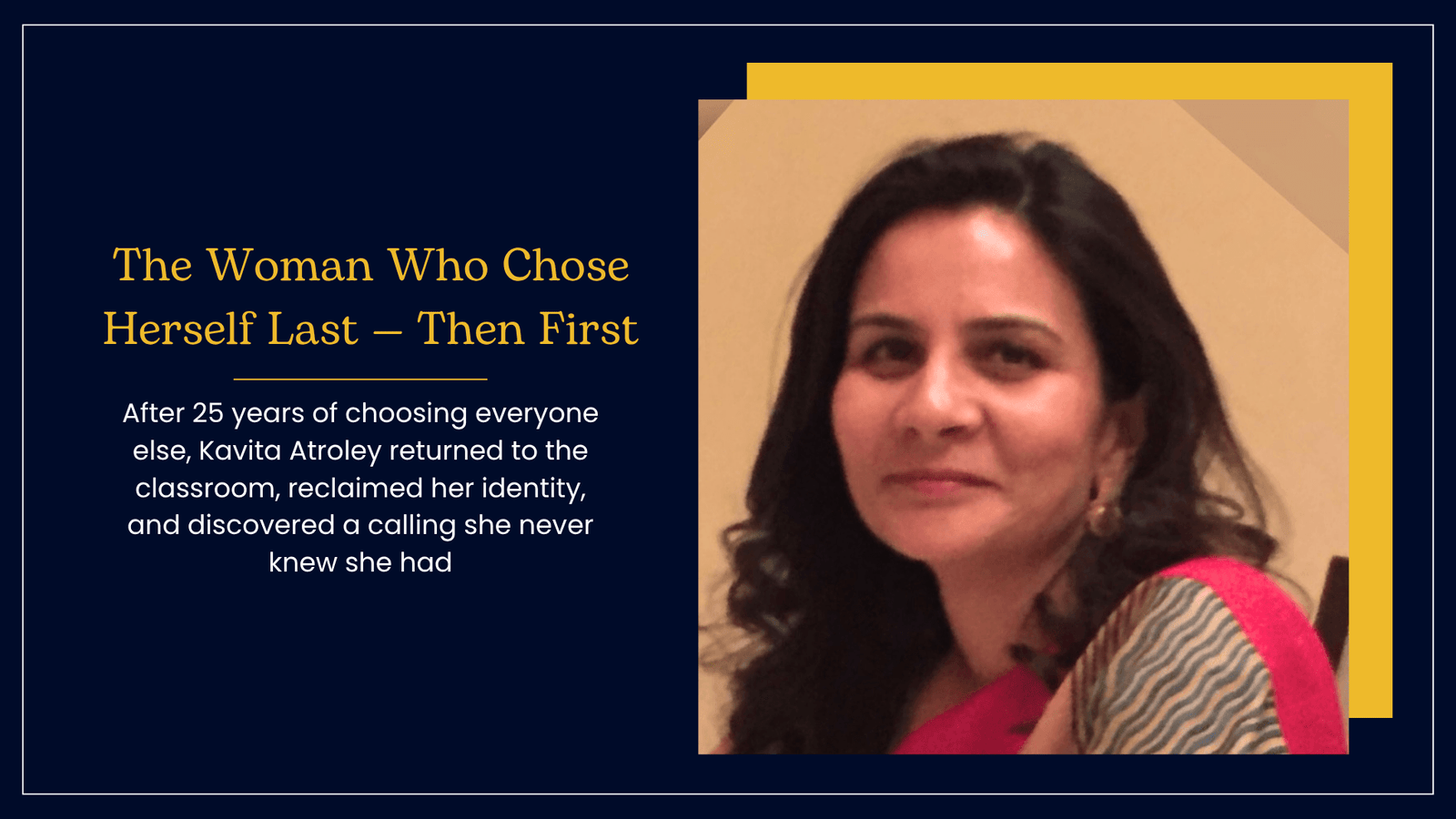
The Woman Who Chose Herself Last
— Then First
— Then First
After 25 years of choosing everyone else, Kavita Atroley returned to the classroom,
reclaimed her identity, and discovered a calling she never knew she had.
THE ABOUTHER SHOW — SEASON 3
There is a particular kind of silence that settles over a woman who has spent decades being everything to everyone. It is not the silence of emptiness. It is the silence of a voice that has learned, very carefully, to wait. Kavita Atroley knows that silence intimately. For over 25 years, she inhabited the roles that society handed her with quiet competence: wife, mother, daughter-in-law, the person who rose to every occasion before the occasion even asked. And beneath all of it, a small, persistent flame refused to go out.
What happened when she finally listened to that flame is the kind of story that does not announce itself with drama. It announces itself with a registration form, filled in and submitted before she had told another soul. Not even her husband. That is where Kavita’s second chapter begins: in the quiet, certain act of choosing herself.
✦ ✦ ✦
1. The Years That Shaped Her
Kavita is quick to correct a common assumption: she was not unhappy. That distinction matters enormously to her, and it should matter to us too, because it complicates the easy narrative of the frustrated housewife longing to escape. The truth was both quieter and more complex.
“I was never discontent. I just performed in a different manner,” she says. “But somewhere inside of me, I knew that I would want to one day step out of the house. I always prepared for when that right time would be.”
“I always looked at myself as somebody who would step out into the career world. But like they say, sometimes life happens. And this is what happened.”
— Kavita Atroley
There is something telling in the way strangers responded to her in those years. People would approach her in grocery stores and ask where she worked. Something in the way she carried herself, the purposefulness with which she moved through even ordinary tasks, signalled a professional sharpness that her circumstances had not extinguished. She brought a kind of professionalism to everything she did, even when the arena was domestic.
The roles she played were played fully. But the woman inside them was always, quietly, preparing.
2. The Moment That Changed Everything
The trigger, when it came, was not a crisis. It was a Montessori school. Kavita’s younger son was enrolled at a place called The Magic Years, and she was so struck by what it did for him that she walked up to the principal and asked to become part of it. She completed her Montessori training and began working there, stepping tentatively back into the professional world after years of telling herself she had missed the window.
“I had somewhere told myself: I can never go back to work after that many years of being a homebody. The world is changing rapidly. I’ll never be able to do anything.”
What she discovered instead was that the world had not moved on without her. It had simply been waiting for her to show up again. The response she received was overwhelmingly positive, and that validation became a confidence booster she has never forgotten.
“That’s where it finally sprouted again,” she says, “that desire to get out of the house and do something.” It would take several more years from that moment to reach where she is today. But the flame, once rekindled, did not go out again.
3. The Internal Battle of Choosing Yourself
When Kavita eventually enrolled in her Master’s programme, she did not stop being a homemaker. She simply added a new role to the ones already on her plate. She woke earlier, slept later, and grabbed 15-minute windows to read and study wherever she could find them. She ran the household exactly as before while also being a student. And then one day, she realised it was not sustainable.
“It’s not anybody else fighting us. It’s us women ourselves, because we feel that everything has to be perfect, everything else has to be done first before we start doing something for ourselves.”
— Kavita Atroley
The breakthrough came when she learned to say two small, revolutionary words to herself: it’s okay. It’s okay if dinner is not immaculate tonight. It’s okay if one task waits until tomorrow. It’s okay to prioritise herself without the world collapsing.
“That mantra is still my mantra,” she says. The shift was not external. Nobody was fighting her. The battle, as it so often is, was entirely within.
4. Back to the Classroom
When Kavita walked into a Master’s programme classroom, she found herself surrounded by freshly minted graduates, young people who had just stepped out of college. She was returning to formal education after two decades away. One might expect discomfort, self-consciousness, a desire to shrink.
What she experienced instead was something closer to delight. Her classmates responded to her with curiosity and warmth. Her children were fascinated. They helped her study, offered tips on exam technique, told her how to approach subjects she had never encountered before.
“My children were like, ‘Mom, you’re going to study at home?’ And they were out there helping me. It was like tables turning.”
Intellectually, she had to relearn the particular discipline of academic writing: answering specific questions on paper, structuring arguments the way examiners require. Life, she observes, teaches you differently. But by and by, she found her footing again.
5. From Qualification to Reclaimed Identity
The Master’s degree gave Kavita something far more valuable than the letters after her name. It gave her back herself. In her own words, it restored her confidence in a way that nothing else had.
“I sort of felt proud of myself again. Suddenly it’s as though the world has opened up for you. You had kind of shut yourself in a space where you felt you can’t do anything. And then you realise: I can.”
— Kavita Atroley
She speaks candidly about the withdrawal she had experienced in the years before: the retreating from social situations because she felt she had nothing to offer beyond her domestic roles. That retreat is familiar to many women who have spent long stretches of their lives as caregivers, slowly losing the thread of the professional or intellectual self they once were.
Completing the degree did not simply prove she could study. It proved she could become. And once that door opened, it did not close again.
6. Why Coaching, Why Now
The step from personal transformation to guiding others felt, for Kavita, almost inevitable. She speaks of an awareness that family structures have dissolved in many ways, that people are more alone than they used to be, and that the kind of consistent, patient listening once provided by extended families and tight communities is now often absent.
“Just being available to another person is very, very important. And sometimes, listening is the biggest thing you can do.”
The years she spent as a homemaker, caregiver and supporter gave her something specific to bring to coaching: a deep, lived understanding that every person is different, and that the first step in working with someone is to accept them exactly as they are. You start from acceptance, and the rest opens up from there.
7. What Success Means Now
Ask Kavita what success meant to her as a young woman, and she gives the honest, familiar answer: independence, earnings, standing, achievement. Ask her what it means today, and her answer has the quality of something hard-won.
“Peace is the biggest success for oneself, more than anything else. Just finding that satisfaction within yourself. Being happy with yourself. Unless you give yourself that approval, it doesn’t really work.”
— Kavita Atroley
She does not dismiss external success. She simply places it where it belongs: secondary to the internal kind. Material recognition comes and goes. Inner steadiness is what holds.
8. For Women Standing at the Edge
The thing that stops women, she says, is fear. Not family. Not age. Not circumstance. Fear. The fear of losing what has been carefully constructed. The fear of failing in front of people who are watching. The fear, particularly acute in midlife, of what others will say if it does not work out.
“When you say ‘it’s okay, what’s the worst that can possibly happen?’ — that’s when you can take a step forward. And every step taken forward is a way to the next step. But if you don’t take that first step, you’re not moving ahead at all.”
— Kavita Atroley
She is honest that it is not easy. The fear at midlife is different from the fear of youth. There is more at stake, or so it feels. But she also knows that this is an internal story, not an external one. And internal stories, however stubborn, can be rewritten.
She offers no tidy formula. She says everyone finds their own. What she does offer is the evidence of her own life: that it is possible, that it is worth it, and that the first step, terrifying as it is, leads to the next one. Always.
✦ ✦ ✦
Key Takeaways
| 1 | Discontent is not required You do not need to be unhappy to want more. Wanting growth and fulfilling your responsibilities are not in conflict. |
| 2 | The battle is internal The loudest resistance to change rarely comes from family or society. It comes from within. Address that first. |
| 3 | “It’s okay” is a mantra, not a resignation Learning to say it’s okay if things are imperfect is not giving up. It is the gateway to actually beginning. |
| 4 | Age is irrelevant to beginning Kavita registered for her Master’s programme before telling a single person. She did not wait for permission. Neither should you. |
| 5 | Identity is recoverable Years of caregiving can erode your sense of self. Education, purpose, and connection can restore it. It is not lost. It is waiting. |
| 6 | Lived experience is a professional asset The patience, empathy, and acceptance built in years of caregiving translate directly into the qualities that make a great coach or guide. |
Share This On Social
About the Author: Sangeeta Relan

Related Posts



I’m Sangeeta Relan—an educator, writer, podcaster, researcher, and the founder of AboutHer. With over 30 years of experience teaching at the university level, I’ve also journeyed through life as a corporate wife, a mother, and now, a storyteller.