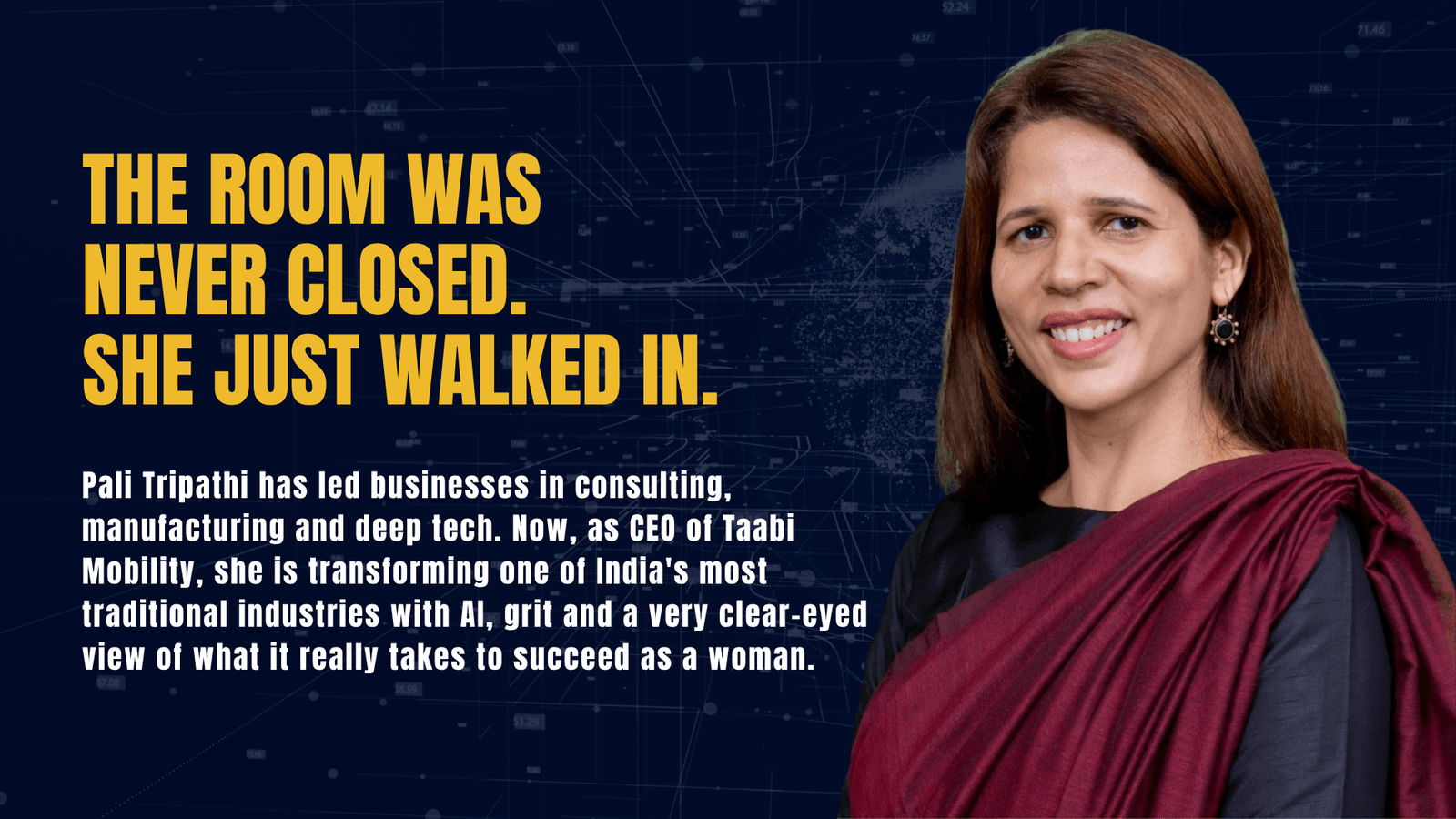
The Room Was Never Closed. She Just Walked In.
WOMEN IN LEADERSHIP · SEASON 4
The Room Was Never Closed. She Just Walked In.
Pali Tripathi has led businesses in consulting, manufacturing and deep tech. Now, as CEO of Taabi Mobility, she is transforming one of India’s most traditional industries with AI, grit and a very clear-eyed view of what it really takes to succeed as a woman.
There is a question Pali Tripathi has heard many times over nearly two decades of leading businesses across consulting, manufacturing and technology. It tends to arrive with good intentions and a slight tilt of the head. How do you manage, they ask, in industries like these? The answer she gives is disarmingly simple. She manages because she is good at what she does. And because what drives traction, as she puts it, is pretty genderless.
Pali is the CEO of Taabi Mobility, an AI and IoT company solving some of logistics and transportation’s most persistent inefficiencies. Her clients are cement companies, mining operators, fleet businesses. The industries her work touches are among the most male-dominated in India. And yet, when you sit with her long enough, the gender question feels almost beside the point. Not because it does not matter. It does. But because Pali has decided that the more interesting question is: once you are in the room, what do you do with it?
What drives traction is very genderless. It is credibility. The moment the conversation switches to the real problems, I don’t see gender playing a role.
PALI TRIPATHI, CEO, TAABI MOBILITY
Her path to Taabi was anything but linear. She has worked at Booz and Company, PwC Strategy, EY and Unilever, and held leadership roles across the RPG Group, including at CEAT. The common thread, she says, was never the industry. It was the problem. She has always gravitated toward situations where there was no playbook, where the answer had to be imagined before it could be executed.
Logistics was no different. Nobody, she laughs, grows up dreaming of fleet management. But when she looked at what logistics actually touches, everything from the school bus that carries a child to the multi-tonne equipment moving materials across a mining site, she saw something remarkable. Here was an industry that underpinned everything and had been almost entirely untouched by digital transformation. That was not a gap. That was an invitation.
Also Read- Voice, Visibility, Power: Kavita Kane on the Women Mythology Left Behind
“If there was ever a marriage that would be very beneficial between an industry and technology, I would put logistics right up there.”
At Taabi, that marriage takes the form of AI-native solutions that help companies reduce fuel consumption, predict route inefficiencies and make data-driven decisions at scale. But Pali is careful about how she sells it. Her customers are not buying AI. They are buying answers to questions they have had for years. How much will I save? Will my people be able to use it? Will it actually change behaviour on the ground? The technology is the engine. The conversation is always about the business.
What she finds most satisfying is that the commercial and the sustainable are not in tension at Taabi. They are the same thing. When a mining company reduces its fuel usage by ten percent, the bottom line improves. So does the carbon footprint. She believes the best form of energy is the energy that is not used. It is a philosophy that runs through everything the company does.
My profitability is in sync with sustainability. I don’t have to choose one over the other. The ways in which I am being profitable are exactly the ways in which I am being sustainable.
PALI TRIPATHI
On the question of being a woman in her world, Pali is both honest and precise. She has not personally been pushed out of a room because of her gender. But she has sat in rooms where women were not heard, where the same idea said by a woman and then repeated by a man suddenly had weight. She calls it a deafness, rooted in years of conditioning, and she has made it her practice to amplify women’s voices when she sees it happen.
She is also careful not to reduce bias to gender alone. Age, language, religion, anything that signals difference can trigger the same unconscious dismissal. She experienced it herself when she walked into a conversation with someone in their late fifties, already certain they would not keep up. She was wrong. The lesson stayed with her: ask, do not assume.
It is a lesson that shaped her thinking on structural change for women in industry. She is not interested in inspiration without infrastructure. If women cannot be deployed to certain territories because facilities do not exist, build the facilities. If CVs from women are not arriving because the perception is that logistics is not for them, go to campuses and change that perception. Leadership representation at the top creates mirrors for everyone below. That is where change actually begins.
“Everything starts at the top. People look for mirrors. If you have more leaders at the top, there will be more leaders created at every level.”
Running Taabi has taught her things that no consulting brief could. The weight of it is different when the stakes are not a client’s problem but the livelihoods of the people in her own company. She thinks about the trucks that need to be on the road because someone’s EMI depends on it. She has had to reckon with how she is perceived, how her presence in a room lands, and whether she is making it easier or harder for people to reach her. These are not things that appear in any job description. They are what running a company actually asks of you.
And future leaders? She would change one thing above everything else. Stop building them based on history. Performance is not the same as potential. The leaders organizations will need in ten years may not look like the ones who have succeeded in the last ten. The box, she says, should flex around the person. Not the other way around.
Her advice for any woman standing at the edge of an industry that has not historically welcomed her is three words. Say yes. Think later. The opportunity, she knows from experience, will not wait.
IN HER WORDS
“Every industry is male dominated. Some are more, some are less.
“What drives traction is very genderless. It is credibility.
“Where gender plays a role is: do you get the seat in the first place?
“Uncertainty is an opportunity. If there is no playbook, you have to imagine what is possible.
“My profitability is in sync with sustainability. I don’t have to choose one over the other.
“The best form of energy is the energy that is not used.
“Don’t build future leaders based on history. Performance is not the only indicator of potential.
“Say yes. Think later.
Five Things We Took Away
Not just about her. It takes all of us.
THE ABOUTHER SHOW | SANGEETA RELAN | SEASON 4
Share This On Social
About the Author: Sangeeta Relan

Related Posts


I’m Sangeeta Relan—an educator, writer, podcaster, researcher, and the founder of AboutHer. With over 30 years of experience teaching at the university level, I’ve also journeyed through life as a corporate wife, a mother, and now, a storyteller.