Stop Auditioning
THE ABOUTHER SHOW · IN CONVERSATION
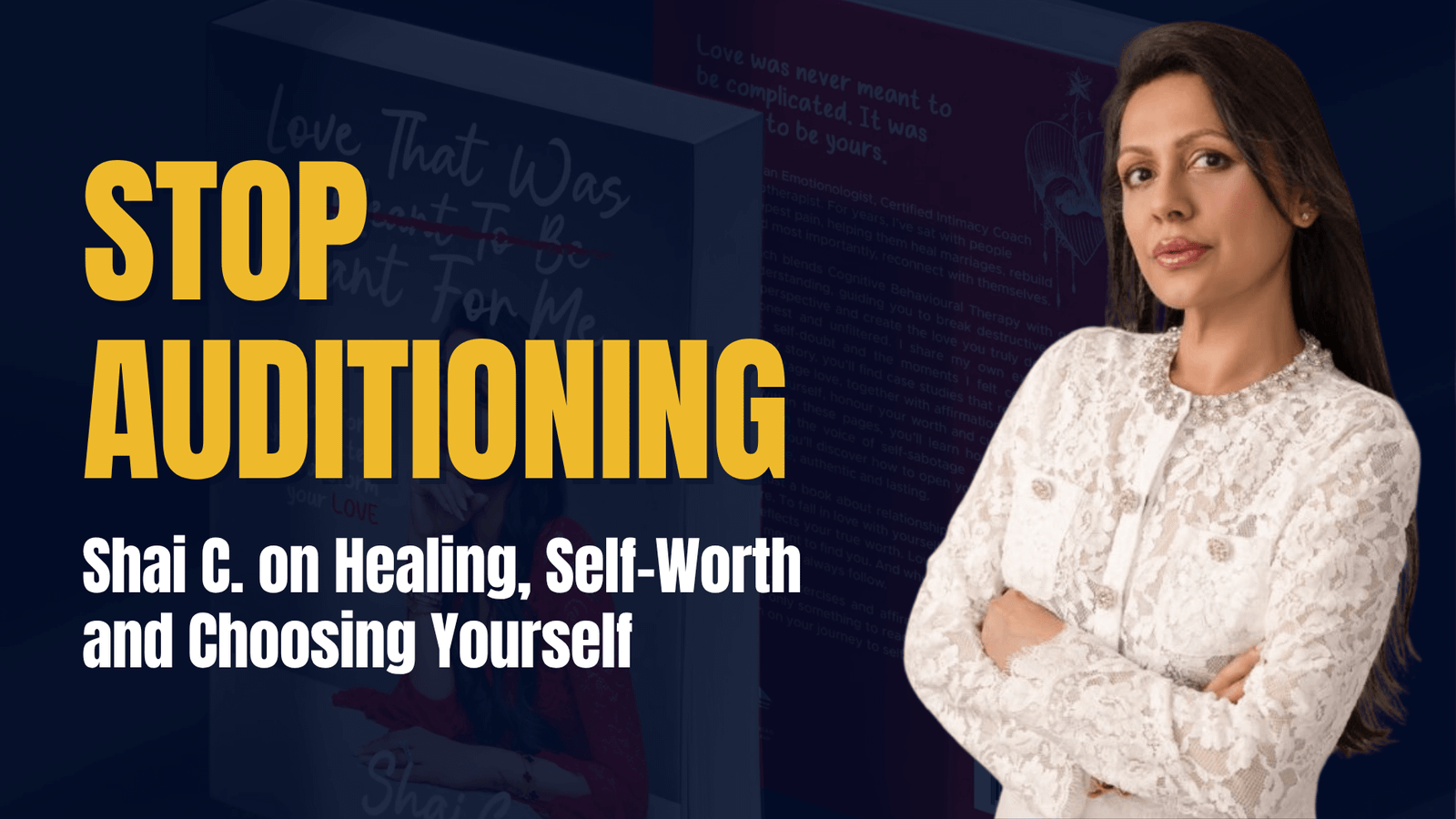
Stop Auditioning
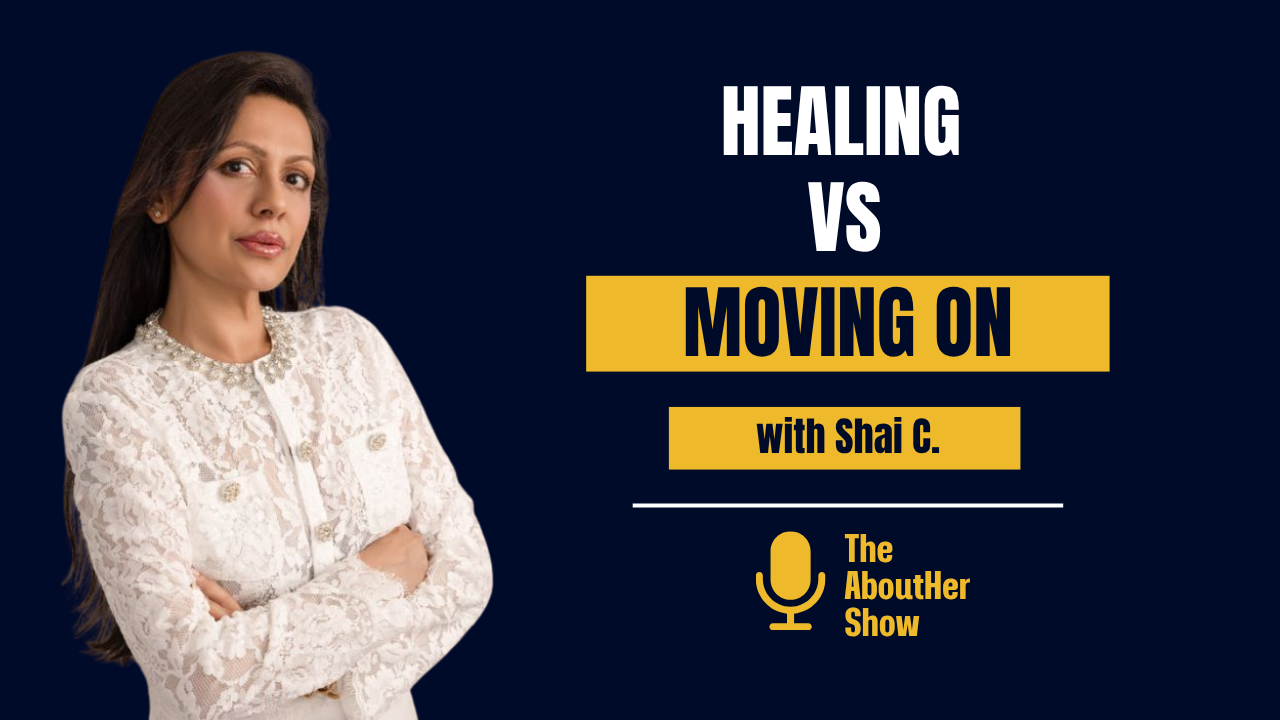
Shai C. on Healing, Self-Worth and Choosing Yourself
Shai C. on Healing, Self-Worth and Choosing Yourself
A behavioural strategist and the author of Love That Was Meant for Me, on why healing is not the same as moving on, and why so many women keep living other people’s lives.
Why you should read this
Have you ever walked into a room and wondered who likes you, before wondering who you like? Kept the peace at your own cost? Been told to “just move on” when you were still hurting?
Shai C. (Shalini Chuganee) is a behavioural strategist, mental health practitioner and author, and she says out loud what many in her field keep quiet. Read this for the one distinction that changes how you think about healing, and for the questions she believes every woman should ask before she commits to a relationship.
A guide, not an expert
When Shai joined me on The AboutHer Show, I expected a conversation about mental health. What I got felt closer to a lesson in being yourself.
I opened with a simple test. If I called her a therapist, what would she correct me on, in one sentence? She did not hesitate. A therapist, she said, is a guide, not the expert. “We don’t heal you. We help you heal yourselves.”
She was just as direct about her own role. She told me she is not the expert in the room, because the expertise comes from the person sitting across from her as well. Too many practitioners, she said, walk in as experts, and that is where it goes wrong.
Healing is not the same as moving on
We talk a lot about healing, and plenty of people simply say “move on.” I have always felt that is incomplete, so I asked Shai why so many women confuse the two.
Her answer was one of the clearest I have heard. Women assume that if they have moved on from a situation, they have healed from it. In her view, you have to move forward from a situation to heal it, and healing comes from processing, not from assuming it no longer hurts. “It always will hurt you,” she said. The healing lies in knowing you can still have a good life despite the hurt.
Then she drew a line I keep coming back to. You cannot let go of something, because to let go, you first have to hold on. What you can do is let it be. When you let it be, you move forward. When you try to let go, you move on, which is incomplete.
True healing, she told me, is coping. You know it happened, you use it to move forward, and if it happens again, you trust that you will be able to deal with it.
Listen to your body
I also asked what her body has taught her that no doctor ever did. Her answer surprised me. Those butterflies in the stomach are not love, she said. They are a red flag. If something makes you anxious, that is not excitement, and it is a sign to move away from that person or that situation. Her body’s message to her was simple: listen to me.
The pattern she had to unlearn
Her book, Love That Was Meant for Me, is about unlearning destructive patterns, so I asked which one she had to unlearn herself. Her answer was reactivity. She believed she could control how a person felt about her, or treated her, by reacting in order to change them. She had to accept that she was responsible only for herself, and she had to stop people pleasing and trying to alter others.
Also Read- Maria Denjongpa on Reclaiming the Woman Who Raised the Buddha
That is where she said the line I now think of often: “I think we all audition through life, and we need to stop auditioning at some point and allow ourselves to just be authentic.”
What practitioners are not supposed to say
I asked what mental health practitioners are not supposed to say out loud. Hers was an answer about judgment. A practitioner is not supposed to judge, or to arrive with a bias, whether the client is an individual or a couple dealing with something like an extramarital affair.
She told me she is an Indian woman raised in America and a mother of two, but she does not walk into a session as any of those. She walks in as a non-judgmental observer, there to help you heal with you holding the reins. The job is to help someone build a skill set and understand what they feel, so they can frame their own thoughts and make their own decisions.
The story behind the title
The title of her book came from her sixth failed relationship. She wrote poetry as a child, and it was poetry that gave her the words: “I loved loving you for that was meant to be. I loved letting you go for that was meant for me.”
When I asked which line from the book readers would screenshot most, she said the title itself. I understood why. It recognises what happened, and it lets it go without bitterness. And as she reminded me, we have to know where to draw the line, with boundaries that serve both us and the relationship.
Who walks into a room more scared?
I asked her to place a bet: do young women or young men walk into a room more scared? Her answer was men, and she explained why. She says men fall in love faster, and when they are rejected, they feel invalidated and emasculated. A woman can think, “he didn’t think I was pretty,” and still find a way to move forward. “Men get more emotionally impacted than women,” she told me. They are simply conditioned not to show it, though she says many of them break down with their friends.
She believes the younger generation is different. In her view, Gen Z men are in touch with their emotions and do not lean on unhealthy coping habits.
What self-worth really looks like
Self-worth is a word we hear everywhere now, so I asked what it looks like as a decision in a hard moment. Shai said we are conditioned to believe that if we are dismissed or disrespected and do not stand up for ourselves, we have no self-worth, and that is not true. You do not need someone to love you as long as you love yourself. Respect has to be earned. And you need to understand the value you bring, because if you let someone else decide it, you have given them too much power.
She also made a distinction I found useful. Confidence is fleeting and goes up and down, while faith in yourself and your worth move in a steady direction.
Then she shared something she has told her 24-year-old daughter. “When I was 18, I used to walk into a room and I would wonder who likes me. Today, I walk into a room and I wonder who do I really like.” Getting from one to the other, she said, takes challenges and pain, which is why she calls pain your greatest power.
The patterns women keep repeating
When I asked what pattern in relationships women repeat from one generation to the next, she had many answers. The first was fear of being themselves. They worry that the mother-in-law will not like them, or that the husband will seek something else, so they live other people’s lives. They confuse sacrifice with compromise, and sacrifice leads to losing the self. And they never allow themselves to choose themselves without guilt or fear, because they have been taught that doing so is selfish.
Her last pattern made me stop. Do not think that going to sleep angry is a bad thing, she said. If your partner is upset with you, let them come to terms with it and come to you. Stop with the push factor and begin the pull factor.
I told her we were always taught never to sleep angry. I added that a quick resolution is often a superficial one, and she agreed: the pattern will repeat because the real issue never healed.
If you feel like you are too much
I asked what she would tell a woman who feels she is too much for the people around her. Her answer was warm and honest: be yourself. Check whether you are overwhelmed, and tone it down if your own anxiety is in overdrive. But if it is about other people’s perceptions, remember that “everybody will want you to succeed as long as you don’t super succeed them.”
What she wishes she had known
My last question was what she wishes someone had told her before it was too late. Her answer was to go into relationships emotionally and financially independent. The health of a relationship, she said, is not decided by the disagreement but by what happens after it. She admitted she lost a lot of herself in the fights.
She also suggested asking harder questions than the ones we asked in the past. Not “where do you see yourself in five years?” but “what are you going to do if your mom doesn’t like me?” or “what are you going to do if I lose my job?” As she put it, “You’re not looking for a partner that you want to marry. You’re looking for a partner today that you do not want to divorce.”
The crux
When we finished, I told her this conversation made me dive deep into myself. If there is one thing to carry away from it, it is this: accept who you are, and be your authentic self. Do not try to be what other people want you to be.
KEY TAKEAWAYS
1. A guide is not a healer.
Good support helps you heal yourself, and the expertise also comes from you.
2. Move forward, do not just move on.
Healing comes from processing, and it means you can still have a good life while it hurts.
3. Let it be, rather than let go.
When you let it be, you move forward.
4. Stop auditioning.
You cannot control how people feel about you by reacting or pleasing, so focus on being authentic.
5. Choose yourself without guilt.
Choosing yourself is not selfish, and compromise keeps the self while sacrifice loses it.
6. Go in independent.
Be emotionally and financially independent, and judge a relationship by what happens after the disagreement.
Key quotes
“We don’t heal you. We help you heal yourselves.”
Shai C.
“The healing is not in the fact that it stops hurting. The healing is in the fact that you can still have a good life despite it hurting.”
Shai C.
“When you let it be, you move forward.”
Shai C.
“I think we all audition through life, and we need to stop auditioning at some point and allow ourselves to just be authentic.”
Shai C.
“When I was 18, I used to walk into a room and I would wonder who likes me. Today, I walk into a room and I wonder who do I really like.”
Shai C.
“Everybody will want you to succeed as long as you don’t super succeed them.”
Shai C.
“You’re not looking for a partner that you want to marry. You’re looking for a partner today that you do not want to divorce.”
Shai C.
“I loved loving you for that was meant to be. I loved letting you go for that was meant for me.”
Shai C.
Not just about her. It takes all of us.
THE ABOUTHER SHOW · BY SANGEETA RELAN
Share This On Social
About the Author: Sangeeta Relan

Related Posts



I’m Sangeeta Relan—an educator, writer, podcaster, researcher, and the founder of AboutHer. With over 30 years of experience teaching at the university level, I’ve also journeyed through life as a corporate wife, a mother, and now, a storyteller.