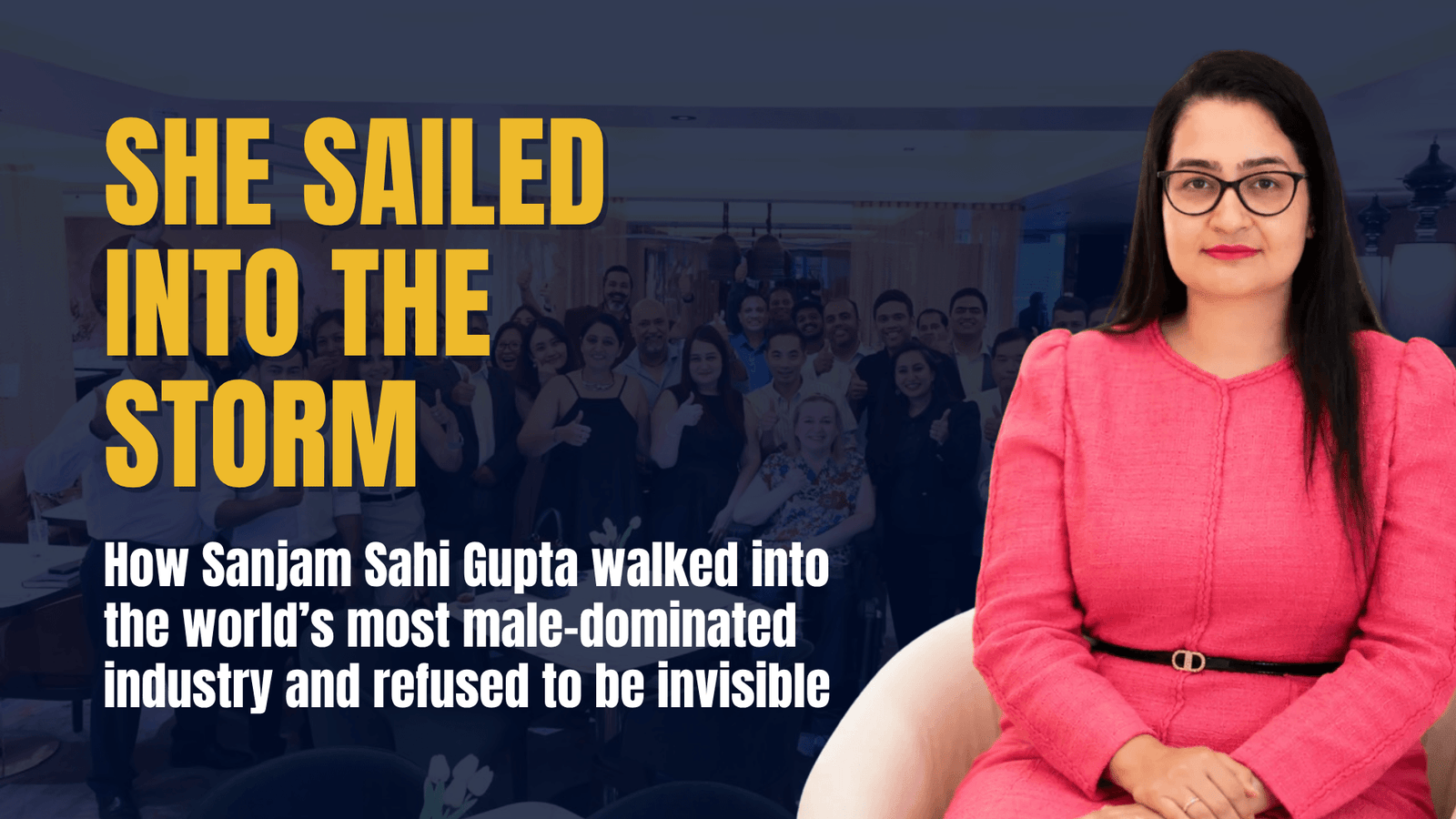
She Sailed Into the Storm
F E A T U R E S T O R Y
She Sailed Into the Storm
How Sanjam Sahi Gupta walked into the world’s most male-dominated industry and refused to be invisible
There is a particular kind of invisibility that women in male-dominated spaces know intimately. It is not the invisibility of absence. It is the invisibility of presence ignored.
Sanjam Sahi Gupta knows it well. She has sat in rooms full of maritime executives, shipping directors and policy leaders, and listened to speakers open with the word gentlemen. As though she were not there. As though the chair she occupied were empty.
She did not storm out. She did not make a scene. She came back the next day, and the one after that, and she built something so large that those rooms could no longer pretend she did not exist.
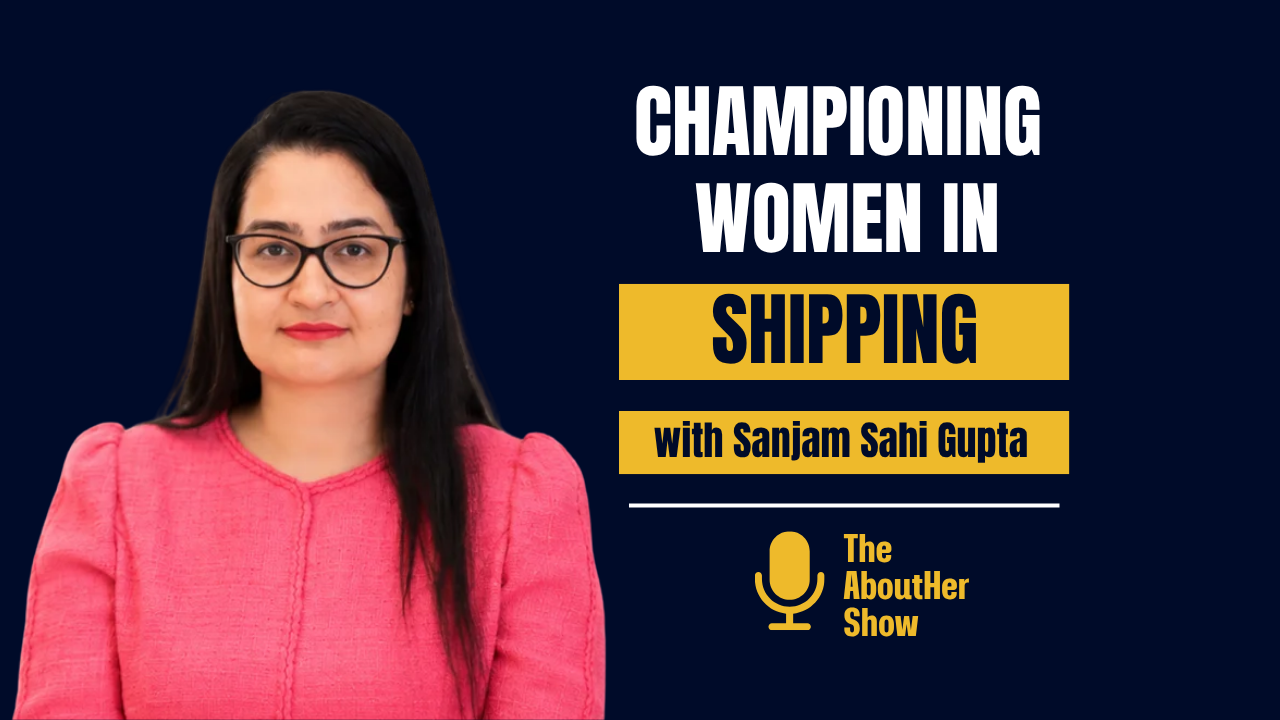
Today, Sanjam Sahi Gupta is Director of Sitara Shipping, Founder of Maritime SheEO, gender expert at the IMO and UN ESCAP, and a newly appointed member of India’s National Shipping Board. She has advised the Norwegian Prime Minister, equipped 90 women through an IMO-funded leadership programme, and convened the world’s largest gender equality conference in maritime history.
This is the story of how she got there, and what it cost her along the way.
The Room That Looked Through Her
Sanjam did not plan to become a movement. She planned to run a shipping company.
When she joined the family business, Sitara Shipping, in 2001, she walked into a world that was visibly unprepared for her. Clients arrived at the office and asked to meet the boss. When she said she was the person they were meant to meet, some of them turned to find a man. One even asked to speak with someone responsible, by which he meant a man, and her father quietly arranged for a male colleague to receive him.
Inside the company itself, senior male managers who had been with the firm for decades did not pass files to her and her sister. They withheld information. They made it clear, without ever saying so directly, that the daughters of the house were not the rightful heirs to the business.
With one exception, all of them eventually changed their minds. They watched the two sisters work and they came around. The one who did not simply left.
There were so many times the speaker would address the gathering simply as gentlemen. It was as though I did not exist in the room.
But it was at industry conferences that the invisibility cut deepest. Speaker after speaker addressing the gathering as gentlemen. The assumption that she was someone’s secretary. The accumulated weight of being unseen in rooms she had every right to occupy.
“After one particularly frustrating day,” she recalls, “I came back and I Googled women in maritime, and I came across a network called WISTA.” The Women’s International Shipping and Trading Association. A community built for women in leadership roles in maritime. She
became the founder of WISTA India, joined the international board, and spent years expanding the organisation across Asia Pacific, helping establish new chapters in Sri Lanka, Georgia, Bangladesh and Malaysia.
And then she realised that even WISTA, for all its reach, was not doing the one thing she believed mattered most: actively building a pipeline of women into senior maritime roles. That realisation became Maritime SheEO.
Also Read- She Never Chose. She Had Both.
The Girl Who Watched
Long before conferences and boardrooms, there was a family.
Sanjam grew up surrounded by women who did not apologise for their ambitions. Her grandmother, her mother, her aunts, all of them were achievers in their own right, in their own ways, in their own time. She did not have to look far for proof of what was possible.
When neighbours told her parents that having two daughters and no sons was a misfortune, and that the family business would one day have to pass to sons-in-law, her parents had a ready answer.
My father and mother would proudly tell them that our two daughters are equivalent to 11 sons.
They told their daughters they could be anybody they wanted to be. And they meant it. So much so that when Sanjam was later offered a seat on the board of the World Maritime University in Malmo, Sweden, and her own impostor syndrome nearly made her turn it down, it was her parents who were furious. Why aren’t you accepting it? Because they had always seen in her what she was still learning to see in herself.
My parents gave me wings,” she says simply. And in those five words is an entire philosophy of raising daughters.
1,600 People. 77 Countries. A Pandemic.
Maritime SheEO was supposed to launch in Mumbai in March 2020. A world-class conference, global speakers, an Indian audience that Sanjam believed deserved the same quality of conversation she had encountered at events abroad. She had the venue, the programme, the
momentum.
Then COVID struck.
What followed was, by her own account, a blessing in disguise. Working with her Norwegian collaborator Birgit Liodden, she moved the entire conference onto a virtual interactive platform, complete with virtual lobbies, auditoriums, chat rooms and breakout spaces. When registrations opened, they watched the counter climb.
Seventy-seven countries. Sixteen hundred participants. A gender ratio of sixty-forty, men and women both present, both invested.
Something that we were doing was resonating with people globally. We were not doing it on a commercial basis. We were doing it out of passion, out of belief for the cause.
The world’s largest gender equality conference in maritime history had been born from a pandemic, a pivot and a purpose. And it grew from there. The second, third, and fourth editions together have drawn over 3,500 participants from around the world.
The Women at Sea
Not all of Sanjam’s work takes place in conference halls and policy panels. Some of it happens in hospital corridors and phone calls from ships.
She tells the story of a young woman she had mentored and helped place on a vessel. They stayed in touch. Then, for a couple of months, silence. When the call finally came, it carried news of a captain who had repeatedly asked the woman to his cabin for drinks. When she refused, he found other ways to make her life difficult. A fall on board went untreated by the captain, who told her not to be such a girl about it. By the time they reached the next port, she needed surgery. Without it, she would have lost full use of her hand.
“That was when I said, not on my watch,” Sanjam says.
There was another case. A woman named Malia from Trinidad and Tobago, sailing on a vessel, facing sexual harassment from her captain. Sanjam helped take it to the ship owners. But there was no proof. It was his word against hers. He stayed. She did not sail again with that company.
It is always his word against hers. And his word still counts for more. That is what needs to change.
These are the stories that do not make it into the award citations and the conference programmes. But they are the reason Sanjam serves as an Ambassador of the Sailors’ Society, the reason she mentors women seafarers, the reason she keeps going when the work is heavy.
You Don’t Need a Strong Back. You Need a Strong Mind.
The maritime industry of Sanjam’s early career was defined by physical labour, male hierarchy and a deep resistance to change. The maritime industry she describes today is something different.
Digitisation. Technology. Decarbonisation. A growing recognition that talent, not gender, should be the deciding factor. And a practical reality: the industry cannot compete with other sectors for young people unless it opens its doors wider.
“No longer do you need a strong back,” she says. “You need a strong mind.”
Her message to young women considering maritime is not one of caution. It is one of invitation. Be passionate. Be hardworking. Be patient. Know that your goals will evolve, that learning never stops, and that every day in this industry will bring something new.
But she is also clear about what still needs to change. She does not believe in quotas, viewing them as implying that women need help to compete. She believes in merit, but insists that merit can only be the true measure once the playing field is level. She is tired of being placed on all-women panels while all-male panels, what she calls manels, go unchallenged. She wants women in every panel, on every committee, in every conversation about the future of the industry, not as a gesture, but because the industry cannot afford to leave half its talent on the sidelines.
If you’re not going to have 50% of the talent at the table, then we are losing out. Women bring their own skill set, and so do men. We need both.
It is, she argues, not just the right thing to do. It is the smart thing to do. Her 2020 research, funded by the Netherlands Consulate in Mumbai and covering over a hundred companies across maritime verticals, found that diverse teams consistently outperformed on profitability, productivity, teamwork and innovation.
The business case, she says, is unanswerable.
What People Don’t See
There is a version of Sanjam Sahi Gupta that the world sees. The awards. The keynote stages. The letter of commendation from the Secretary-General of the IMO. The appointment to the National Shipping Board of India. The convening power. The global reach.
And then there is the version that exists alongside it.
Time away from family. Missed events. The emotional weight of working on harassment cases, of becoming personally invested in women whose stories break your heart. The physical toll of being everywhere, for everyone, all the time.
“What people see is only the success,” she says quietly. “They only see the accolades, the attention. But in reality, what people don’t see is how much you are losing, at what cost you are achieving that.”
She is saved, she says, by the knowledge that she has found her purpose. And by the people who hold her up when the weight gets heavy: her parents, who gave her wings. Her husband. Her son, who is growing up watching his mother be a strong woman, and learning, she hopes, what that means for how he will move through the world.
KEY TAKEAWAYS
1. Invisibility is a choice they make, not a fact you have to accept.
Walking into rooms that were not built for you is an act of courage. Staying is an act of resistance. Sanjam chose both, every time.
2. It starts at home.
The women who shape industries are often shaped first by the women who raised them, and the parents who refused to treat their daughters as second best.
3. Impostor syndrome is real, and it is not a personal failing.
It is a product of conditioning. The antidote is naming it, building support systems, and accepting success on the same terms men do.
4. Diversity is not charity. It is strategy.
Companies with diverse teams outperform. Industries that exclude half their talent are not competing at full strength. The business case is not soft. It is hard data.
5. Purpose is the cost of the cost.
The personal price of a life like this is real. What makes it bearable is knowing why you are paying it.
The Reveal
We ended our conversation, as we always do on The AboutHer Show, with The Reveal. Quick- fire. No thinking allowed.
One word she wants to be known by in 20 years: Passionate.
One word that describes maritime today: Progressive.
Something people assume about her that is completely wrong: That she is a superwoman.
The moment she felt most out of place but stayed anyway: One of her first conferences.
The ocean or the boardroom? The boardroom.
Of course it is. The ocean is where the ships sail. The boardroom is where the decisions are made. And Sanjam Sahi Gupta has spent her entire career making sure the right people are in that room.
Listen to the full episode on The AboutHer Show, Season 4.
Not just about her. It takes all of us.
Share This On Social
About the Author: Sangeeta Relan

Related Posts



I’m Sangeeta Relan—an educator, writer, podcaster, researcher, and the founder of AboutHer. With over 30 years of experience teaching at the university level, I’ve also journeyed through life as a corporate wife, a mother, and now, a storyteller.