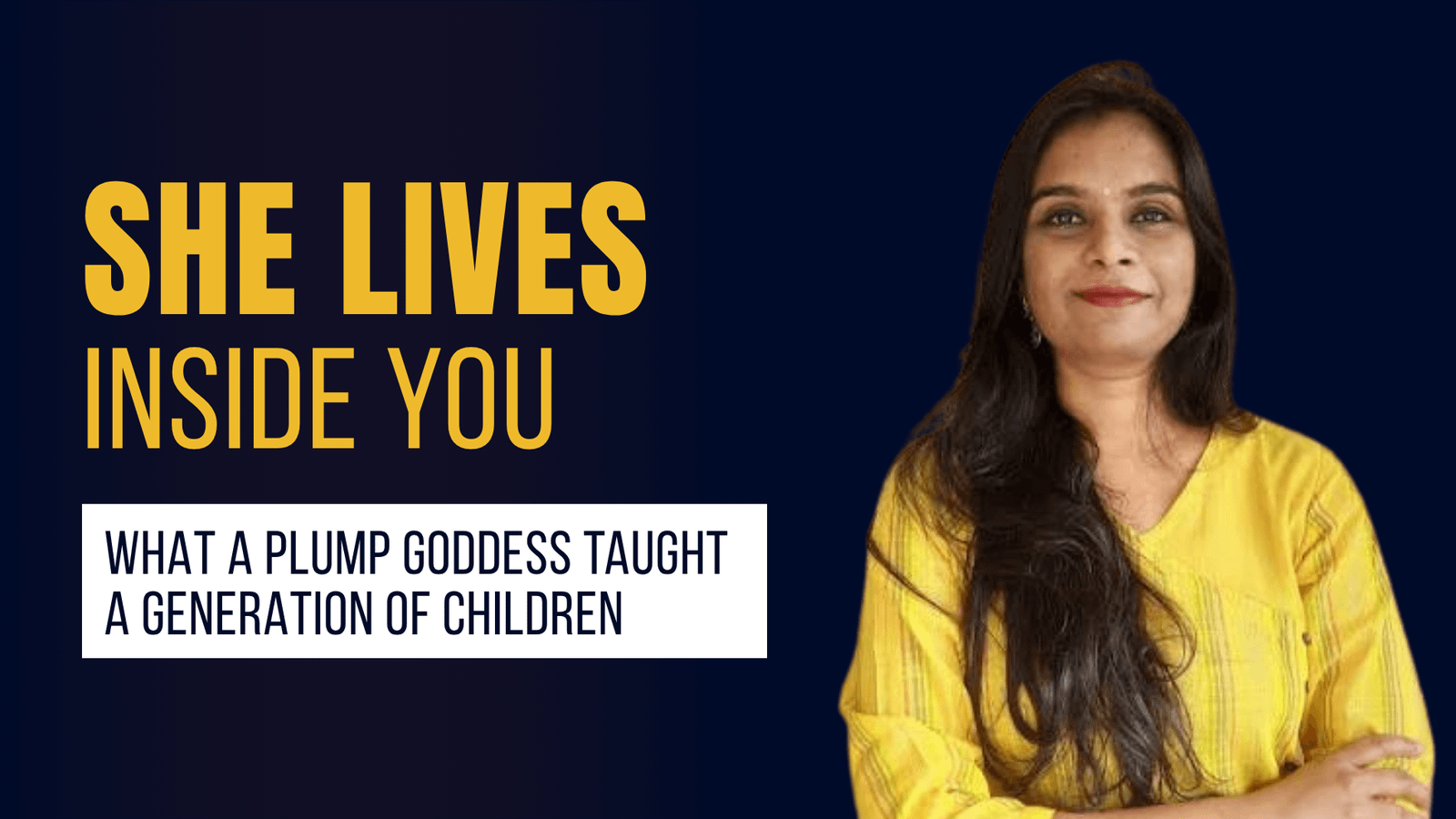
She Lives Inside You: What a Plump Goddess Taught a Generation of Children
THE ABOUTHER SHOW · IN CONVERSATION
She Lives Inside You:
What a Plump Goddess Taught a Generation of Children
What a Plump Goddess Taught a Generation of Children
Author Nalini Ramachandran on grandmothers, goddesses and why the stories we tell ourchildren at three shape who they become.
Why read this: If you have ever wondered what stories your daughter is growing up with,or why every goddess in her picture books looks the same, this conversation will changehow you see the books on her shelf. Nalini Ramachandran, who once wrote ShikariShambu and Suppandi for Tinkle, has spent over a decade quietly rewriting how Indianchildren meet their gods and goddesses. Her answer to the question “Is three too youngfor mythology?” may surprise you.
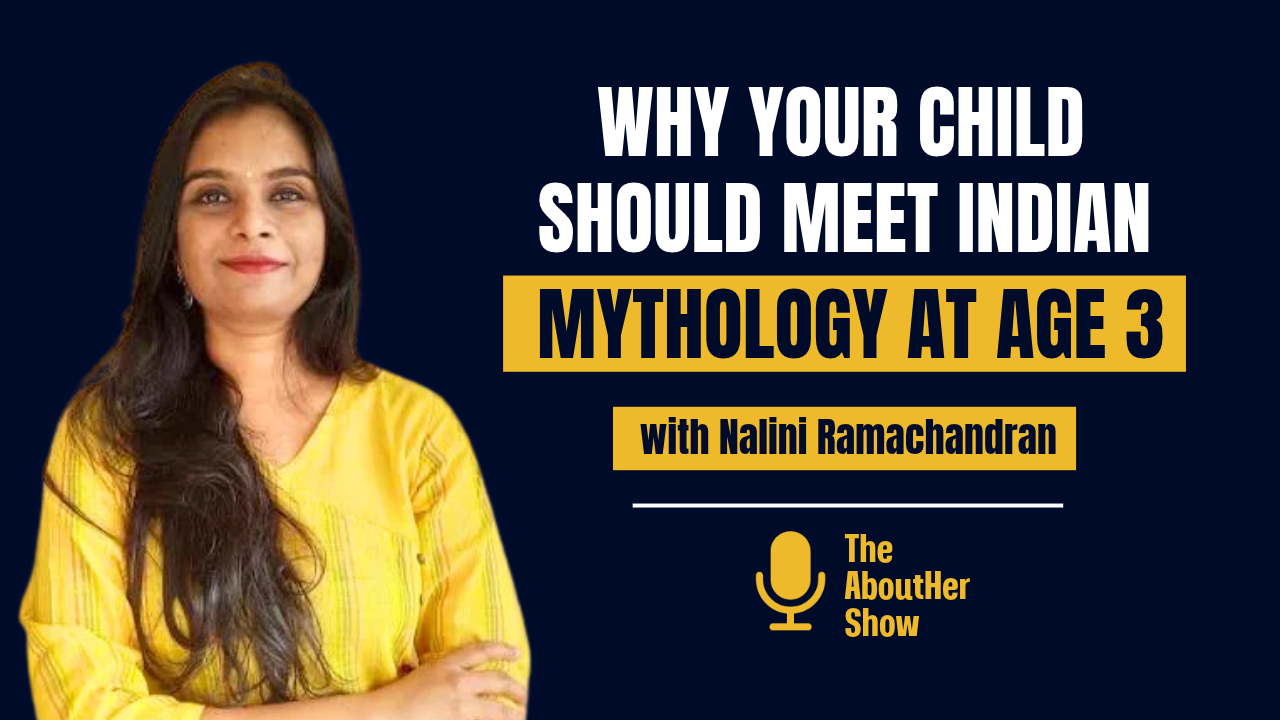
When I sat down with Nalini Ramachandran on The AboutHer Show, I expected to talk about children’s books. I did not expect to come away thinking about my own childhood, the stories I was told, and the ones I was never told at all.
Nalini is an author, graphic novelist, editor and storyteller. Her books have been published by Puffin, HarperCollins, Hachette, Scholastic and more, and her graphic novel on APJ Abdul Kalam won the Best of Indian Children’s Writing award. Her newest, My Little Book of Dashavatara, tells the story of Vishnu’s ten avatars for children as young as three.
Three is not too young
My first question was the obvious one. Why start children on mythology so early?
Nalini’s answer was simple. Around two or three, parents start telling children stories anyway. It is the age when a child learns that there is a world outside her own, full of characters she has never met. And in many Indian homes, she pointed out, gods are already part of the family. “It’s always like, this is mama, this is papa, and this is Krishna, or this is Ganesha, or this is Durga.”
The stories also teach right and wrong long before a child has words like “values” or “morals”. She does not need to be told what kindness is. She learns it from a story.
How do you fit ten avatars into a board book?
The Dashavatara is not a simple story. There are battles, demons and backstories that link one avatar to the next. So how do you tell it to a toddler?
Nalini relies on three things: pictures, rhyme and sound. Children learn from pictures first.Rhyme helps them pick up words. And speech balloons, borrowed from her years in comics, make it feel as if the characters are talking straight to the child. Then come the sound words. When the fish dives into the water, the book says “whoosh”, and the child says it too.
The real magic, she says, happens when a parent sits beside the child, reads the rhyme aloud and points to the pictures. The book is as much about that time together as it is about Vishnu.
Also Read- One Step Ahead of the Other: Mansi Madan Tripathy
A monkey with a drum
Then I asked who told her stories, and her face lit up.
Her grandmother told her about a monkey with a drum, singing the sound of it, “dum, dum, dum”. Her father told her Tamil folktales, rooted in the soil of Tamil Nadu where Nalini comes from, about sorcerers, magicians and parrots that turned into something else. Her mother told animal tales, including one about sparrows that Nalini asked her to repeat again and again. At her convent school, the prayer assembly added stories about honesty and kindness.
“Each of these storytellers gave me a very different kind of understanding,” she said. Rhythm from her grandmother. Imagination from her father. Animals from her mother. Values from school. Without knowing it, she was learning every tool she would later use as a writer.
I think many of us have a grandmother’s story like that tucked away somewhere. We just rarely stop to notice what it gave us.
From Tinkle to the goddess
Nalini started in television, moved to print journalism, and then joined Tinkle, where she got to write as Shikari Shambu and Suppandi. What she learnt across all of them was this: “What matters most is the story itself first, and second is the telling.”
She gave the example of the Ramayan, which can be told through comics, dance drama, miniature paintings, Rangoli, puppetry or simply a grandmother’s voice. “We now look at these as mere art forms,” she said, “but they all began as storytelling traditions.”
Girls as heroes, not helpers
This was the part of our conversation I keep coming back to.
Most of the mythology published for children focuses on male gods. When Nalini wrote Nava Durga, there were hardly any children’s books about goddesses at all. Her aim was clear: “For readers, especially girls, to see themselves in the goddess and to see the goddess in themselves.”
So she gave each of the nine forms of Durga one quality a child could understand. “She lives inside you as generosity. She lives inside you as kindness. She lives inside you as truth.”
Then her illustrator, Priyanka, went further than the brief. The goddesses were given different skin tones and different hairstyles, curly and straight, so every child could find one who looked like her. And the ninth goddess, Siddhidatri, was drawn plump and healthy. “It’s very rare for us to see any divine image that’s not perfect,” Nalini said. “It was a risk.” Today, children write to her saying they love Siddhidatri because she is “cute and plump”.
She is honest that some goddesses are harder to explain. Kalratri, who drinks drops of blood in battle, can sound frightening. But Nalini sees a simple lesson in her story for a child: “It’s not going to be smooth all the time. There will be difficulties, and you face them and you overcome them.”
It takes all of us
When I asked which woman taught her the most about building her career, Nalini refused to pick just one, and borrowed our own tagline to explain why: it takes all of us.
She named Preeti Vyas, former CEO of Amar Chitra Katha, who taught her to trust herself and to know “when to let go” instead of reworking a text again and again. She named her editors, who taught her what to leave out, her illustrators, who taught her how words and art work together, and her publishers, who taught her that an idea has to find its market. “From passion to saleability,” she said, “is a very long journey.”
Ten or eleven years ago, Nalini took what she thought would be a short break from full-time work to try writing a book or two. She never went back.
As I listened to her, I thought about how many of us grew up with stories where women were helpers in someone else’s story. Nalini is making sure the next generation of girls grows up with a different story, one in which the goddess looks a little like them and lives inside them too.
Listen to the full conversation with Nalini Ramachandran on The AboutHer Show.
KEY TAKEAWAYS
1. Start early.
Three is not too young for mythology. Children are already learning how stories work, and stories teach right and wrong before they have the words for it.
2. Read together.
A board book works best when a parent sits beside the child, reads aloud and points to the pictures. The time together matters as much as the story.
3. Notice who told you stories.
Each storyteller in our lives, a grandmother, a father, a teacher, shapes how we see the world
4. Let girls see themselves in the story.
When goddesses have different skin tones, hairstyles and body shapes, every girl can find herself in them.
5. Hard stories have a place.
Even a fierce goddess can teach a child that life will not always be smooth, and that difficulties can be faced and overcome.
6. Know when to let go.
Perfecting your work forever is not the goal. Trust yourself and finish it.
7. Passion needs a market.
A great idea still has to find its readers. From passion to saleability is a long journey, and you need others to make it.
Key quotes
“I wanted readers, especially girls, to see themselves in the goddess and to see the goddess in themselves.”
“She lives inside you as generosity. She lives inside you as kindness. She lives inside you as truth.”
“In many Indian homes, gods are part of the family.”
“What matters most is the story itself first, and second is the telling.”
“We now look at these as mere art forms, but they all began as storytelling traditions.”
“It’s very rare for us to see any divine image that’s not perfect. It was a risk.”
“It’s not going to be smooth all the time. There will be difficulties, and you face them and you overcome them.”
“Just be yourself. Own your voice. Just be who you are. That is what matters.”
“From passion to saleability is a very long journey.”
Listen to the full conversation
Hear Nalini Ramachandran’s full story on The AboutHer Show, ranked in the Top 3 on Feedspot’s list of Indian Women’s Leadership Podcasts 2026.
Not just about her. It takes all of us.
Share This On Social
About the Author: Sangeeta Relan

Related Posts







I’m Sangeeta Relan—an educator, writer, podcaster, researcher, and the founder of AboutHer. With over 30 years of experience teaching at the university level, I’ve also journeyed through life as a corporate wife, a mother, and now, a storyteller.