
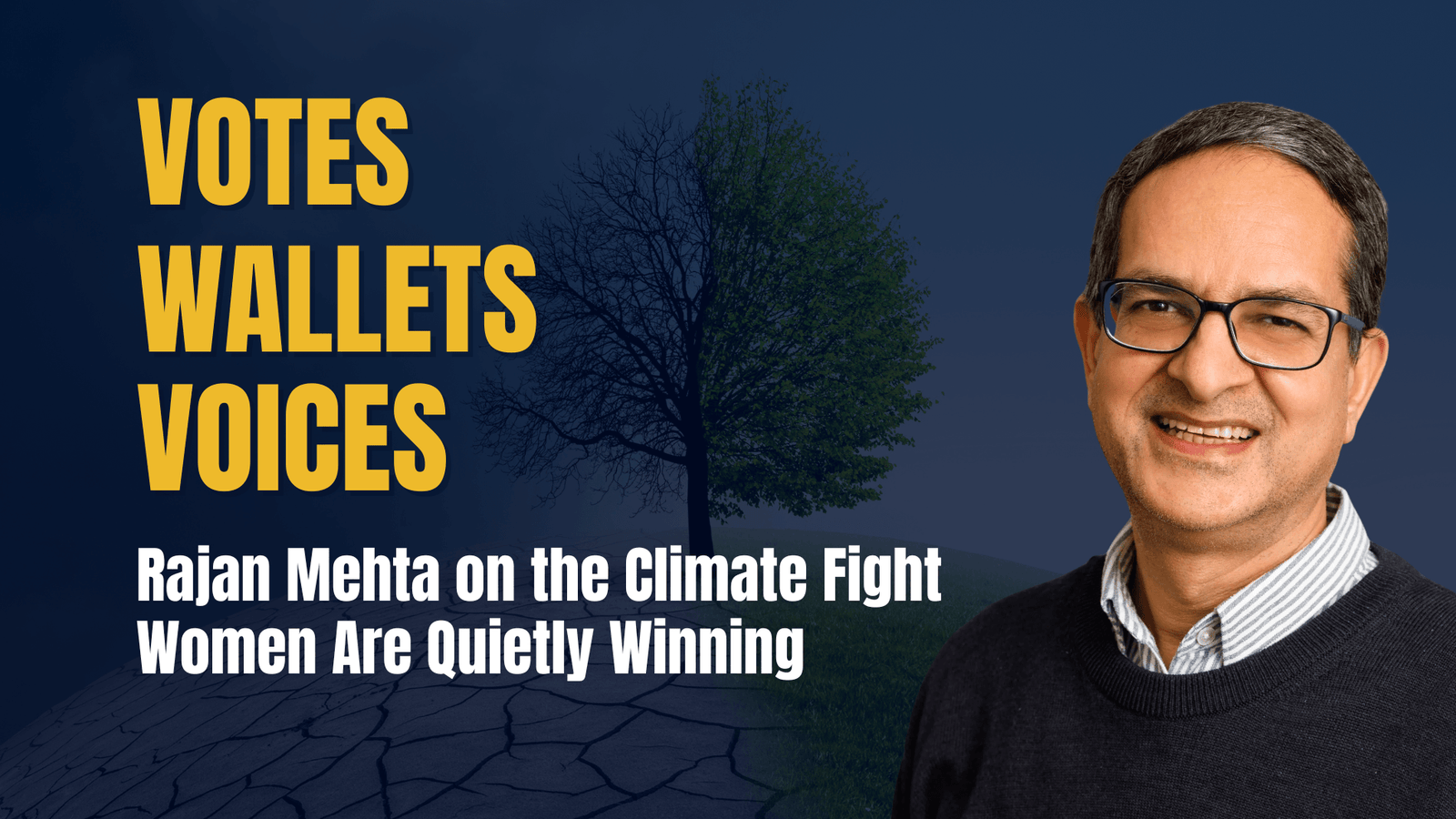
Votes, Wallets, Voices: Rajan Mehta on the Climate Fight Women Are Quietly Winning
THE ABOUTHER SHOW · SEASON 4
Votes, Wallets, Voices: Rajan Mehta on the Climate Fight Women Are Quietly Winning
He spent thirty years building tech companies. Then he walked away to ask a harder question: can we save a planet we’ve already overdrawn?
THE ABOUTHER SHOW WITH SANGEETA RELAN
Rajan Mehta built two successful companies and held senior roles at Motorola and Nortel before COVID gave him, like so many of us, an unwelcome pause to reflect. What he did with that pause was rarer: he walked away from three decades in tech to found Climate Action Labs and Climate Ventures Partner, and to write Backstage Climate, a book about the science, politics, and economics hiding behind every headline about the crisis.
In this episode, Sangeeta Relan presses him on the number most of us have never heard, the sector he’d bet his own money on, and the one comfortable belief about the economy that even smart people get wrong.
“Women are 14 times more likely to lose their lives in a climate disaster compared to men.”
ON THE UN STUDY MOST PEOPLE HAVE NEVER HEARD
That statistic anchors one of the episode’s most striking threads. Women, Rajan explains, are usually the primary caregivers, so in a disaster they look after others before evacuating themselves. In the developing world’s rural economies, women are also the ones responsible for food, fuel, and water, all three of which climate change hits hardest. They carry the weight of the crisis. They just don’t get to write the policy for it.
Except, as Rajan pushes back, they do shape it, just not from behind a podium. He points to Christiana Figueres steering the Paris Agreement from behind the scenes, a teenage Greta Thunberg forcing governments to sit up, and the fact that most of India’s visible climate activists are women. Influence, he argues, is its own form of authorship.
Also Read: Why So Many High-Achieving Women Struggle With Self-Doubt
KEY TAKEAWAYS
- Women don’t write climate policy, they drive it. From the Paris Agreement to grassroots activism in India, the influence is real even when the byline isn’t.
- The economy’s biggest blind spot: we still talk about infinite GDP growth on a planet with finite resources, an equation Rajan says has to break somewhere.
- Agriculture looks climate-friendly. It isn’t. From land-clearing to flooded rice fields to the 34% of food wasted globally, farming is a quietly major emissions contributor.
- Waste is the new gold. A circular economy stops treating what we throw away as garbage and starts treating it as feedstock, the way nature already does.
- Clean tech has to be led by economics, not just technology. People and governments choose what’s cheaper, not what’s cleaner, until the two are the same thing.
- You already hold more power than you think. Rajan’s framework for everyone, not just young women: use your votes, your wallets, and your voice, deliberately and often.
“You cannot have an infinite economy on a finite planet.”
THE ONE LINE HE WANTS SMART PEOPLE TO SIT WITH
Rajan’s clearest thesis lands here. The global economy runs on natural resources, and natural resources run out. Either we accept a ceiling on growth, or we rebuild the economy so it stops depending on virgin resources altogether. There isn’t a third option.
That rebuilding, he says, is exactly what a circular economy looks like, and nature has been running one all along. Nothing in the natural world is waste. Every output becomes someone else’s input. Applying the same logic to industry, he argues, is the difference between a linear economy racing toward collapse and one that can actually sustain itself.
“We all have the power of votes, wallets and our voices with us.”
HIS ANSWER TO WHAT COMES AFTER RECYCLING
Asked what he’d tell a young woman who wants to do more than cut plastic, Rajan widens the lens for all of us. Vote for people who take real issues seriously, because politicians respond to what voters actually reward. Spend in a way that makes sustainable companies win and unsustainable ones fade. And use your voice, at the dinner table, in a podcast, on the street, because silence is also a choice.
He’s just as direct about where he’d put his own money for the next decade: clean tech, without hesitation. Not because it’s fashionable, but because dismantling an economy built on fossil fuels means every downstream industry has to be rebuilt on clean energy too. And if he had sixty seconds with a Prime Minister guaranteed to act, his ask would be exactly that: move off fossil fuels as fast as possible.
Why You Should Listen
Because Rajan Mehta refuses to let climate change stay abstract. He turns a global crisis into something you can actually act on this week, at the ballot box, in your shopping cart, and at your own dinner table. And because this conversation makes the case, quietly but firmly, that the women already doing this work, from Delhi’s grassroots activists to the founders reshaping clean tech, have been leading the climate movement long before anyone handed them the title.
Listen to the full conversation with Rajan Mehta on The AboutHer Show, wherever you get your podcasts.
Not just about her. It takes all of us.
Share This On Social
About the Author: Sangeeta Relan

Related Posts








I’m Sangeeta Relan—an educator, writer, podcaster, researcher, and the founder of AboutHer. With over 30 years of experience teaching at the university level, I’ve also journeyed through life as a corporate wife, a mother, and now, a storyteller.