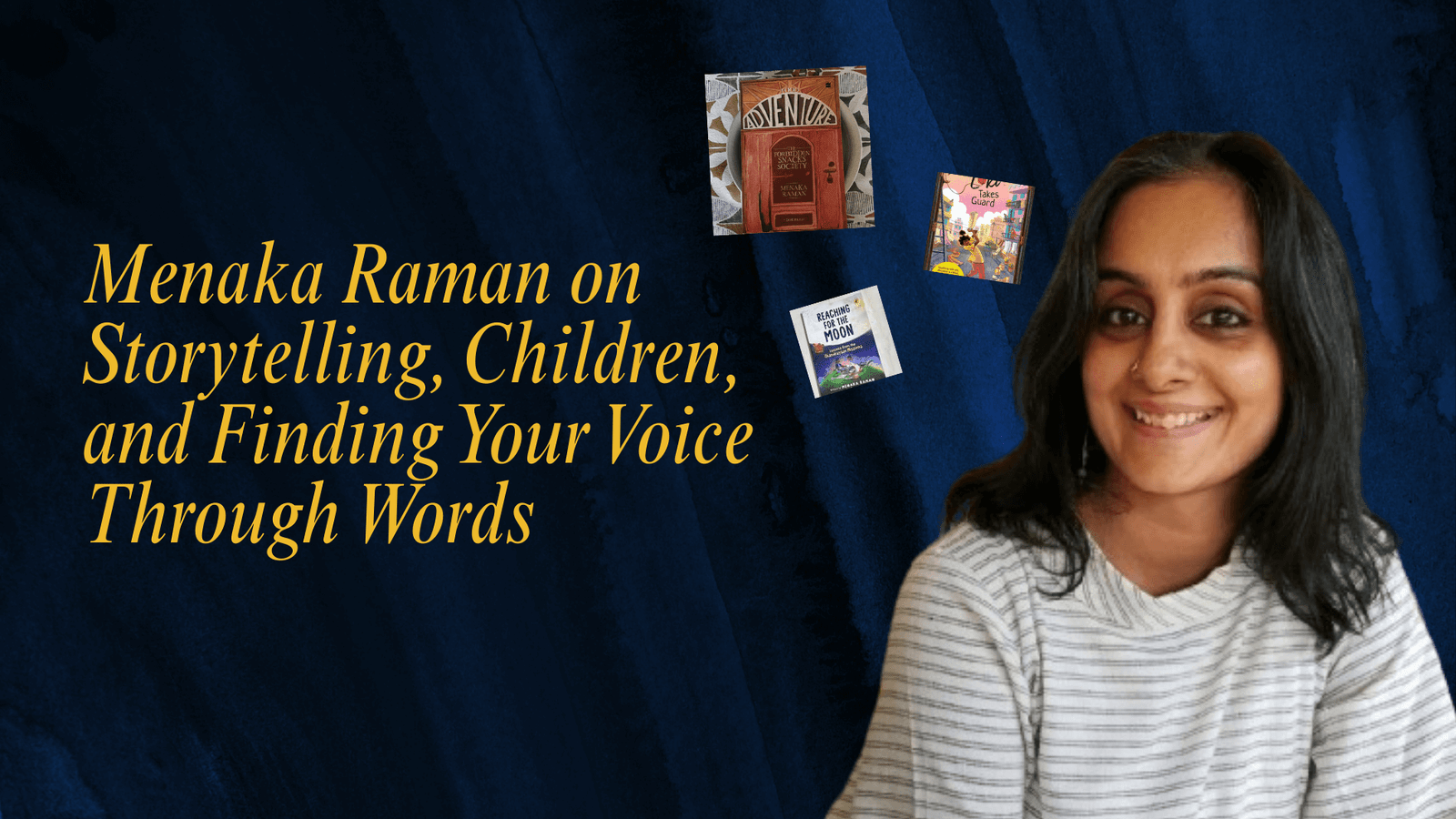
Menaka Raman on Storytelling, Children, and Finding Your Voice Through Words
Some conversations don’t announce their importance while they’re happening. They unfold quietly, through honesty, humour, and lived experience, and only later do you realise how much they’ve stayed with you.
This conversation with Menaka Raman on The AboutHer Show is one such exchange. It moves gently across her journey from advertising to children’s literature, from far-fetched childhood imagination to deeply grounded adult storytelling. Along the way, it touches upon creativity, motherhood, gender, self-acceptance, and the enduring power of words, without ever trying to “teach” a lesson.
A Journey Shaped by Unexpected Turns
Menaka’s path to writing was anything but linear. She began by studying computer science, quickly realising it wasn’t where her strengths lay. Writing, debate, quizzing, and humour came far more naturally to her, eventually leading her into advertising, a field she entered almost on a whim, after a family friend suggested she might enjoy copywriting.
Advertising offered her a creative outlet, but as life evolved, marriage, children, and the desire for a more balanced rhythm, Menaka stepped away from the industry and began writing newspaper columns, particularly around her parenting journey. The response from readers was encouraging, affirming that her voice resonated beyond campaigns and brands.
The real turning point, however, came when an editor at Pratham Books, who had been reading her column, asked her a simple question: Have you ever thought of writing for children? Menaka hadn’t. But she wrote a story “for a complete lark,” never imagining it would be published. When it was, she discovered something unexpected: writing for children was joyful, rewarding, and deeply fulfilling.
Writing for Children: The Most Honest Audience
One of the most striking parts of the conversation is Menaka’s description of children as an audience. Far from being easy readers, she calls them the most demanding, and the most truthful.
Also Read: Creeps, Crooks & Courage- What Yadhav Mehra Taught Me About Authenticity, Power & Emotional Survival
Children don’t hesitate to abandon a book if it doesn’t hold their attention. They’ll question endings that don’t make sense, challenge characters’ decisions, and openly tell authors what worked and what didn’t. Menaka speaks about school visits and literary festivals where children offered direct, unfiltered feedback, a reminder that storytelling for young readers leaves no room for pretence.
That honesty, she believes, is what makes writing for children such meaningful work. There’s no scope for packaging morals or disguising messages. The story has to be real, engaging, and emotionally truthful.
Intuition over trends
When the conversation turns to whether women approach storytelling differently, Menaka resists easy generalisations. Instead of attributing empathy or intuition to gender alone, she speaks from personal experience. Her writing, she says, is guided almost entirely by intuition.
She doesn’t begin a project thinking about trends, market demands, or what will sell. Once those external pressures enter the process, she feels something essential is lost. Writing, for her, starts with a sense of where the story wants to go, what the characters feel like doing next, and she trusts that instinct.
It’s a creative philosophy that prioritises honesty over performance, and one that has quietly shaped her body of work.
Holding on to Imagination – and Learning Restraint
Menaka fondly recalls being a child who wrote wildly imaginative, far-fetched stories. That child, she says, is still very much present within her. She continues to enjoy stories that are slightly exaggerated, quirky, and larger than life — the kind she loved reading growing up.
What adulthood and experience have taught her, however, is discernment. She speaks about the role editors play in helping writers understand when imagination needs to be pushed further, and when it needs to be held back.
In one example, she describes writing an over-the-top, cinematic climax that she was convinced was perfect, only for her editor to suggest a quieter, more contained version. The editor wasn’t dismissive; she invited Menaka to try a different approach. When she did, Menaka realised the scene worked far better. It was a lesson in trusting collaboration and being open to shaping creativity, not abandoning it.
Writing About Self-acceptance Without Preaching
When discussing I Love Me, Menaka is clear that she doesn’t set out to write books with prescribed “takeaways.” Once a book is out in the world, she believes it belongs to the reader, who will form their own relationship with the characters.
That said, the subject of self-acceptance is deeply personal. She reflects on growing up feeling insecure about appearance – something many women relate to – and contrasts it with the pressures children face today. From social media imagery to beauty marketing aimed at very young audiences, children are absorbing messages about how they “should” look far earlier than before.
For Menaka, if a book can help a child feel okay about themselves – even momentarily – that matters. She speaks movingly about mothers telling her they wished they’d had a book like this when they were young. Those moments, she says, affirm why she writes.
Representation that Opens Doors
Another important thread in the conversation is representation. Menaka talks about writing several books with young girls as protagonists, particularly in stories about science and space. This wasn’t always a conscious decision, the stories simply demanded those characters.
Also Read: From Forests to Fiction- Why This Conversation With Arefa Tehsin Will Stay With You
Over time, she realised how necessary those narratives were. Despite progress, girls in STEM still face barriers, and stories can quietly challenge assumptions long before children encounter them in real life. She shares a moment where a child, after hearing a story, expressed surprise that women could fly airplanes, a reminder of how powerful these early impressions can be.
Motherhood, Creativity, and Letting go of Perfection
Balancing motherhood, writing, and professional work is something Menaka speaks about with refreshing honesty. Some days, she says, she’s more present as a parent than a writer. Other days, the opposite is true. The idea of doing everything perfectly, every day, simply doesn’t hold.
What has helped her is creating small pockets of protected time, often early in the morning, and practicing kindness towards herself. Some days yield pages; others produce a single sentence. Both, she believes, are valid.
She also offers reassurance to younger parents: the years of constant demand don’t last forever. Children grow, become independent, and space opens up again. Staying lightly connected to your interests, even in small ways, helps keep that part of yourself alive.
Stories that Stay
Toward the end of the conversation, Menaka reflects on what she hopes her work leaves behind. More than accolades or longevity, she values the idea of being part of a child’s reading journey, from a parent’s lap, to a library, to a bookshelf.
Books, she says, act as mirrors that reflect a child’s own reality, and windows that open onto other lives and possibilities. To be part of that process, to help shape a reader, gently and honestly, feels like a legacy worth having.
Listen to the Full Conversation
YouTube
Spotify
Apple Podcasts
Stay Connected
If this conversation resonated with you, you can explore more episodes of The AboutHer Show, visit the website, and follow AboutHer on social media for episode updates, quotes, and stories.
Website: https://aboutherbysangeeta.com/
Spotify: https://shorturl.at/VRItp
Apple Podcasts: https://shorturl.at/5tAbk
Audible: https://shorturl.at/MQuw8
Share This On Social
About the Author: Sangeeta Relan

Related Posts



I’m Sangeeta Relan—an educator, writer, podcaster, researcher, and the founder of AboutHer. With over 30 years of experience teaching at the university level, I’ve also journeyed through life as a corporate wife, a mother, and now, a storyteller.