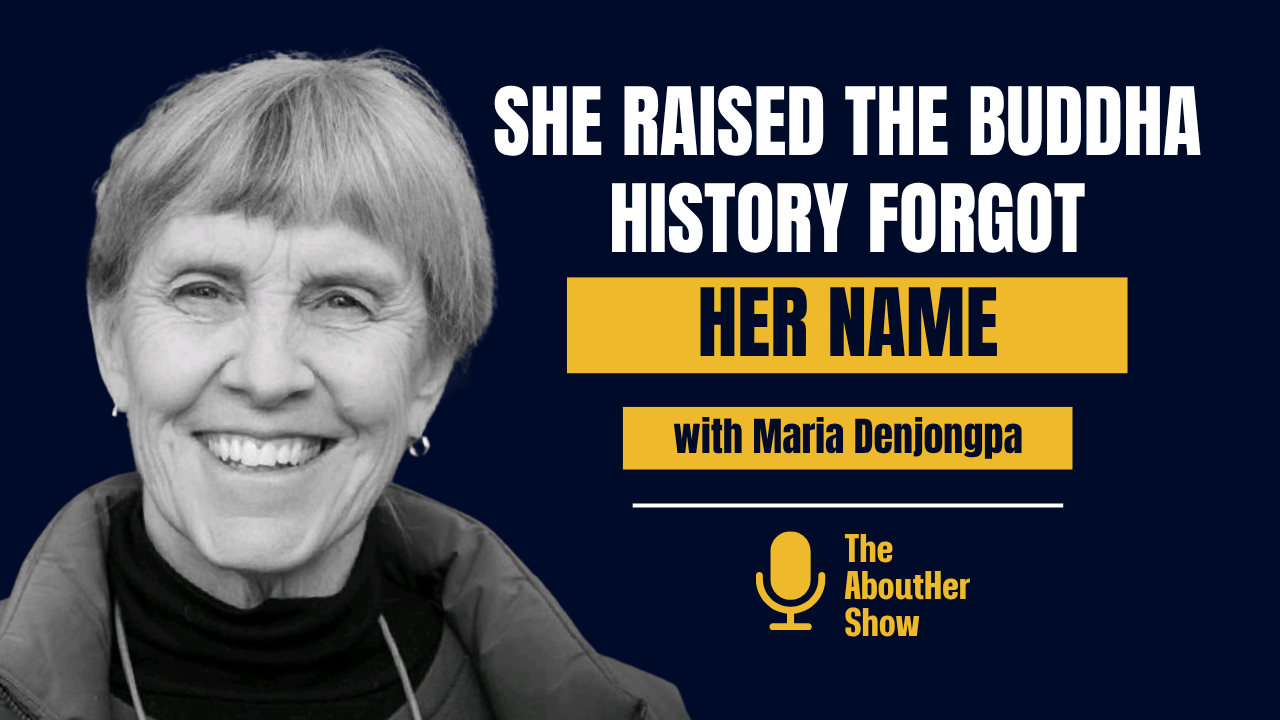
Maria Denjongpa on Reclaiming the Woman Who Raised the Buddha
THE ABOUTHER SHOW · GUEST FEATURE
Who Has Been Doing the Writing
Maria Denjongpa on Reclaiming the Woman Who Raised the Buddha
Maria Denjongpa on Reclaiming the Woman Who Raised the Buddha
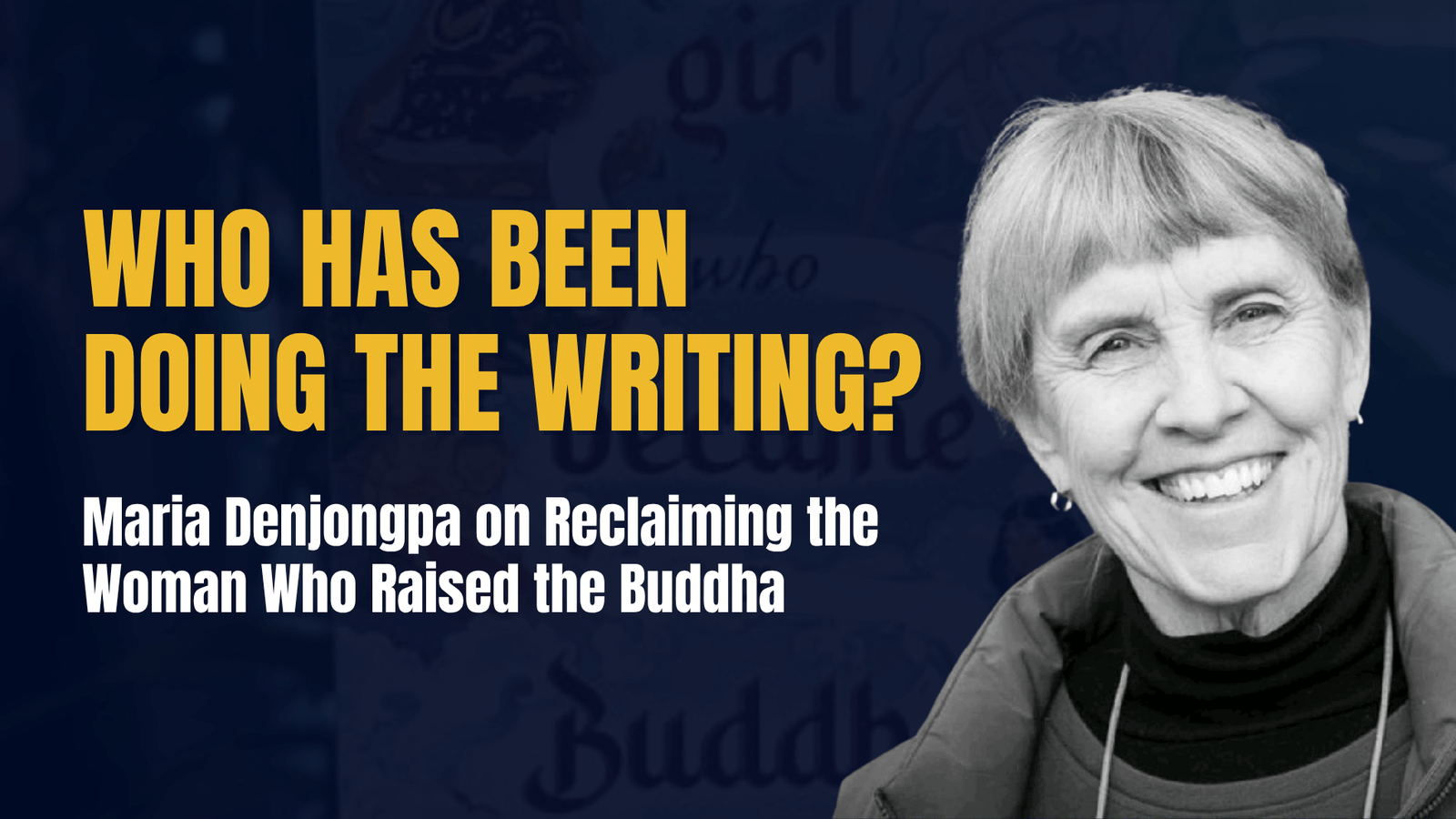
Teacher, paper-mache artist, and now debut novelist Maria Denjongpa spent thirteen years teaching English in Sikkim before she sat down to write Pajapati back into her own story. She tells us why dissatisfaction is not something to fear, why exhaustion is the thing nobody warns you about, and why good enough has to be good enough.
For twenty five centuries, the story of the Buddha has belonged to the Buddha. Maria Denjongpa, a Massachusetts-born teacher who built her adult life in Sikkim, decided it was time somebody told it from a different seat at the table: the seat of Pajapati, the aunt who raised Siddhartha after his mother, her own sister, died a week after his birth. Her debut novel, The Girl Who Became a Buddha, is the result. On The AboutHer Show, Maria spoke about grief, duty, dissatisfaction, and why she believes the most difficult emotions in a woman’s life are also the ones that can propel her into something wonderful.
A Footnote, Reclaimed
Maria did not set out to rewrite the Buddha’s story so much as to finally tell the story sitting quietly beside it. Pajapati raised Siddhartha, grieved her sister Maya, and eventually became a Buddha in her own right, yet history has mostly let her stay in the background.
“Who has been doing the writing? The men have been doing the writing for centuries. And one exciting thing about being alive now is that women are writing these stories.”
MARIA DENJONGPA
It is not a small observation. Maria pointed to the wave of women now digging back into Pali, Sanskrit, Tibetan and Chinese texts to recover what was actually written about women like Pajapati, and to novelists like Madeline Miller, who gave Circe her own book after a few lines in the Odyssey. The retelling, Maria says, is not just correction. It is a whole new angle of light.
Grief, Written From the Inside
Some of the novel’s most resonant pages came from a place Maria did not plan for. She lost her own mother while writing Pajapati’s story, and that loss, she says, found its way onto the page even though the historical facts of the narrative stayed untouched.
“I don’t think it’s an accident that I lost my own mother as I was writing this. I was very close to my mother, I adored my mother, and that loss, I think, found its way in.”
MARIA DENJONGPA
She was careful, she says, not to let her own modern life bleed too freely into a woman who lived in the fifth century BCE. The balance she was chasing was universal truth, not personal transcription, drawing on the emotional weight of dependence and loss rather than the specific facts of her own story.
The Woman Who Hated Rules
Pajapati, as Maria writes her, is a woman who hates rules and yet is almost entirely bound by duty, a tension Maria believes never really went out of fashion for women in any century.
“Our most difficult emotions, they can get us into trouble, but they can also propel us into something wonderful.”
MARIA DENJONGPA
It was Pajapati’s anger and her restlessness, Maria says, that eventually propelled her to take her vows and walk the long road to becoming a Buddhist nun herself. Neither good nor bad on their own, she suggests. Sometimes both at once.
Also Read- 18 Years of Choosing Leaders. Here Is What He Has Learned About Women.
The Book
The Girl Who Became a Buddha — The Story of Pajapati, the Woman Who Raised the Buddha
Keep Going: Pajapati for the Scrolling Generation
Asked what Pajapati might say to a woman today, caught between raising a family and having a self of her own, Maria didn’t hesitate.
“Keep going. That is the project of a woman’s life.”
MARIA DENJONGPA
She was quick to add that men carry their own version of this confinement too, but that women are often doing a bigger balancing act: raising the family, keeping the house, and still reaching for a life of their own, whether that is teaching, writing, medicine, or something else entirely. One advantage she named without hesitation: the web of deep female friendship that women build around themselves, something she believes is rarer among men.
“Don’t fear your own dissatisfaction. It’s not something to fear. Let it propel you.”
MARIA DENJONGPA
On Exhaustion, and the Myth of Perfect
Thirteen years of teaching English from kindergarten through Class XII, alongside raising two sons, taught Maria something she wishes more women said out loud.
“People don’t talk about exhaustion. You can’t do it all perfectly, and you don’t have to. You just have to do a reasonably good job of whatever you’re doing, and that’s good enough.”
MARIA DENJONGPA
A Spirit Figure for 2026
Maria’s other great love is paper-mache, spirit figures built from the fears, joys, vulnerabilities and pride she finds in the bones of people and animals. Asked what a spirit figure of modern womanhood would look like if she built one today, her answer arrived somewhere between a wing and a branch.
“We’re branching out, and we’re also flying. Something would be missing too, maybe resting, maybe even struggling, because there’s struggle involved in flying too.”
MARIA DENJONGPA
KEY TAKEAWAYS
From Maria Denjongpa’s Conversation on The AboutHer Show
1. Women are finally writing the stories that men wrote for centuries, and that shift changes who gets remembered.
2. Grief and craft are not separate things. Maria’s own loss of her mother shaped the emotional truth of Pajapati’s story, even where the historical facts stayed fixed.
3. Difficult emotions are not the enemy. Anger and dissatisfaction propelled Pajapati toward her own spiritual path, just as they can propel any woman toward her own.
4. “Keep going” is the whole project. Balancing a family with a self of your own has never been simple, for Pajapati or for us.
5. Exhaustion deserves to be said out loud. Good enough, not perfect, is the standard worth aiming for.
6. Reinvention is enriching, even when it’s hard. Maria’s move from Massachusetts to Sikkim, learning a language with no translator, taught her that difference is rarely something to fear.
The Last Word
Asked what she understood about being a woman only with age, something she wishes someone had told her at twenty five, Maria didn’t offer a neat line of advice. She offered something closer to permission.
“We have to go through life to really understand life. Be open to whatever life delivers, which is joy and sorrow. Being open to it is really the only advice I could give.”
MARIA DENJONGPA
Not just about her. It takes all of us.
Share This On Social
About the Author: Sangeeta Relan

Related Posts






I’m Sangeeta Relan—an educator, writer, podcaster, researcher, and the founder of AboutHer. With over 30 years of experience teaching at the university level, I’ve also journeyed through life as a corporate wife, a mother, and now, a storyteller.