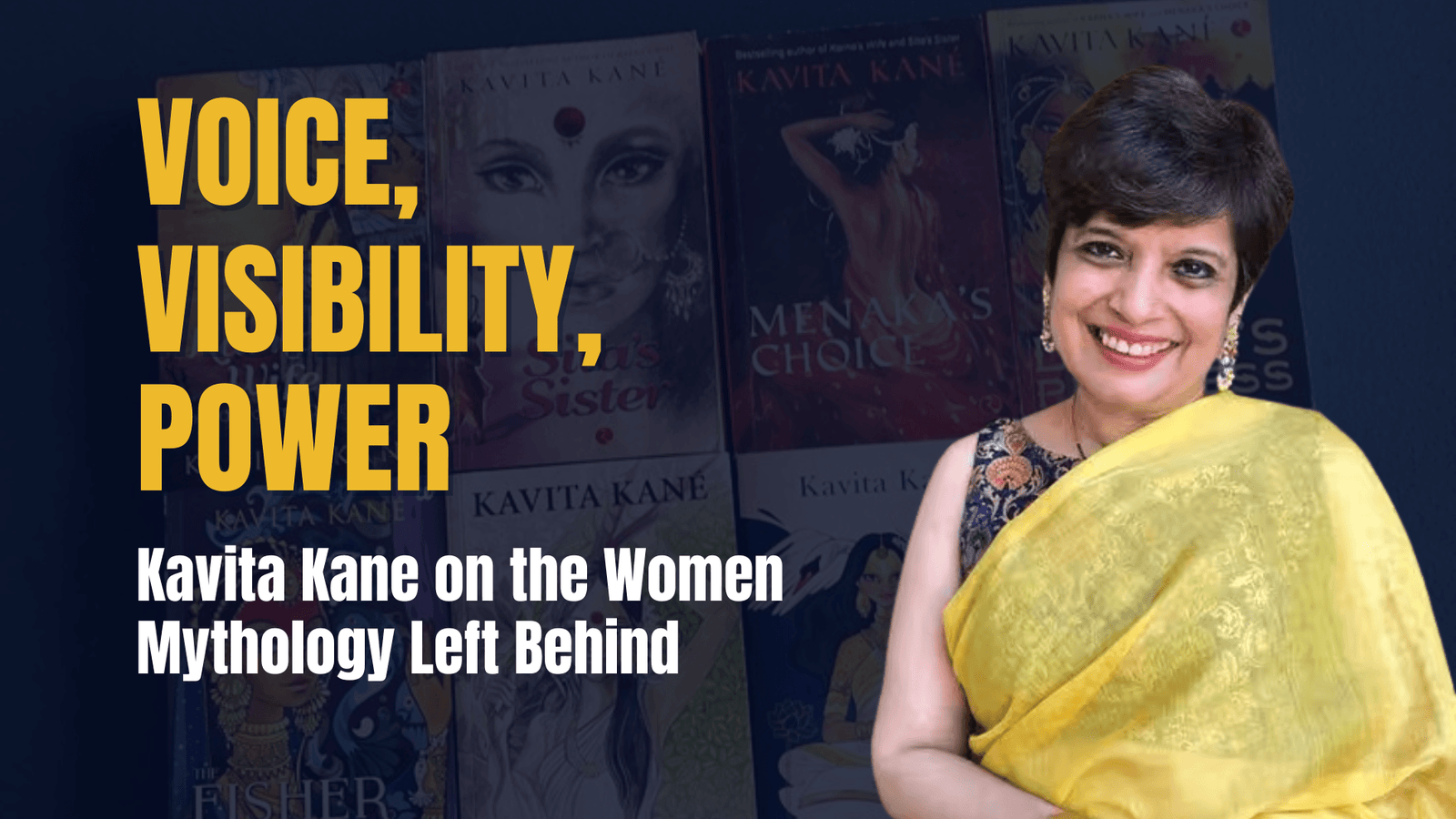
Voice, Visibility, Power: Kavita Kane on the Women Mythology Left Behind
THE ABOUTHER SHOW · SEASON 4
Voice, Visibility, Power: Kavita Kane on the Women Mythology Left Behind
She built a literary career giving voice to the women India’s epics wrote out of the story. On this episode, she makes the case that the truth was always more radical than the version we were handed.
THE ABOUTHER SHOW WITH SANGEETA RELAN
Kavita Kane still remembers the moment she decided not to give Karna’s story to his wife or his mother, but to a woman who didn’t even exist yet. That single choice, made in her very first book, has quietly defined everything she has written since: nine books spent going back into the Ramayana and the Mahabharata and pulling out the women everyone else skipped past. Urmila. Surpanakha. Satyawati. Ahilya. Saraswati. Tara. Hidimba. Women who shaped the biggest stories India tells itself, and were written out of them anyway.
In this episode, Sangeeta Relan asks her the question at the center of all of it: were these women always powerful and simply ignored, or are we choosing, only now, to finally look?
“These stories were so many thousand years ago, but nothing has really changed.”
ON WHY WOMEN FROM CENTURIES AGO STILL FEEL LIKE WOMEN YOU KNOW
Kane doesn’t see her retellings as reinterpretation. She calls it revision, and she means it literally. Ahilya’s story, she argues, was never really about deception, it was about a woman’s sexual agency, a subject the original texts were more honest about than we are today. Even a scene as small as Menaka being sent to seduce a sage reads, in Kane’s telling, like a woman being told to do her job with no room for how she feels about it. “If a manaka is being forced to do her job,” she says, “it is actually the dynamics of a male boss and a woman employee.”
Also Read: Votes, Wallets, Voices: Rajan Mehta on the Climate Fight Women Are Quietly Winning
KEY TAKEAWAYS
- She restores, she doesn’t reinvent. Kane stays close to the original texts because she believes the truth in them was already powerful enough, it just got buried under centuries of convenient retelling.
- Visibility and power are the same fight. A woman can’t hold power in a story she has been erased from. Giving her a voice is the whole mechanism.
- Her hardest character to write was a goddess, not a queen. Saraswati challenged her most, because humanizing a deity who rejected marriage, motherhood, and worship meant unlearning her own assumptions first.
- This isn’t a new appetite, it’s overdue attention. Kane doesn’t think today’s readers are projecting modern feminism onto ancient women. She thinks the agency was always there in the text.
- Her one-line writing mantra: spontaneous, daily writing, built on curiosity rather than waiting for an epiphany to arrive.
“The power is given only when you give them a voice.”
THE LINE SHE WANTS READERS TO SIT WITH
Ask Kane whether retelling these stories is about visibility or about power, and she refuses to separate the two. Her clearest example is Satyawati, the woman who rewrote the rules of succession in the Mahabharata and set an entire war in motion, and is still remembered mostly as a grand matriarch rather than what she actually was. “Satyawati was one of the most politically powerful people in that story,” Kane says. “But yet we do not see her as a woman of power at all.” Without visibility, she argues, there is no power to speak of, the two rise and fall together.
“It is not that she was tricked. The story is actually talking about a woman’s sexual agency.”
HER ANSWER TO WHY SHE WON’T SOFTEN THE TRUTH
Kane has faced pushback, but not for straying from the original texts, for staying too close to them. The common version of Ahilya’s story paints her as deceived. Kane’s research led her somewhere far less comfortable: a woman who knew exactly who she was with. “If they could talk about a woman’s sexual agency back then,” she says, “why are we not ready to face this reality today?”
She’s just as direct about Sita, who popular retellings have flattened into the meek, obedient wife. “She was anything but that. The first thing she did was argue with Ram, because she wanted to join him in exile. It was not duty. She wanted to go.”
“Ramayan is also a story of sisterhood.”
THE PART OF THE EPIC ALMOST NO ONE TALKS ABOUT
Kane points out something that rarely gets said about the Ramayana at all: we only ever see the brotherhood, the four princes of Ayodhya, the bond between Rama and his brothers, the sacrifice they made for each other. What gets missed is that Sita arrives in Ayodhya an adopted daughter and finds Urmila and two cousins waiting for her, a household of women whose relationships shift and deepen through exile, grief, and war. “Her relationship with every woman is a story of sisterhood,” Kane says. “But we don’t see that. This also needs to be seen.”
“Nothing is going to happen for us. We have to do it ourselves.”
HER CALL TO EVERY WOMAN LISTENING
It’s the line Kane keeps returning to across the whole conversation, and by the end it stops sounding like something about mythology at all. She connects it directly to what she sees in Indian households today, girls who don’t get to choose what they study, discrimination that starts at home and repeats itself for generations. “We tend to judge women very easily,” she says. “The epics are trying to say, don’t judge her.” Her point is that the fight for visibility isn’t only in the pages of ancient texts. It’s happening in real households, right now, and the only people who can carry it forward are women themselves.
Why You Should Listen
Because Kavita Kane doesn’t ask you to see mythology differently, she asks you to actually read it. She turns stories most of us think we already know into something unfamiliar and far more honest, and makes the case, quietly but firmly, that the women in these epics were never secondary characters. They were simply never given the page space their stories deserved, until now.
Listen to the full conversation with Kavita Kane on The AboutHer Show, wherever you get your podcasts.
Not just about her. It takes all of us.
Share This On Social
About the Author: Sangeeta Relan

Related Posts



I’m Sangeeta Relan—an educator, writer, podcaster, researcher, and the founder of AboutHer. With over 30 years of experience teaching at the university level, I’ve also journeyed through life as a corporate wife, a mother, and now, a storyteller.