
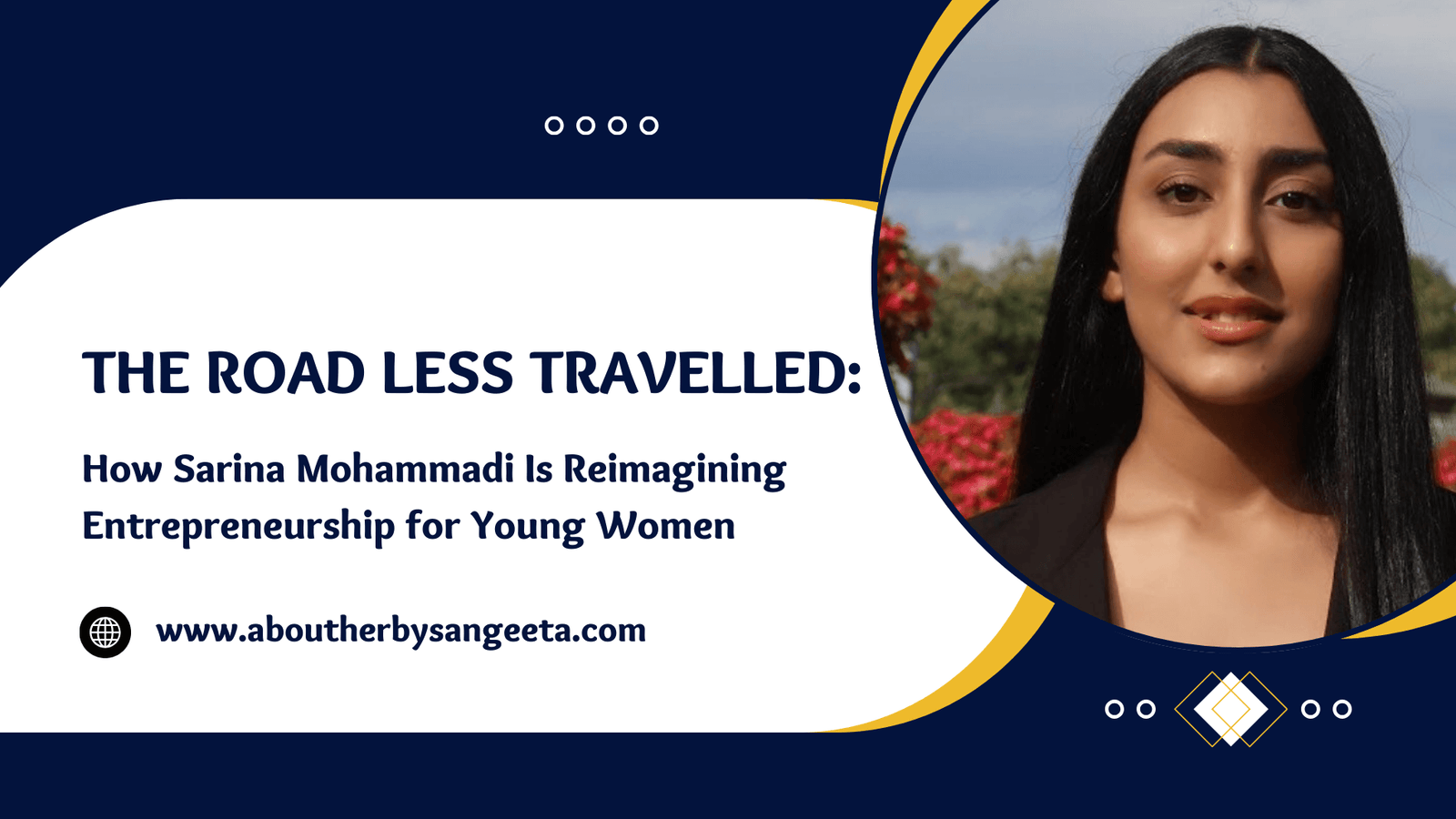
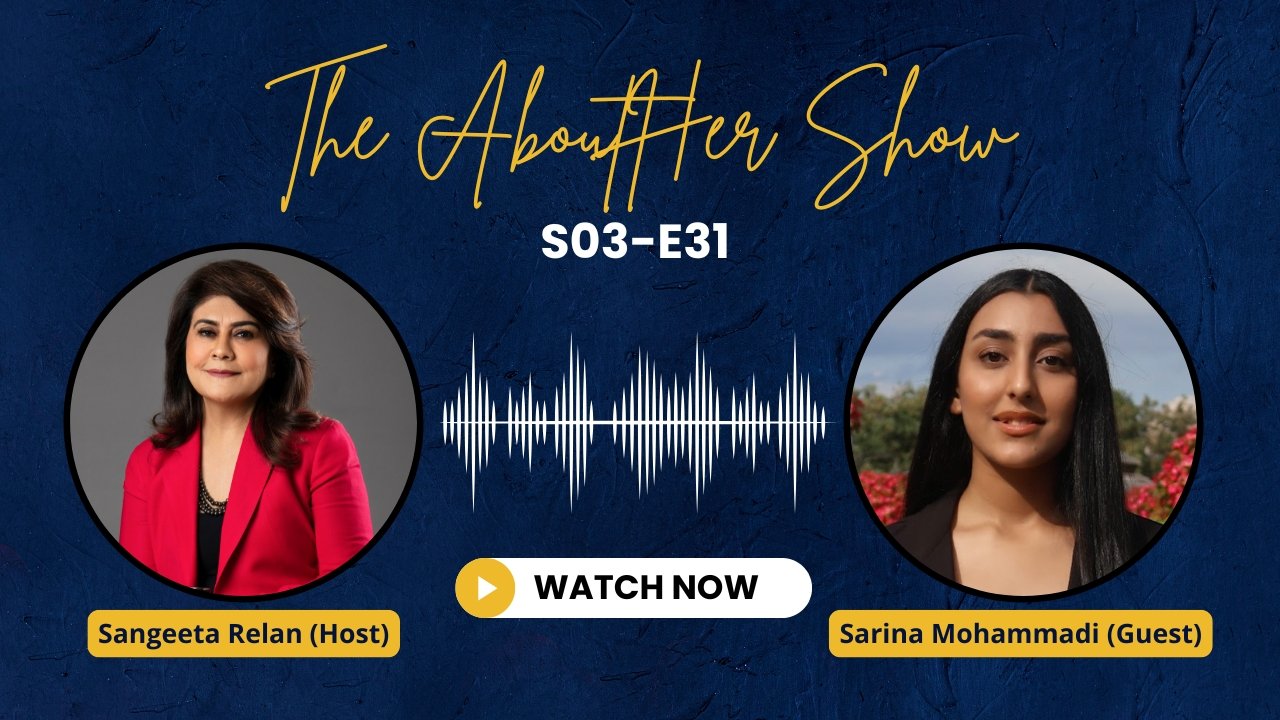
The Road Less Travelled: How Sarina Mohammadi Is Reimagining Entrepreneurship for Young Women
What happens when a young girl notices that brilliant ideas are being ignored, not because they lack value, but because of who they come from?
That question sits at the heart of Sarina Mohammadi’s work.
An internationally recognised social entrepreneur, TEDx speaker, and Founder of Youth Forge, Sarina is focused on one big mission: reshaping the future of entrepreneurship for the next generation. But what makes her work especially compelling is that she is not just talking about youth potential in theory. She is listening to young people across countries, gathering real insights, and turning those insights into something powerful-advocacy, mentorship, and change.
At a time when so many young people are told to wait their turn, Sarina is asking: why should they?
And when it comes to young women, that question becomes even more urgent.
You can listen to the episode here:
Spotify: https://shorturl.at/teuuV
Apple: https://shorturl.at/mtyNa
Audible: https://shorturl.at/1c6wL
YouTube: https://www.youtube.com/watch?v=v4Eiss4nfYQ
When the first spark came
Sarina’s journey started early. As a child, she saw something that stayed with her: a friend had come up with a thoughtful idea to solve the problem of lack of school supplies for low-income families. It was smart, practical, and rooted in a real issue. But instead of being encouraged, the idea was brushed aside.
That moment clearly left a mark.
Because it wasn’t only about one idea being ignored. It reflected something bigger—the way young people are often underestimated, and how their ideas are dismissed before they are even given a chance.
Rather than accepting that, Sarina decided to build something different.
What young people are really missing
One of the strongest takeaways from this conversation is that young people across the world may come from different places, but many of their struggles are surprisingly similar.
And one of the biggest? A lack of mentorship.
Not just motivational advice, but actual guidance. The kind that helps young founders understand business basics, financial literacy, decision-making, and how to move an idea forward. Sarina points out that many young people have the passion and the instinct, but not always the support structure.
That gap matters.
Because talent is everywhere. But access to guidance is not.
Why young women experience this differently
The conversation becomes especially powerful when it turns to young women.
Sarina speaks honestly about how young women often face not just the usual challenges of entrepreneurship, but also the added weight of gender stereotypes, social expectations, and the subtle message that leadership is still not fully “for them.”
And often, these messages are absorbed so deeply that they become internal.
Many young women hesitate, not because they don’t have ideas, but because they’ve been conditioned to doubt themselves. To second-guess. To shrink before they’ve even started.
That part of the conversation feels especially real, because it touches on something so many women understand instinctively: sometimes the biggest barrier is not a rule written down somewhere. It’s the voice in your own head that has been shaped by years of underrepresentation.
Sarina’s response to that is simple but powerful: women are capable. Deeply capable. And capability has nothing to do with gender.
Why data matters so much
What makes Sarina’s work stand out is that she doesn’t stop at inspiration. She believes in evidence.
Through Youth Forge, she gathers insights from thousands of young people across countries including Canada, India, Japan, Greece, Pakistan, the UAE, Iran, Uganda, and Ghana. That data helps bring youth realities into policy conversations that would otherwise ignore them.
And this is such an important point.
If you want systems to change, stories matter, but often, data is what gets institutions to listen. It gives weight to what people have been feeling all along. It helps move youth and women’s experiences from “personal anecdotes” to something decision-makers can no longer overlook.
In that sense, Sarina is doing something quite important: she is not just amplifying voices, she is helping make them harder to dismiss.
The invisible barriers no one talks about enough
Another strong thread in the conversation is the idea of invisible barriers.
Not always the obvious ones. Not just lack of funding or networks. But the quieter barriers, self-doubt, hesitation, not seeing enough role models, not being taken seriously early enough.
These things rarely make it into formal policy conversations, but they shape outcomes in very real ways.
For young women especially, confidence is often shaped by culture, family expectations, and what they grow up seeing around them. When girls are not encouraged to take risks, speak up, or imagine themselves as builders and founders, that has consequences.
At the same time, Sarina is very clear that support systems can make a huge difference. Family support, emotional backing, and meaningful mentorship can go a long way in helping a young woman trust her own voice.
A refreshing take on leadership
One of the most grounded parts of the conversation is Sarina’s approach to navigating bias.
Yes, she acknowledges that women often have to prove themselves more. Yes, she recognises that unfair barriers exist. But instead of becoming consumed by what she cannot control, she focuses on what she can.
Her knowledge. Her ability. Her work. Her preparation.
It’s a practical mindset, and a useful one, not just for young founders, but for anyone trying to build something in the face of doubt.
That doesn’t mean ignoring injustice. It means strengthening yourself while also working to change the system for others.
Passion or power?
A particularly important point in the conversation is how women-led social impact work is often seen.
Too often, when women build something meaningful-especially in social change spaces-it gets labelled as “passion.” Something heartfelt, admirable, maybe even inspiring. But not always powerful. Not always strategic. Not always worthy of serious funding or recognition.
That framing is limiting.
Because women-led impact work is not just passion. It is leadership. It is systems thinking. It is influence. It is power.
And the more visible women’s work becomes, the harder it becomes to reduce it to something soft or secondary.
Looking ahead
When asked what entrepreneurial ecosystems need to urgently unlearn, Sarina’s answer is clear: stop judging ideas based on labels.
Age. Gender. Assumptions.
Instead, look at ideas on merit. Look at potential. Look at impact.
It sounds obvious, but clearly, we are not there yet.
And perhaps that is why this conversation feels so timely. It reminds us that building a better future for entrepreneurship is not just about telling young people to dream big. It is about creating systems that actually meet them with seriousness, support, and belief.
Why this conversation matters
This is very much a Road Less Travelled kind of conversation. It’s about choosing paths that are not easy, obvious, or already paved. It’s about building anyway. Speaking anyway. Showing up anyway.
And at its heart, this piece sits firmly in the Voice & Visibility pillar-because so much of what emerges here comes down to one essential question: who gets heard, who gets seen, and who gets believed?
Sarina’s work reminds us that when young women are visible, supported, and taken seriously, they do not just build businesses. They expand what leadership itself can look like.
A few key takeaways
- Young people across the world need more than encouragement; they need real mentorship.
- Young women often face both external barriers and internalised self-doubt.
- Data-backed advocacy is essential if youth voices are to influence policy.
- Women-led social impact work must be recognised as leadership and power.
- The future of entrepreneurship depends on judging ideas by merit, not by stereotypes.
Quotes to highlight
“The biggest number one barrier is always the lack of mentorship.”
“There is a self-perception… that I’m maybe not capable. But that is so untrue.”
“I don’t want to focus on things that I cannot control. I want to focus on things that I can have control over.”
“Women are so much more than just ‘passion.’
Stay Connected with AboutHer
If this conversation resonated with you, stay connected with AboutHer for more stories, reflections, and conversations that spotlight women’s journeys, leadership, and impact.
Follow AboutHer on social media for updates, clips, and new episodes:
📲 Follow AboutHer on Instagram, Facebook, LinkedIn, Twitter, and Pinterest
And do follow The AboutHer Show to keep discovering powerful conversations with women and allies who are shaping change in their own unique ways.
Share This On Social
About the Author: Sangeeta Relan

Related Posts



I’m Sangeeta Relan—an educator, writer, podcaster, researcher, and the founder of AboutHer. With over 30 years of experience teaching at the university level, I’ve also journeyed through life as a corporate wife, a mother, and now, a storyteller.