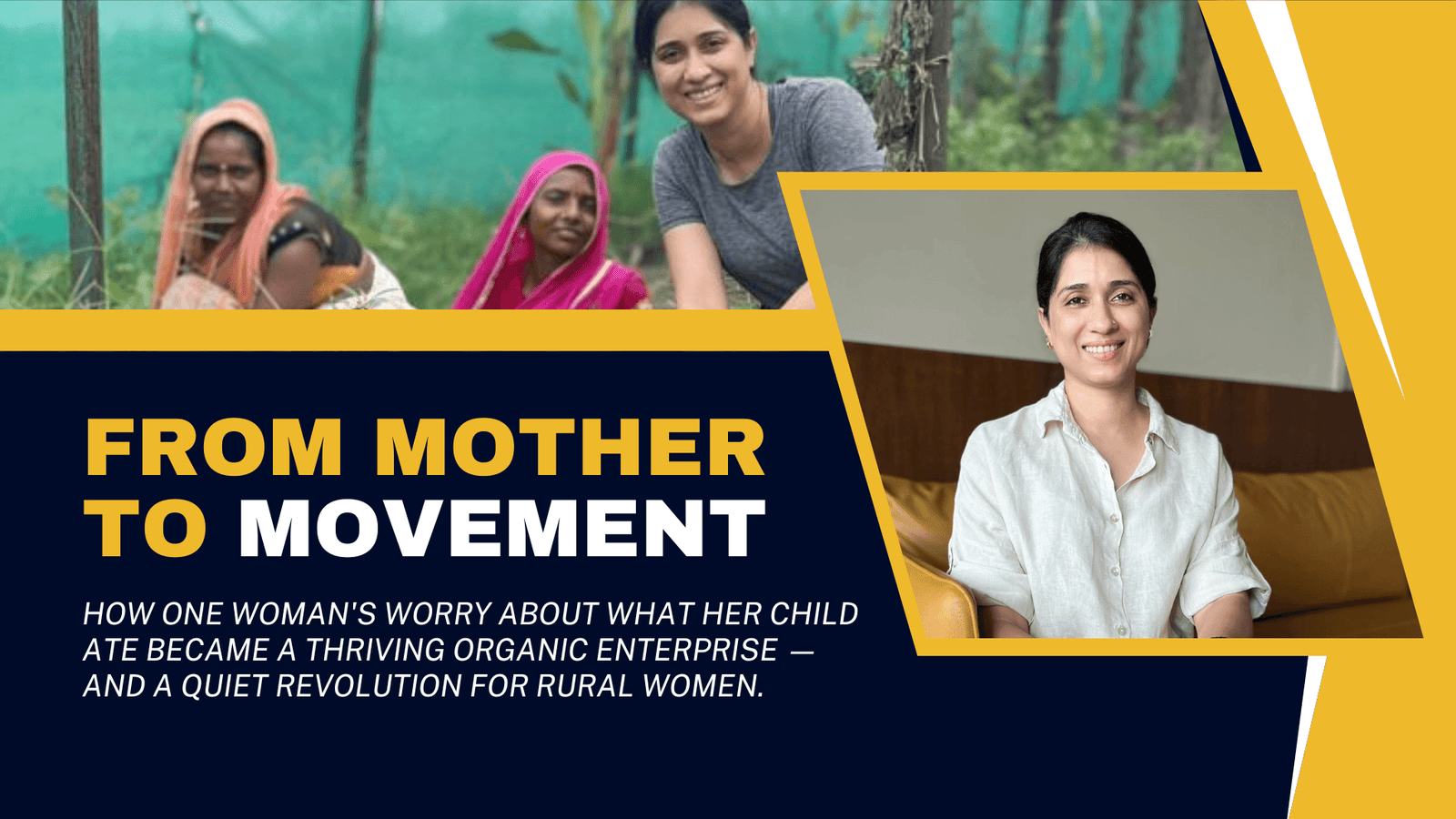
From Mother to Movement
ABOUTHER · STORIES THAT MATTER · SEASON 3, EPISODE 143
POWER & LEADERSHIP · MONEY & AGENCY · VOICE & VISIBILITY
From Mother to Movement
How one woman’s worry about what her child ate became a thriving organic enterprise — and a quiet revolution for rural women.
PURPOSE-DRIVEN LEADERSHIP
WOMEN’S FINANCIAL INDEPENDENCE
ORGANIC FARMING & TRADITION
There is a particular kind of clarity that only a mother standing over her sick child can produce. In 2016, when Pallavi’s one-year-old son fell ill after drinking milk from a supposedly clean local goshala — the family’s own farm supply temporarily unavailable — that clarity arrived, sharp and irreversible. Something had to change. Not just for her family, but for every family that trusted a label without knowing the story behind it.
That moment didn’t create Adya Organics; it crystallised it. The seeds had been planted years earlier by her father-in-law, Mr. Arha, who had turned to organic food to heal himself and believed, with quiet certainty, that children deserved clean nourishment. By 2018, with just four SKUs grown entirely at their own farms, Adya Organics was ready for the world. Today, in its eighth year of commercial operation, it is building something far more significant than a food brand.
“I am building something with a lot of integrity — and I am doing something that I promised myself years ago: that I will, in some way or the other, empower women at whatever level I am capable of.”
— Pallavi, Managing Director, Adya Organics
The Honest Farmer in a Dishonest Market
In an industry crowded with greenwashed claims, Pallavi introduces herself not as Managing Director but as an honest farmer — a title she wears with the conviction of someone who knows exactly what it costs. When certifications could be purchased and organic labels slapped onto non-organic products, she refused. It cost Adya Organics dearly on the P&L. She held firm anyway.
Her definition of honesty is operational, not philosophical. She works the fields alongside her team, understands the difficulty of every harvest, and keeps the supply chain deliberately lean — no middlemen, no inflated margins, no ingredients she wouldn’t feed her own children. When a vendor proposed adding maltodextrin to one of their products, her answer was immediate and categorical: if she wouldn’t give it to her child, she would not sell it.
“You need to really read your labels. Understand the brand history. Know what the founders are like. Get to the depth of it — because there is so much clutter in the organic industry today.”
Her advice to consumers is as frank as her business ethics: research before you buy, scrutinise before you trust. In a market where a single search for ghee on any major platform returns over a thousand sellers, she believes the onus falls on honest brands to communicate with complete transparency — and on consumers to demand nothing less.
When Motherhood Becomes a Management School
Pallavi is a mother of three. Her eldest, now eighteen, taught her how to be a parent. All three, she says with a laugh, taught her how to lead. Coming from a boarding school background, she found herself, after marriage, suddenly navigating conversations with farmers and goshala workers in a language and register entirely foreign to her. It was her children — their demands for patience, their refusal to be hurried — who gave her the tools she needed.
“My children actually taught me the patience which I could use with my farmers — because many times it was difficult for us to understand each other.”
— Pallavi
She credits them, half-jokingly, with the very foundation of Adya Organics. Without the patience they forced her to develop, she says, she might never have been able to build the trust that forms the bedrock of the company’s relationships on the ground.
Tradition as a Tool for Justice
One of the most quietly radical decisions Pallavi made was to retain traditional production methods — stone grinding, hand-churned ghee, kachi ghani oil pressed using bulls — in an age when machines offer far greater efficiency. Her reasoning defies easy categorisation: it is simultaneously ecological, economic, and feminist.
Also Read: She Filed Her Nomination and Went to the Hospital the Very Next Day
The Vedic methods require human hands. And those hands, at Adya Organics, belong almost entirely to women. Women who came to the farm having very little — some escaping abusive households, others with no independent income at all. Women who now earn their own wages, make their own choices, and sing while they work.
“I talked to them today and I feel so proud — because they are like… it’s something I always wanted to do. Help women.”
— Pallavi
The transformation she describes is not merely economic. Confidence replaces shame. Laughter replaces silence. Women who arrived looking hollow now arrive singing folk songs on foggy winter mornings. In villages in Bihar, UP, and Haryana where female feticide once quietly persisted, some of these same women are now making different choices — for themselves and for their daughters.
Redefining What Success Looks Like
Ask Pallavi about profit and she becomes gently philosophical. She does not dismiss it — she runs a business, after all — but she refuses to let it govern her. Five years ago, she says, her idea of success was chaotic and unformed. Today, it is quieter, more grounded, more precise.
“Success for me is knowing that the farm I nurture produces clean food. As a mother, it is knowing my children can freely dream and be healthy. As a business leader, it is building something with integrity.”
She leads a company that still uses bulls to press oil, still employs women in roles that machines have displaced elsewhere, still refuses to scale at the cost of honesty. By conventional metrics, this is inefficient. By her own, it is exactly right.
Her Message to Women with a Calling
Pallavi built Adya Organics between school runs and sleepless nights, amid doctor visits and the ordinary chaos of raising three children. She did it, she says, because someone truly believed in her — and because she learned to believe in herself first.
“Trust your gut. Do not want to be perfect — want to be powerful. Lead with dignity.”
— Pallavi’s message to women everywhere
The distinction she draws — between perfection and power — is not semantic. It is a lived philosophy. Perfection is the enemy that keeps women waiting for the right moment, the right conditions, the right permissions. Power is what happens when you stop waiting.
What began as a mother’s concern about a sick child is now a living, breathing ecosystem: clean food grown in honest soil, tended by women singing at work, guided by a woman who measures success not in margins but in meaning. That, in the end, is what a movement looks like from the inside.
Share This On Social
About the Author: Sangeeta Relan

Related Posts










I’m Sangeeta Relan—an educator, writer, podcaster, researcher, and the founder of AboutHer. With over 30 years of experience teaching at the university level, I’ve also journeyed through life as a corporate wife, a mother, and now, a storyteller.