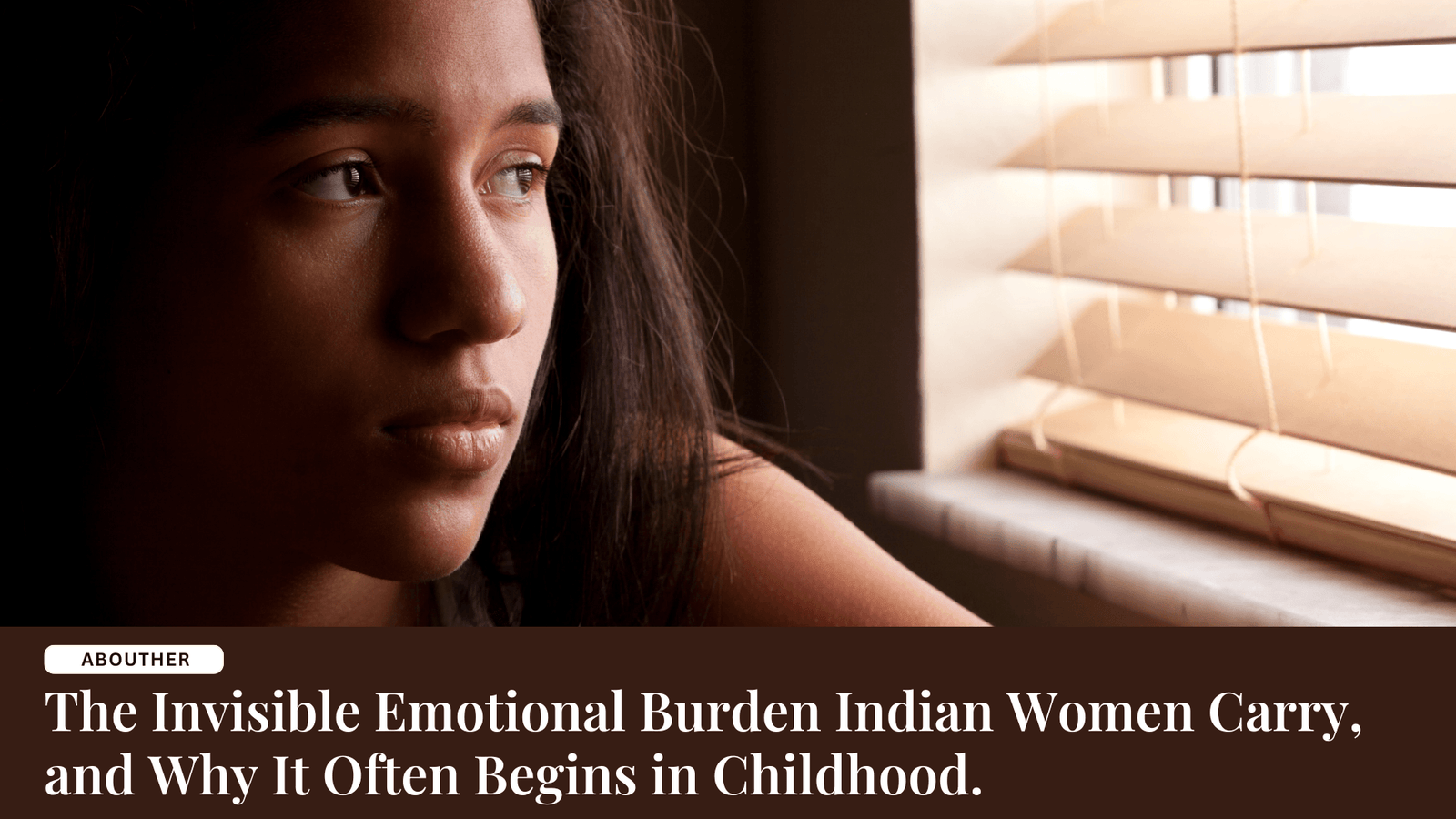
The Invisible Emotional Burden Indian Women Carry, and Why It Often Begins in Childhood.
She pours chai for everyone before pouring her own. Not because there isn’t enough, but because it never occurs to her to go fi rst. She manages the school schedule, grocery list, doctor’s appointments, in-law birthdays, and the emotional climate of every room she enters all at once, without anyone noticing.
If you asked her, “How are you?” she would say, “I’m fi ne.”
I know this woman, because I have been this woman.
Where It Begins Before She Even Has Words for It
Nobody sits a girl down and says her needs come last. Nobody has to.
She watches her mother serve everyone and eat last. She hears praise for being “so helpful,” for adjusting when plans change, for not crying when she is disappointed. By the time she is ten, she has absorbed a belief she will carry for decades: I am most lovable when I am most useful.
Psychologist Dr Shefali Tsabary calls this the “role self” the version shaped entirely by what earns approval, while the authentic self quietly recedes. In Indian homes, this process is rarely conscious. It isn’t cruelty. Its conditioning passed through generations who never questioned it because the culture never gave them permission.
A 2023 Lancet study on women’s mental health in South Asia confi rmed that gender-based conditioning in childhood is one of the strongest predictors of anxiety and depression in adult women. The burden doesn’t start at marriage. It starts at the dinner table.
When She Stops Seeing Herself Through Her Own Eyes
Somewhere between childhood and adolescence, she stops seeing herself through her own eyes and begins seeing herself through everyone else’s. Parents. Teachers. Relatives. The culture. She builds her identity on refl ections on how others perceive her. The woman looking back is never quite herself. She is the adjusted version, the one who says “I’m fi ne” until she forgets what fi ne actually means.
A 34-year-old mother in Ahmedabad once told me: “I don’t know what I want for dinner. I genuinely don’t know. I’ve spent so many years asking everyone else what they want that I’ve lost access to my own preferences. It’s not just dinner. It’s everything.”
That isn’t a food preference problem. That’s identity erosion one small surrender at a time.
Where She Disappears And Blames Herself for It
Then comes relationships. The girl who learned to over-give becomes a woman who cannot exist in love without losing herself. She gives endlessly not from abundance but from fear. The fear that if she pauses, she will be seen as selfish.
And here’s what nobody talks about: before the world even judges her, she has already judged herself. A voice inside says: you’re not doing enough. You’re failing. If you were better, this wouldn’t be so hard.
Also Read: Why So Many High-Achieving Women Struggle With Self-Doubt
Terri Cole, psychotherapist and author of “Boundary Boss,” calls this “high-functioning codependency” where a woman’s entire sense of worth is built on being needed. She doesn’t recognise it as a pattern. She calls it love. The conditioning taught her to be her own harshest critic long before anyone else had the chance.
Motherhood Where the Weight Doubles
Then children arrive. The woman who was never taught to honour her own feelings is now raising tiny humans who feel everything deeply.
I once watched a mother comfort her sobbing 9-year-old after a fi ght with a classmate. The mother said, “It’s okay, just ignore her. Be strong.” The daughter looked up and said, “But I don’t WANT to be strong right now. I want to be sad.”
That moment contained everything. The mother was offering her only emotional tool suppress and move on. The daughter was asking for something her mother never received permission to feel.
As Dr Brené Brown writes: “We cannot selectively numb emotions. When we numb the painful emotions, we also numb the positive ones.” Indian women have been numbing for generations. Their children are paying the price not in rebellion, but in silence. In “I’m fi ne.” In the door that slowly closes between parent and child. For many women, healing begins the moment they fi nally step away, even briefl y, through spaces like a Women’s Retreat, where she is fi nally asked “how are you,” and given room to answer honestly.
The Burden Nobody Named
We don’t call it a burden. We call it love. Duty. Culture.
But beneath those words is a woman who hasn’t been genuinely asked how she’s doing with someone willing to sit with the real answer in years. Maybe decades.
A 2024 study in the Indian Journal of Psychiatry found that 73% of Indian women in caregiving roles reported chronic emotional exhaustion, but only 12% had ever spoken to anyone about it. The silence doesn’t come from a lack of feeling. It comes from losing faith that anyone would listen.
Why This Isn’t Just About Her
When a woman heals when she stops seeing herself through the world’s eyes she doesn’t just change her life. She changes what her daughter inherits.
The mother who names her feelings raises a child who believes feelings are allowed. The mother who sets a boundary teaches her daughter that boundaries aren’t betrayal.
An egg cracked from the outside life ends. An egg cracked from the inside life begins.
The mother needs to open from within through her own emotional freedom. The child needs to grow from within through understanding their own mind and emotions. What has been silently inherited for generations can stop here. With you. And with your child.
If anything here resonated that recognition is not weakness. It’s the most honest breath you’ve taken in a long time.
Share This On Social
About the Author: RasEsha Rabari

Related Posts









I’m Sangeeta Relan—an educator, writer, podcaster, researcher, and the founder of AboutHer. With over 30 years of experience teaching at the university level, I’ve also journeyed through life as a corporate wife, a mother, and now, a storyteller.